You can feel it in a small shop before the first part is cut. The phone rings, three customer emails pile up, and the estimator is trying to decide which RFQ deserves the next ten minutes because one late response can mean the job's gone. In a typical machine shop RFQ process, the first battle isn't pricing, it's sorting the inbox, reading the drawing fast, and deciding what's real work, what needs a callback, and what should never have landed on the desk as a quote request in the first place.
That's why owners and estimators who treat RFQs like a simple math problem usually get burned. The quote number matters, but the hidden labor before the quote is built, triage, clarification, routing, and review, is what decides whether the shop quotes cleanly, protects margin, and gets the order back. In practice, the fastest shops don't just estimate faster, they absorb incoming work better.
Table of Contents
A Monday Morning in the RFQ Inbox
Monday starts the same way in a lot of shops. The estimator opens a laptop and sees 40 unread messages, a mix of new RFQ emails, updated drawings, and a forwarded thread from the owner asking if the team can “take a quick look” at a new opportunity. One subject line is obvious, a medical device housing with a full print package. Another is a returning aerospace buyer sending a bracket run with familiar part numbers. A third only says “need quote ASAP”, with no drawing in the body and no material note.
That inbox is the front door of the typical machine shop RFQ process. Before anyone starts calculating spindle time or forming cost, the estimator is already making decisions about priority, completeness, and risk. A good triage pass can keep the shop focused on jobs it can win, while bad triage lets urgent but fuzzy requests consume the whole morning.
What gets attention first
A returning customer with clean revisions usually jumps the line because the shop already knows the part family and the buyer's expectations. A medical or aerospace part gets a closer look because the consequences of missing a detail are higher, even if the quote has to wait for clarification. The vague “ASAP” request usually gets parked until someone sends the drawing, the quantity, and the finish callout.
Practical rule: if the first message doesn't tell you what the part is, what it's made of, and when it's needed, the estimator hasn't received a quote request yet. They've received a starting point.
That's why intake discipline matters before any estimating math starts. The shop that can quickly separate clean RFQs from incomplete ones protects the day's queue, reduces rework, and gives the right jobs a fair shot. For a broader look at how buyers outside machining structure requests, the comparison at ecommerce platform industries shows how organized intake improves any request-based workflow.
What an RFQ Really Is and Who Is Involved
A machine shop RFQ usually lands as a pile of clues, not a finished job packet. The buyer may send a drawing, a model, a note about quantity, and a target date, but the estimator still has to sort out what is clear, what is missing, and what needs a follow-up before any quote can be trusted. That hidden work, triage, clarification, and routing, is what happens between the inbox and the quote.
RFQ, or Request for Quote, is the buyer's structured ask for price and timing on a part or assembly. It tells the shop what to make, how many to make, and what quality expectations apply. In shop-floor terms, it is the point where a request becomes something the team can evaluate without guessing.
The information that makes a quote possible
A usable RFQ usually includes a 2D drawing or 3D model, a material spec, tolerances, quantities, lead time, finishing, inspection requirements, and any NDA the buyer wants signed first. A 6061-T6 CNC bracket with a clear GD&T callout is easier to review than a sketch with no datum scheme. A laser-cut 304 stainless sheet metal panel with a powder coat note is clearer than a drawing that just says “finish needed.”
The people involved are usually split between the customer and the shop. On the customer side, that often means the buyer, the engineering contact, and procurement. On the shop side, the work usually touches the estimator, sales engineer, production planner, and shop lead. Each role answers a different question, and the quote gets stronger when those questions are answered in the right order.
Why role clarity matters
The buyer wants a clean price and a realistic due date. Engineering wants to know whether the part is manufacturable and whether the drawing leaves gaps. Procurement needs a response they can compare across suppliers. The estimator gathers the facts, the sales engineer handles technical questions, the planner checks capacity, and the shop lead knows whether the floor can support the work.
If you want a broader parallel for how complete inputs change the response, the structured request flow on ecommerce platform industries shows the same basic idea in another request-driven setting. For material pricing specifically, Uptool's estimating material cost resource is a useful reference for how input quality affects the next step.
The Six Stages of a Typical RFQ From Request to Quote
Most shops talk about quoting as if it starts with estimating. It doesn't. It starts with intake, and the quote only gets accurate after the request has been cleaned up, sorted, and assigned to the right person.
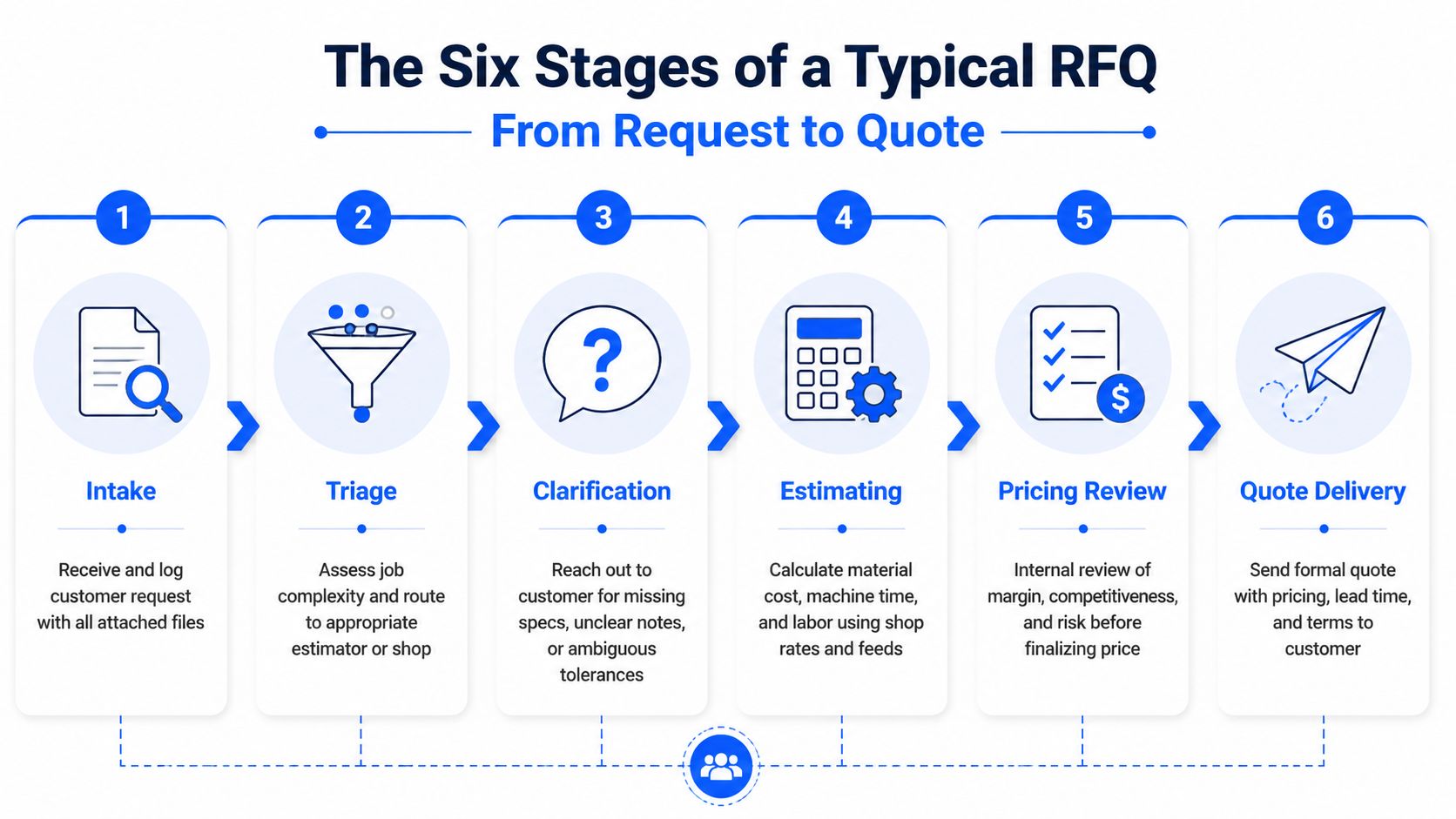
Stage 1, intake
RFQs arrive by email, portal upload, or a forwarded PDF. Someone logs the request, attaches the drawing set, and tags the job so it doesn't disappear in the inbox. If the shop uses multiple inboxes, requests get lost when nobody owns the handoff.
Stage 2, triage
The shop decides whether the RFQ belongs on the active quote list. A simple repeat bracket may go straight to a familiar estimator, while a complex part with outside processing might need a production planner or shop lead involved early. Triage is where win-likelihood starts to show itself, because not every request deserves the same amount of attention.
Stage 3, clarification
Missing tolerances, unclear quantity breaks, or vague finish notes trigger questions back to the customer. This back-and-forth is normal, and it's often what separates a clean quote from a guess. Every clarification cycle adds time, but it also protects the shop from quoting the wrong work.
Stage 4, estimating
The estimator breaks the part into setup time, cycle time, tooling, and secondary operations. A part that looks simple on paper can still require complex fixturing, extra deburr work, or outsourced finishing. The math only works after the routing is honest.
Stage 5, pricing review
Now the shop checks margin, overhead, and whether the promised lead time is still realistic. A quote can be sharpened or pulled back. A price that wins but creates a mess later isn't a good quote.
Stage 6, quote delivery
The final quote should include the cover note, the breakdown, the terms, and a clear revision history if the request changed along the way. That record matters because the buyer needs to know what was assumed, and the shop needs a paper trail when the PO arrives. The hidden labor before this stage is what keeps the final number credible.
How Materials, Tolerances, and Finishing Shape the RFQ
A machine shop does not quote geometry alone. It quotes risk, capability, and supply chain reality, and those three things shift the moment the RFQ asks for a different alloy, a tighter tolerance, or a finish that has to go outside the shop.
A simple part on screen can turn into a longer intake conversation at the bench.
Materials change the whole conversation
A 6061-T6 plate and a 304 stainless part may look close in the model, but they do different things on the floor. Stainless can change machine choice, tool wear, and the material buy itself. If the buyer also wants certification or a specific stock form, the estimator needs that answer before the quote can be trusted.
Tolerances and finish add work before the quote
A tight tolerance can send the request back for a closer look at fixturing, inspection, and whether the shop can hold the feature on the intended machine. Finishing works the same way. Anodizing or powder coat is not just another line item, it means checking a vendor, asking about lead time, and often clarifying which faces must stay masked or visible.
RFQ Variable | Example | Added Clarification | Impact on Quote |
|---|---|---|---|
Material grade | 6061-T6 or 304 stainless | Confirm stock form, cert need, and supplier availability | Changes sourcing and routing |
Tolerance class | Tight feature callout versus general dimensions | Ask which dimensions are critical and which are reference only | Changes inspection effort |
Finishing | Anodizing or powder coat | Confirm color, thickness, masking, and vendor lead time | Extends quote review |
Secondary ops | Heat treat, plating, testing | Confirm who coordinates outside processing | Adds coordination work |
The job is to turn those unknowns into confirmed assumptions before the number goes out. A RFQ is really a conversation about how the part will be made, not just what it looks like. For a related look at material-cost thinking, Uptool's estimating material cost guide is a useful companion.
A shop that handles these details early gets a cleaner routing path and a quote the buyer can read without a second round of questions.
How the RFQ Process Differs Between CNC Machining and Sheet Metal
CNC and sheet metal shops share the same intake discipline, but the documents they read and the questions they ask aren't the same. A machinist looks at STEP files, fixture notes, and machine-specific feeds and speeds. A fabricator looks at DXFs, bend tables, weld symbols, and material gauge callouts.
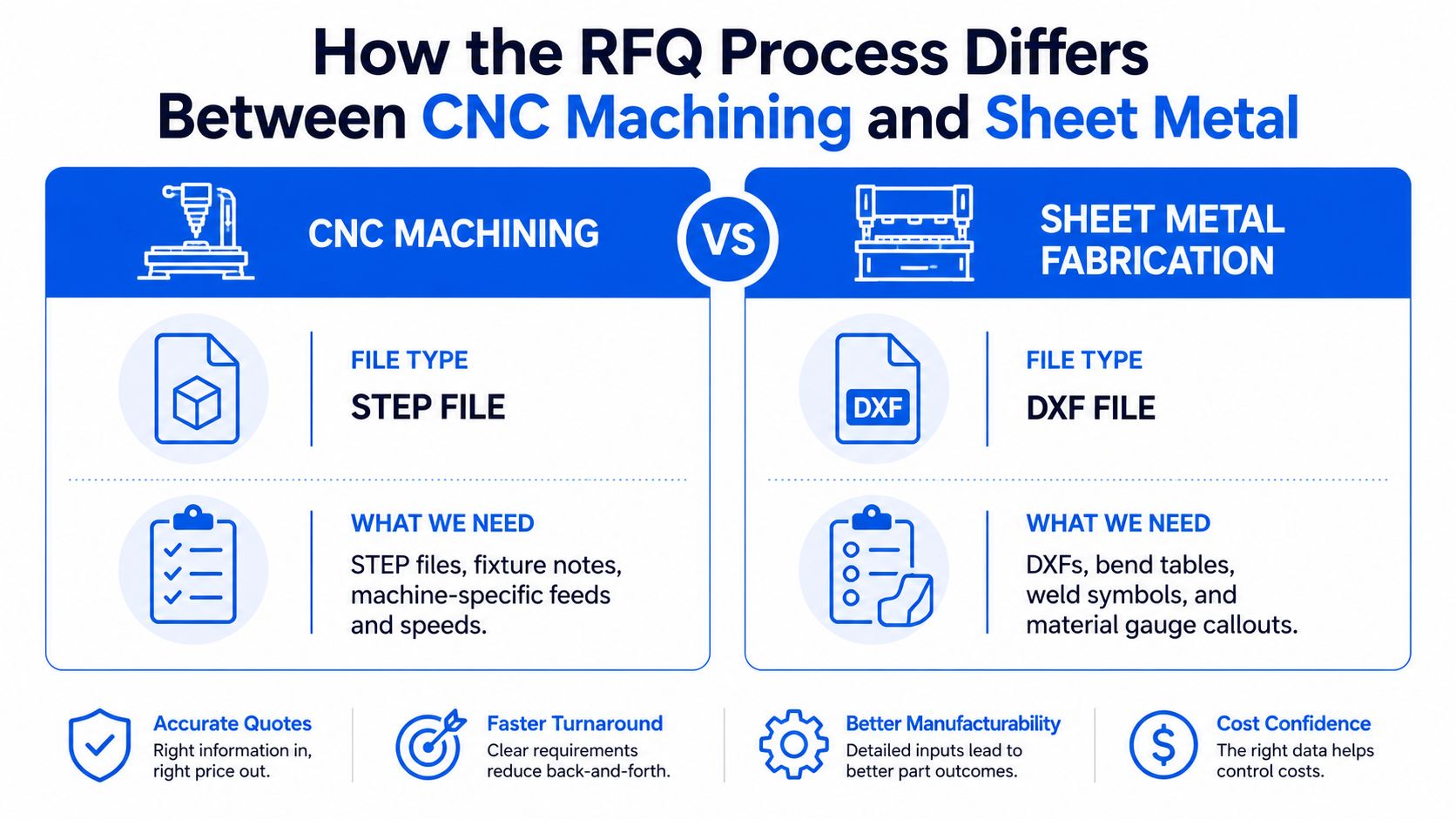
Where the paths split
In CNC work, the estimator often wants to know how the part is held, whether the geometry needs soft jaws or a custom fixture, and whether the print reflects the latest revision. In sheet metal, the questions shift toward bend allowances, hole-to-bend spacing, material thickness, and whether the buyer wants a flat blank, a welded assembly, or a finished kit. Those details change the routing before the quote even begins.
Where they overlap
Both workflows still need the same basic discipline. The estimator has to confirm the drawing revision, the quantity, the finish, and the required-by date. Both shops also need to know whether the buyer expects a prototype, a small run, or a repeat order that will come back later.
For a deeper shop-specific view on fab quoting inputs, Uptool's sheet metal estimating resource fits neatly with the kind of questions fabricators ask every day. The big difference is that CNC often revolves around machining capability and fixturing, while sheet metal often revolves around forming sequence and assembly logic.
Common RFQ Pitfalls and the Habits That Prevent Them
A lot of shops think the main tradeoff is speed versus accuracy. That's the wrong frame. The choice is whether speed is coming from a tight intake process or from skipping the steps that protect the quote.
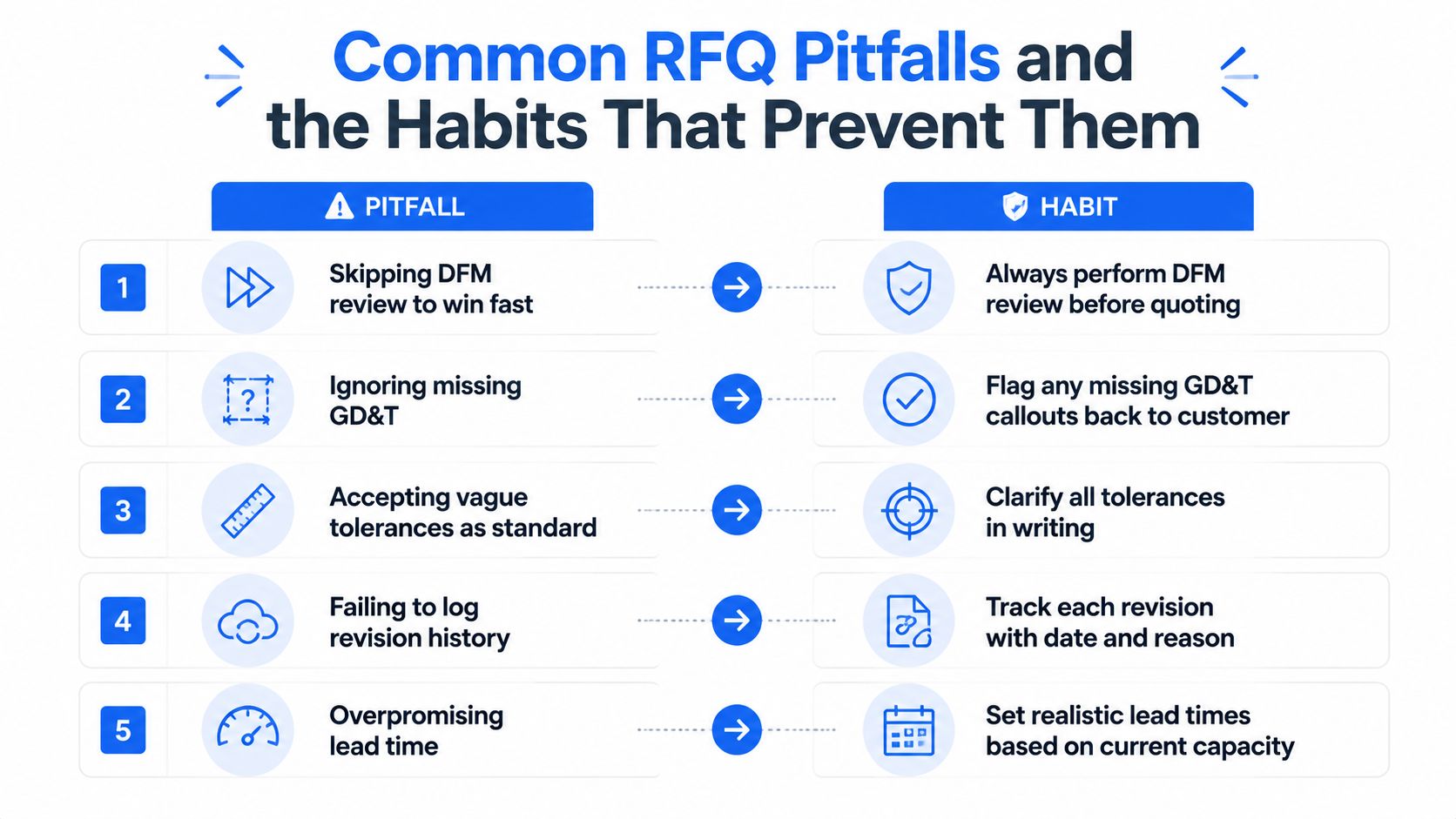
The mistakes that hurt the most
Skipping DFM review to win fast is a classic mistake. So is ignoring missing GD&T, accepting vague tolerances as if they were standard, failing to log revision history, and quoting without checking finish lead times. Those problems usually show up later as missed assumptions, and by then the quote is already in the market.
A job shop management source warns that if a shop takes more than three days to return a quote, there's a strong chance the order has already gone elsewhere, which is why slow quoting hurts so much The Fabricator on faster quoting in the job shop. That warning doesn't mean every quote should be rushed. It means the shop has to remove avoidable delays before they stack up.
Habits that actually help
A 15-minute intake triage keeps bad RFQs from eating the morning. A standard clarification email template makes sure the same missing details get requested every time. A documented revision log on every quote protects the team when the buyer sends a changed print after the first response.
Useful habit: treat every revision like a new fact pattern. If the drawing changed, the quote record needs to show what changed, when it changed, and why the price or lead time moved.
That's the point most shops miss. Accuracy doesn't slow down quoting when the intake process is set up right. It speeds it up because the estimator isn't re-reading the same unclear package three times.
A Practical RFQ Checklist and Where Automation Fits Next
A clean RFQ isn't complicated, but it does need the right inputs in the right place. If you're training a new estimator or tightening your CRM, this checklist keeps the intake conversation focused on what the shop needs to quote responsibly.
A 12-item intake list
Drawing present. Without the print, there's no shared reference for the work.
STEP or 3D model attached. This helps the estimator understand geometry fast.
Revision letter matches title block. That keeps old files from slipping into the quote.
Material spec and grade. The shop needs the exact material, not a guess.
Quantity and lot size. Batch size changes setup and pricing decisions.
Surface finish or coating requirement. Finish choice affects both timing and cost.
Tolerances noted. Critical features need to stand out right away.
Thread callouts. Tapped holes and inserts change tooling and inspection.
Inspection criteria. CMM, FAI, or other checks should be clear.
Delivery date. The shop needs the actual need-by date, not a rough wish.
Packaging specification. Some parts need special protection or labeling.
Special instructions. NDA, supplied material, or customer-specific notes belong here.
Where software helps, and where it doesn't
Automation already helps by flagging missing fields on intake forms, routing jobs based on material or tolerance class, and pulling historical cost from similar part numbers. Some systems can also extract tolerance data from PDFs and organize RFQs from multiple inboxes into one queue. That doesn't replace the estimator. It just clears the desk so the estimator can spend time on the parts that need judgment.
If you're looking at quoting software, Uptool's CNC estimating software resource is a useful example of how shops are structuring that work today. AI quoting assistants can draft initial pricing and organize the request, but a human still needs to review edge cases, odd revisions, and parts with tricky finishing or inspection requirements. That's where shop experience still matters most.
If your shop is buried in RFQs, Uptool helps bring the inbox, drawings, and revision history into one quoting workflow so your team can sort faster and quote with better context. Visit Uptool to see how AI-powered quoting software can help your estimators move from scattered requests to organized quotes without losing control of the details.
