You can have a clean drawing, a decent model, and a customer who wants the job, then lose margin because the material number was too optimistic. That's the part most shop owners learn the hard way. Estimating material cost is where the quote gets real, because the metal has to exist, it has to arrive on time, and it has to survive the cut list, the nesting plan, and the scrap pile.
A lot of shops still treat material as a quick multiplication problem. In CNC machining, sheet metal fabrication, and finishing work, that usually misses the factors that actually move the number, especially when supplier availability, offcuts, remnants, and local pricing all pull in different directions.
Table of Contents
Why Material Cost Estimating Is Harder Than It Looks
A 50-part run of 6061 aluminum brackets looks simple on paper. Weight times price per pound, add a little waste, send the quote. Then the buyer calls and says the material has to be on the floor in three weeks, the distributor says the smallest order is bigger than you expected, and your nesting software shows a sheet utilization rate that makes the raw number look cheap until you realize how much stock gets trapped in unusable remnants.
That's the gap between textbook math and shop-floor pricing. In precision machining and sheet metal fabrication, material often drives whether the quote works at all. A bad assumption on plate, bar, tubing, or specialty alloy can wipe out the profit on the whole job, especially when the work involves volatile metals, tight lead times, or stock sizes that do not match the part geometry well.
The part price is never just the part price
Estimators know the purchase price is only the start. The job also inherits handling loss, order minimums, leftover stock that may or may not be reusable, and timing pressure that changes what vendors will quote back.
Practical rule: if you can't explain why your material number is higher than a catalog price, you probably haven't accounted for the actual way the job will be bought, cut, and shipped.
If your plant moves sheet, plate, bar, and tubing through a crowded floor, material handling matters too. A useful reference for that side of the job is Material Handling USA's manufacturing solutions, because poor storage and movement practices can turn a decent estimate into a messy one. Material rarely loses money all at once. It leaks it a little at a time.
The Bottom-Up Method That Actually Works

The most defensible way to price material is to start with the parts, not the final sales number. A bottom-up material estimate begins with a detailed bill of materials or a clean takeoff from the CAD model, then applies current unit prices to each item before any markup goes on top. In a machining or fabrication shop, that means tying the estimate to the way the part will actually be purchased and processed, not to a rough memory of what the material cost last quarter.
Measure first, price second
For a CNC-turned shaft, that means measuring the raw bar length needed, not just the finished part length. For a welded enclosure, it means counting every sheet, bend allowance, and internal panel that gets consumed. For a fixture plate, it means knowing whether you need a full plate, a drop, or a remnant that already exists in stock.
A bottom-up approach forces the uncomfortable questions early. Is the stock size standard? Does the CAM layout waste half a sheet? Does the job require a special alloy or temper that's not sitting on the shelf? If the answer is yes, the estimate should show it.
Add waste after the takeoff
Waste belongs in the estimate, but it belongs in the right place. The sequence that holds up best in quoting is simple, measure, price, add waste, then layer overhead and margin separately. That keeps the material number visible, which matters when a buyer pushes back or when the job changes after award.
A good estimating workflow also uses actual supplier quotes when the material is expensive or volatile. In a shop setting, that means bar stock, plate, tubing, and specialty finishes deserve more than a guess.
Hidden Cost Factors Most Estimators Miss
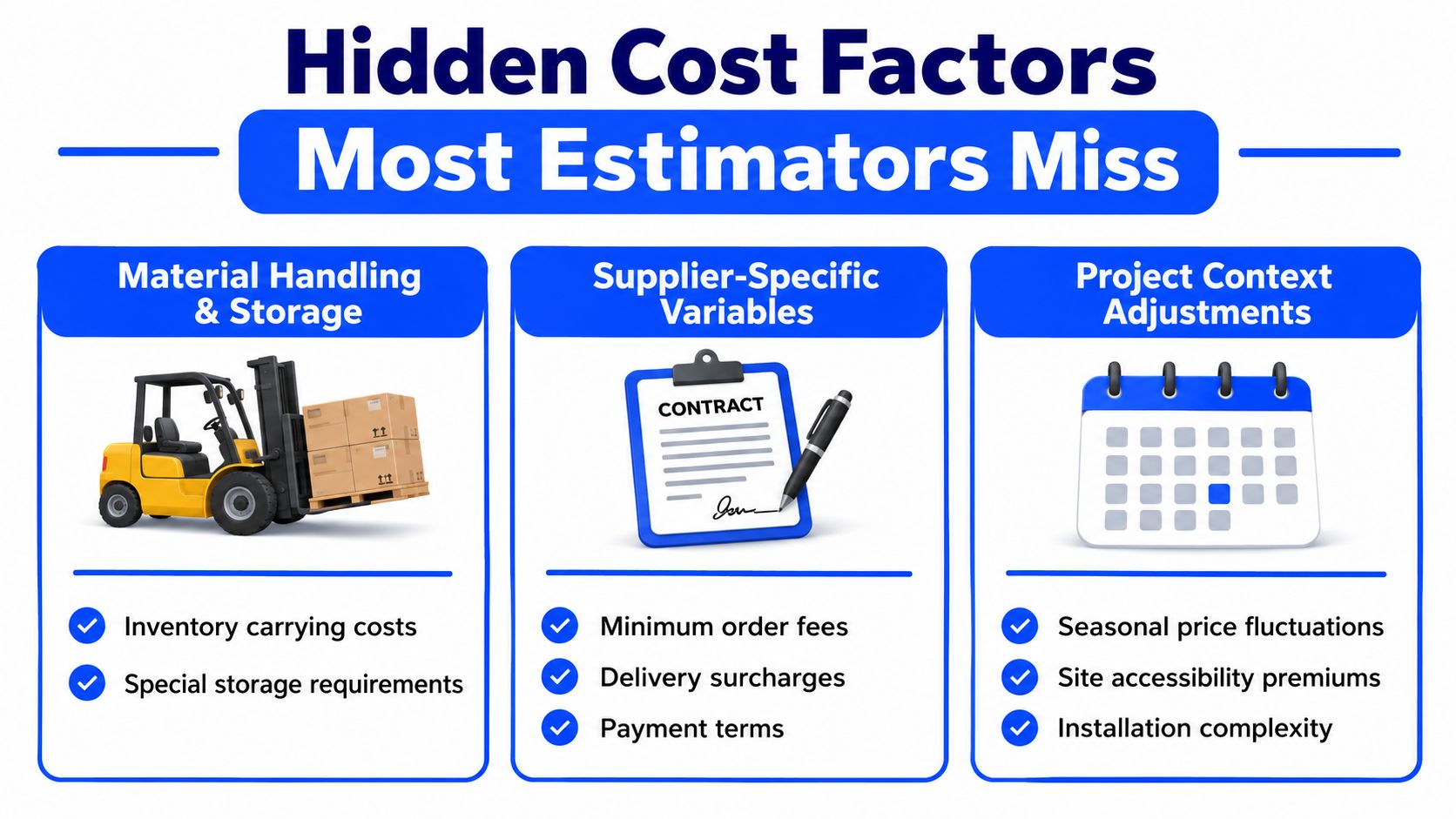
Most quoting errors don't come from the obvious part of the formula. They come from the parts people leave out because they feel small. In CNC and fabrication work, nesting efficiency, scrap value recovery, and regional price variation can change the effective material cost far more than a flat waste factor suggests.
Nesting changes the real material consumption
A part that weighs two pounds doesn't necessarily cost like two pounds. If it has to be nested on a full sheet, the shop may consume far more stock than the finished part suggests. That is why sheet utilization, remnant size, and cut-plan layout matter as much as the raw geometry.
For laser-cut brackets or formed panels, the blank may be cheap, but the stock pattern can be expensive if the layout leaves unusable islands. In other words, the material line should reflect the effective consumption, not just the theoretical weight.
Scrap is not always dead cost
Scrap value matters when the offcuts have reuse value or resale value. Aluminum drops, short bar remnants, and plate cutoffs can often feed later work if the shop tracks them well enough. If you ignore that, you're pricing as though every offcut goes straight to the dumpster.
That's why the old habit of slapping on a flat waste number can be too crude. Some jobs deserve a higher waste charge because the cut plan is ugly. Others deserve a lower effective material cost because the remnants are useful. A shop that understands the difference protects margin without overpricing easy work.
A practical quoting mistake shows up when estimators assume the same waste factor fits every job. The article at Uptool's quoting mistake resource points to the same pain point many shops see daily, bad assumptions around quoting logic create avoidable misses.
Location and timing change the number
The same alloy can cost differently depending on region, freight, and availability. Older estimating methods also warn against blindly reusing historical data when local conditions differ (Carnegie Mellon cost estimation reference). That matters when a quote is built from a last-quarter price sheet but the order won't land for weeks.
A quote is only as stable as the quote window behind it.
Lead time changes the economics too. If you need material tomorrow, you're buying a different market than if you can wait for a regular replenishment cycle. Shops that ignore that difference end up underbidding urgent work and subsidizing the customer's schedule.
Finding Reliable Suppliers and Current Pricing
You can't estimate material well without current pricing, and you can't get current pricing from a stale spreadsheet. A shop should know who answers fast, who gives usable quotes, and who stocks the material families it buys most often. That usually means building a short list of local distributors, online metal suppliers, and specialty vendors by material type.
Split suppliers by job type
Local distributors are useful when lead time is tight, when freight would distort the number, or when you need a real answer on stock in the building right now. Online suppliers can work well for repeatable material families and simple size ranges, especially when you're comparing published pricing across several sources. For volatile or special materials, a spot quote usually beats a catalog number.
The best questions are plain and specific.
What stock sizes are on the floor? Don't accept a generic “available” if the size isn't real.
What's the quote validity window? If they won't stand behind the price for even a short period, treat it carefully.
Are there minimum order charges or cut fees? These can matter more than a small unit-price difference.
Can you quote remnants or drop stock? Some vendors move those at a different price point.
What is the temper, finish, or certification status? A wrong assumption here can wreck the quote.
Watch for pricing that won't hold up
A red flag is a supplier who can't tell you what's in stock versus what will need to be transferred. Another is a quote that doesn't separate material, freight, and cut charges. If the vendor's answer sounds vague, your estimate will probably be vague too.
Speed and organization matter. A shop that tracks suppliers by alloy, shape, and response time can refresh quotes fast without starting from scratch every time. For teams looking to connect quoting data with repeatable workflows, Uptool's machine shop software stack fits naturally into that kind of process.
Rethinking Waste Allowances and Scrap Strategy
The old advice says add 10% to 20% for waste and move on. That can be a decent rough placeholder, but it's not a serious answer for a CNC or fabrication shop that wants clean margins. In precision machining and sheet metal fabrication, waste behavior changes by process, stock form, and how reusable the leftover material really is.
Waste should reflect the process
A nested laser-cut job can carry very different waste behavior than a 5-axis machined billet. In one case, the material layout may be efficient but sheet remnants are awkward. In the other, the setup may consume more raw stock because the finished part starts as a larger blank.
That means one waste rule for everything is too blunt. Material utilization should come from the actual CAM output, nesting software, or cut plan whenever possible. If the software shows strong sheet utilization, don't pad the estimate just because a generic shop rule says to.
Remnants deserve a line of their own
Remnants are a small but real part of the material conversation. If your shop regularly reuses offcuts for brackets, gussets, or fixture stock, that reuse lowers effective material cost. If you never track remnants, you'll keep buying material that's already sitting in the corner.
Practical rule: if a remnant can realistically be reused on the next three jobs, it should be treated as inventory value, not invisible scrap.
The smarter move is to separate purchased material, expected loss, and recoverable scrap in your estimate logic. That gives you a cleaner read on where money is going and stops you from overcharging on jobs that nest well.
Building a Dynamic Pricing Workflow for Volatile Markets
Static spreadsheets break down fast when material prices move while your quote is still open. A better system treats price as a live input with a validity window, not a fixed cell that never gets touched again. The goal is simple, lock in what you can, refresh what you must, and avoid promising yesterday's number on tomorrow's order.
Set update rules by material family
Some materials need frequent checks because they move quickly or they're hard to source. Others can be reviewed less often if your volume is stable and supplier response is predictable. The point isn't to update everything constantly, it's to give your team a clear rule for what gets checked now and what can wait.
A workable workflow looks like this.
Define trigger materials. Mark the alloys, gauges, or finishes that need fresh pricing every time.
Use a regular review cadence. Tie common materials to a weekly or monthly refresh cycle based on how often you buy them.
Match pricing to lead time. If the job won't release right away, build in the time gap.
Separate quote validity from internal cost sheets. The customer sees a clean expiration date, while your team keeps the underlying price history.
Automate reminders. A stale quote should get flagged before it turns into a margin problem.
Make the customer aware without sounding nervous
Customers don't need a lecture on the market. They need a clear quote, a stated validity window, and a simple explanation that long-lead material can move before the order is released. If the quote may change after a delay, say so early and keep the language plain.
A shop that uses quoting software can make this easier. Uptool's manufacturing quoting software is one example of a tool that helps organize quotes, but the workflow matters more than the platform. If your team can't tell which price is current, no software will fix that by itself.
Structuring Quotes So Material Cost Supports Profitability
Material should stay visible in the quote. When shops bury it inside a single lump number, they lose the ability to see whether the job is profitable because of material efficiency, labor control, or just luck. The clean structure is still the simplest one, material, labor, overhead, and profit separated into distinct lines.
Show detail where it helps, bundle where it doesn't
Some customers want a detailed breakdown. Others just want a firm price and a believable delivery date. If the material is volatile, expensive, or special order, it's usually smart to show enough detail to support the number without exposing every internal assumption.
For long-lead work, keep the material line and the validity window easy to find. If the order won't be released for weeks, the quote should make it obvious that pricing can change if the market moves. That protects the shop and keeps the conversation honest.
Keep overhead out of the material line
Overhead belongs in its own place, not buried inside the material number. The same goes for margin. In a machine shop or fab shop, that structure makes it easier to see whether margin is being earned through good purchasing, solid process control, or simple luck.
A simple quote structure also makes change handling easier. If the customer revises the part or asks for a different finish, you know exactly which line changed and why. That makes reviews faster, reduces finger-pointing, and keeps your estimating history useful for the next job.
If you want faster quotes with cleaner material pricing logic, visit Uptool, Inc.. It helps machine and fabrication shops organize RFQs, extract material and finishing inputs, and turn messy quote work into a repeatable process that's easier to review, update, and trust.