Monday morning in a fabrication shop rarely starts with a hush. RFQs are stacked across a crowded inbox, drawings are missing a view, a material grade is unclear, and a customer wants pricing before the day gets away from you. The estimator has to decide what can be priced confidently, what needs clarification, and what will become a margin problem if the shop wins the job.
That pressure makes quoting sheet metal fabrication more than a spreadsheet exercise. A quote is a working model of scope, time, capacity, and risk. If any of those inputs are wrong, the final price can look competitive while the job consumes the profit.
Table of Contents
Why Quoting Sheet Metal Fabrication Is a High-Stakes Game
A quote can look profitable until the job reaches the floor. One RFQ may require material purchasing, laser or waterjet cutting, CNC bending, welding, deburring, coating, inspection, and packaging. Every handoff adds another assumption about time, yield, outside processing, or capacity. A missed assumption becomes a cost the shop absorbs.
Speed matters because customers may be comparing several shops at once. The Fabricator reports that the average win-to-bid ratio usually hovers around 30%, so roughly 70% of estimator effort on RFQs doesn't convert into work orders. That makes slow quoting expensive even when the estimate is technically accurate. The Fabricator's discussion of AI-assisted quoting also cites a job-shop review of 1,794 RFQs over one year, where more than half of winning bids reached the customer within three days after the shop sent its quote.
The practical trade-off is straightforward. Spend too long perfecting a low-probability RFQ, and another opportunity may pass. Rush without checking the drawing package, bend sequence, finish, or available capacity, and the shop can win work it cannot produce at the quoted cost or date. A useful quoting process makes that decision visible instead of leaving it to instinct.
The commercial cost of a slow answer
The Fabricator notes a milestone used by many shops: after three days, an order may already be awarded elsewhere. Buyers do not always choose the first response, but a quote must arrive while the comparison is still active.
Traditional quoting can take one to two days just to process an RFQ, according to industry coverage summarized by Bloomfield, while digitized platforms can return pricing and design feedback in about three minutes. Those sheet metal quoting speed benchmarks show that response time affects operations, not only sales.
Slow quoting also carries an opportunity cost for shops deciding which work deserves engineering attention. Understanding why slow quoting is costing U.S. machine shops work helps frame that cost before it gets buried in administrative time.
A shop does not need to automate every decision. It needs a repeatable way to define scope, price each operation, record assumptions, and pressure-test material, labor, finish, and capacity before the quote leaves the building. That discipline keeps a competitive number from becoming an unprofitable commitment when costs move.
The Four Cost Buckets Every Quote Must Capture
A quote that survives production starts with four separate buckets: raw material, processing time, finishing, and commercial overhead. Keeping them visible turns the estimate into a working control document. It also explains why two parts with similar weight can carry very different prices.

Raw material
Price the specified alloy, thickness, sheet size, and purchasing condition. A 4-foot by 2-foot 304 stainless blank is not priced by weight alone. Include the sheet or remnant required, expected nesting yield, grain direction where relevant, and any certification or sourcing requirement.
Put scrap in the material bucket, not inside a broad labor rate. Poor nesting can force the shop to buy a full sheet even when the finished parts use only part of it. A separate material line also makes revisions manageable. If the alloy or thickness changes, the estimator can update that input without rebuilding the quote. This guide to estimating material cost provides a practical way to structure the calculation.
Material is also a risk check. Compare the assumed purchase condition with what the supplier can provide, then record any remnant, minimum-order, or certification assumption in the quote.
Processing time
Processing covers programming, setup, cutting, forming, welding, deburring, inspection, and handling. Sheet metal work usually benefits from operation-specific pricing because cut length, bend count, weld access, and setup changes can vary sharply from part to part.
Keep programming and setup visible instead of burying them under “shop time.” A one-off bracket and a repeat batch may run on the same press brake, yet setup amortization changes the unit economics. The estimator should be able to identify which operation carries the schedule or labor risk before accepting the order.
Finishing
Finishing can include deburring, brushing, powder coating, anodizing, passivation, plating, masking, and appearance inspection. Powder coating an enclosure may require racking, cleaning, masking, coating, curing, and handling. Give those activities their own line, including outside processing, so a finish change does not consume the margin.
Commercial overhead
Overhead pays for estimating, administration, quality systems, tooling amortization, facility costs, profit, and commercial risk. Correct material and direct-labor figures still produce a loss if the quote does not recover these costs.
One cost guide places material at 25% to 40%, labor for cutting, bending, and welding at 40% to 55%, and surface finishing at 10% to 25% of total cost. That sheet metal cost calculation guide offers sanity-check ranges, not fixed rules. Let the actual process mix set the allocation, then test the quote against material and labor changes.
Practical rule: If the template shows only one total and one hourly rate, it hides the information needed to protect margin.
The Five RFQ Inputs That Make or Break a Quote
Incomplete RFQs create two costs at once. The estimator loses time chasing answers, and the shop risks pricing an assumption that the customer never intended. The most useful response is a standard intake checklist that makes missing information visible before anyone starts calculating.

Material grade and thickness
“Stainless sheet” isn't enough. The estimator needs the exact grade and thickness because cutting behavior, bendability, welding method, availability, and price can change with the specification. The same applies to aluminum and carbon steel.
If the drawing uses gauge, confirm the actual thickness expected by the customer. If the buyer permits an equivalent grade, record that as a commercial assumption instead of substituting material.
Part geometry and bend count
A flat blank with holes is a different job from a formed enclosure with multiple flanges. Count bends, identify bend angles and radii, and check whether holes sit close to bend lines. Geometry also determines cutting path, nesting efficiency, fixturing, weld access, and handling.
Missing views or unclear bend notes trigger clarification loops. A quick model review often catches more risk than a long calculation based on incomplete drawings.
Tolerances
Separate functional tolerances from general dimensions. Tight tolerances may require special tooling, secondary machining, fixtures, additional inspection, or a higher scrap allowance. If the drawing applies a tight tolerance everywhere, ask which features interface with another component.
Quantities
Quantity affects more than the unit price. It determines how setup and programming are spread, whether nesting can improve yield, and whether the shop can schedule the work as a batch. Ask for prototype quantity, initial release quantity, and expected repeat volume when those are known.
Finishing requirements
The quote needs the finish type, color, surface standard, masking requirements, and whether the part is cosmetic or functional. Powder coating, anodizing, passivation, plating, and painting each add different handling and outside-processing costs.
A standardized RFQ form should also capture the requested delivery date, inspection documentation, assembly, packaging, and shipping requirements. Those details may not change the metal price, but they can change the labor plan and available capacity. The key is to push back clearly: identify the missing input, explain why it affects price or lead time, and offer a budgetary assumption only when the customer accepts it.
Pricing Each Operation Instead of Guessing a Blended Rate
A blended shop rate can make a quote look tidy while hiding where the margin goes. Cutting, bending, welding, and finishing use different mixes of machine time, labor, setup, consumables, inspection, and outside services. Price each operation separately, then test the total against the job's scope, schedule, and risk.
Operation | Typical Rate Range | Unit |
|---|---|---|
Laser cutting | $0.10 to $5.00 | Per cut |
CNC bending | $0.50 to $10.00 | Per bend |
Production bending after setup is spread over volume | $0.50 to $3.00 | Per bend |
Welding | $5 to $50 | Per assembly |
Manual welding | $40 to $120 | Per hour |
Powder coating | $1 to $20 | Per part |
The ranges above come from this 2026 sheet metal fabrication cost guide. The manual welding range is supported by this operation-based fabrication cost guide. Use these figures as starting points, not shop rates to copy. Check equipment, labor burden, region, utilization, and current backlog before releasing a price.
Cutting
Cutting price should follow the actual process. Laser time changes with material, thickness, pierce count, cut length, small features, skeleton handling, and nesting efficiency. Waterjet, punching, and CNC machining need their own rate logic, so do not force them into a laser formula.
For a one-off, include programming and setup as visible charges. For repeat work, distribute that effort across the batch, while keeping the setup recorded. A small release should show why its unit price is higher than a larger production run.
Bending
Price bending by bend and part, with a setup charge for each unique program. One cost reference places common setup fees around $15 to $45. The recurring bend cost should remain separate from setup so the estimator can see how volume changes the result.
Bend count is only the first input. Check tool changes, part flips, operator handling, back-gauge access, springback, sequence difficulty, and inspection time. A part with fewer bends can still take longer if access is poor or the sequence requires repeated repositioning. Production volume lowers the effective bend cost only when setup is spread across enough pieces.
Welding
Review fixture needs and weld access before assigning labor. The estimate should cover fit-up, tack welding, repositioning, grinding, cleanup, visual inspection, and required documentation. A compact assembly with awkward access may consume more labor than a larger assembly that sits easily in a fixture.
Finishing
Keep coating and other finishing separate, particularly when an outside processor is involved. Powder coating may add $30 to $80 per part, anodizing aluminum $15 to $50 per part, and stainless passivation $20 to $60 per part, according to this sheet metal quoting software cost guide. Add freight, masking, racks, minimum charges, and rejected-part handling where they apply.
Use a structure the estimator can audit:
Quote price = material + cutting + bending + welding + finishing + inspection and handling + overhead and profit
Before the quote leaves the shop, challenge each line. Confirm that setup is covered, repeat volume is real, outside processing has a current basis, and labor assumptions still hold if the schedule tightens. The formula is simple. Profit depends on assigning credible time and risk to every operation.
How Geometry and Finish Swing the Final Number
Weight is a poor shortcut for fabrication pricing. Two parts can use the same amount of metal and still demand very different setups, cycle times, inspection effort, and finishing work.
Consider two parts made from the same blank weight. Part A is a simple flat bracket with two bends, standard holes, ordinary fabrication tolerances, and no appearance-grade coating. Part B is an enclosure with ten bends, tight ±0.005-inch tolerance requirements, difficult bend sequencing, weld access constraints, and a cosmetic powder coat finish.
The raw material may be similar. The quote shouldn't be.
Part A is simple because the process is simple
The bracket may require one cutting program, one press brake setup, a short bend sequence, deburring, and a quick inspection. If the quantity is healthy, the setup spreads across the batch and the operator can repeat the process consistently.
The commercial risk is relatively easy to understand. There are fewer opportunities for handling damage, bend interference, cosmetic rejection, or rework. A blended rate might come close to the right answer, but an operation-based estimate still gives better control.
Part B carries premium operations
The enclosure adds cost in several places:
Bend count: Ten bends create more handling, more opportunities for sequence errors, and more inspection points than two bends.
Tight tolerance: A ±0.005-inch requirement can demand better tooling control, fixtures, secondary work, or more inspection than standard fabrication.
Weld access: Closed corners and difficult torch access increase fit-up and manual labor.
Cosmetic finish: Powder coating adds cleaning, masking, racking, coating, curing, and appearance review.
Quantity: A small batch leaves setup, programming, fixture, and finishing charges concentrated on fewer parts.
The result can be several times the price of the two-bend bracket even though the blank weight is the same. That isn't an arbitrary markup. It reflects more process steps and more ways for the shop to miss the expected result.
Pressure-test the design before you price it
Check whether each tight tolerance serves a functional purpose. Review custom bend radii, hole locations near bends, weld access, masking requirements, and visible surfaces. If the customer needs a cosmetic finish, clarify the acceptance standard instead of assuming that every surface has the same appearance requirement.
The estimator's job isn't to punish complexity. It's to identify which complexity is necessary, which is optional, and which one needs a price before production discovers it.
Quantity can change the answer in either direction. More parts may improve nesting and setup amortization, but a full schedule can make the promised lead time expensive if the shop must displace higher-priority work. Price and capacity have to be reviewed together.
Manual vs Spreadsheet vs AI-Assisted Quoting Workflows
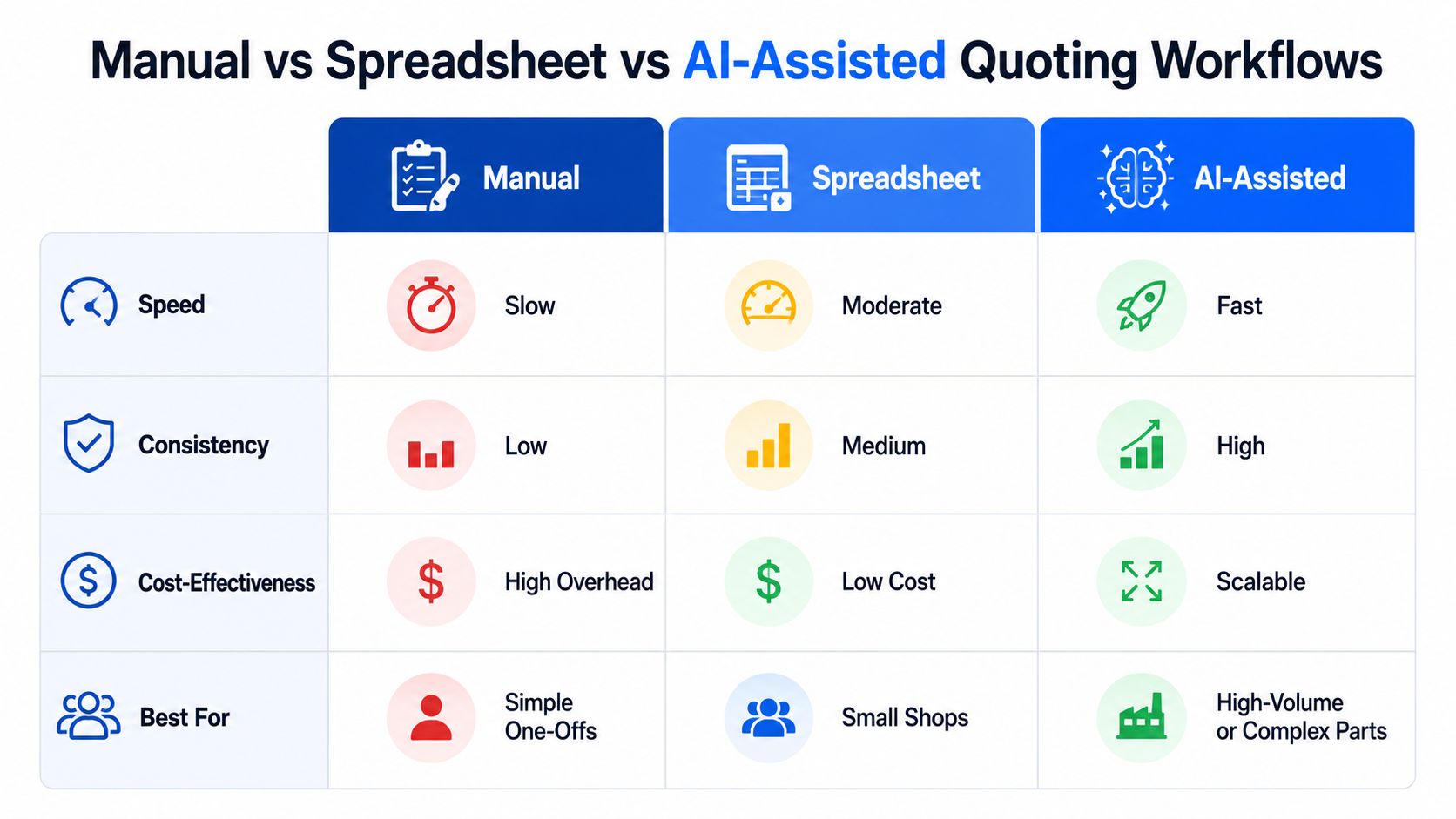
Every shop has a quoting system, even if that system is an estimator's memory, a folder of old jobs, and a spreadsheet with several hidden tabs. The choice is how much structure and automation the business wants around that process.
Manual estimating
Manual quoting works for simple one-offs and unusual jobs that require experienced judgment. An estimator can open the CAD model, inspect the drawing, call a supplier, check the schedule, and build a price around the actual process.
The weakness is repeatability. Important details can remain in email threads or in the estimator's head. A sick day, a rush RFQ, or a revision can expose that dependency. Manual review also makes it harder to compare quoted assumptions with actual job performance later.
Spreadsheet estimating
Spreadsheets give small shops a practical middle ground. They can store material rates, operation formulas, markups, setup fees, and reusable quote language at low cost. They're useful when the estimator understands the process and maintains the file carefully.
They also have failure points. A copied formula can be wrong, a material table can age, and version control can become unclear when several people save local copies. Spreadsheets calculate what they're given. They don't know that a drawing is missing a bend view or that the coating vendor's minimum charge changed.
AI-assisted workflows
Digital platforms can reduce the time spent reading emails, extracting drawing data, organizing BOMs, and transferring values into an estimate. Industry commentary reports that geometry-based methods can reduce complex assemblies that once took half a day or more to about 30 minutes, while manual quote preparation still commonly takes 24 to 48 hours in job shops. This RFQ guide discusses geometry-based estimating and quote workflow design.
AI assistance is most useful when it handles repetitive extraction and presents the estimator with traceable inputs. It shouldn't replace review of weld access, tolerance intent, finish acceptance, or capacity. A shop can use manufacturing quoting software for RFQ organization and estimating while keeping a human approval step before the price reaches the customer.
The strongest workflow is usually hybrid. Automation handles intake, geometry, and consistency. The estimator handles judgment, exceptions, and the final risk review.
Building Quotes That Stay Valid When Costs Move
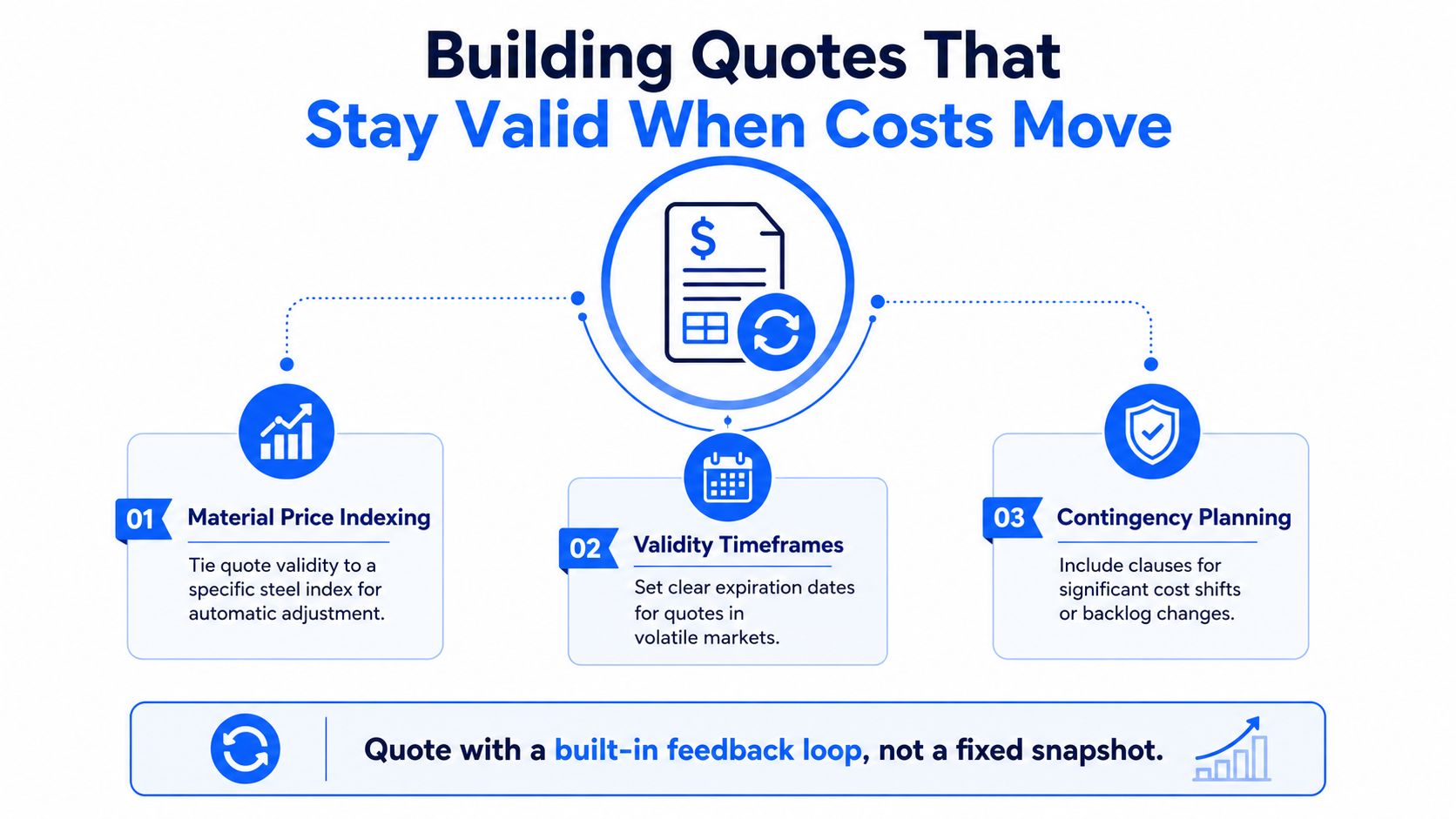
A quote is a snapshot, but the job won't be produced in a snapshot. Material availability can change, the backlog can fill, a finisher can revise its price, and a nesting decision can alter the required sheet count. A profitable shop builds those variables into the quote instead of hoping they remain stable.
Use a clear validity rule
State how long the material and outside-processing prices remain valid. If the customer needs a longer purchasing window, add a review point rather than pretending the original number is fixed. Shops that buy volatile materials should consider a documented adjustment mechanism tied to an agreed index or supplier confirmation.
Track external conditions before they affect the floor. Resources for tracking supply chain signals can help the team watch changes that may affect material availability and delivery planning.
Price the local drivers
Nesting determines yield. Bend setup determines how much one-off work gets spread across the order. Finishing adders determine whether a visually simple part becomes labor-intensive. Capacity determines whether the quoted date requires overtime, subcontracting, or a less profitable schedule change.
Before sending the quote, ask:
Material: Is the grade, thickness, sheet size, and expected yield documented?
Operations: Are cutting, bending, welding, deburring, inspection, and handling priced separately?
Finishing: Are outside processing, masking, freight, and minimum charges included?
Capacity: Can the shop meet the promised date with current material and machine availability?
Risk: Which assumption would hurt most if it changed, and is that assumption visible to the customer?
Add contingency when the drawing is incomplete, the finish standard is unclear, the tolerance requirement is unusually demanding, or the delivery date depends on uncertain capacity. Don't use contingency to hide poor estimating. Use it to price a specific uncertainty and record the reason.
The quote should also preserve its assumptions and revision history. When the customer changes thickness, quantity, finish, or delivery date, the estimator needs to update the affected operations without losing the original commercial record.
Common Quoting Questions Shop Owners Actually Ask
How fast should a sheet metal quote go out?
For a clear RFQ, respond while the buyer is still comparing suppliers. Traditional shops may need one to two days to process an RFQ, while digitized platforms can return pricing and design feedback in about three minutes, according to Bloomfield's quoting benchmarks. Speed matters only if the quote still exposes its assumptions and risks.
Should setup fees appear separately?
Usually, yes. A separate setup line explains one-off pricing and shows how that cost is distributed across repeat quantities. It also gives the estimator a clear line to revise when the quantity or process changes.
How should finishing adders be presented?
List powder coating, anodizing, passivation, masking, and outside processing separately. Customers can review those requirements without mistaking a fabrication total for a finished-part price.
What should happen when the RFQ is incomplete?
Request the missing material, geometry, tolerance, quantity, or finish information before issuing a firm quote. For a budgetary number, state each assumption and identify what could move the price.
A repeatable workflow should keep CAD, drawings, BOMs, operations, finishing, markups, lead times, and revisions together. Uptool helps CNC machining and fabrication shops organize RFQs and generate structured estimates. Visit Uptool to assess whether its workflow fits your sheet metal quoting process.