
Stephanie Hendrixson
Editor-in-Chief, Additive Manufacturing | Manufacturing Connected Published 06/05/2026
For manufacturers in the United States, “Proximity should be an advantage,” says Alex Huckstepp, cofounder and CCO of Uptool.
Yet despite being closer to the customer these (primarily) small and medium domestic manufacturers often lose out on work to overseas suppliers.
The problem isn’t that U.S. shops lack technology or expertise — instead, it often comes down to how quickly they can quote.
“One of the elements in which we get outbid by Asia is not only cost, it’s also speed,” says cofounder Benny Buller. “We are living in a world where you can get almost anything in 10 days from Vietnam or China. They became more agile. They know how to turn things around faster.”
Buller and Huckstepp each have years of experience in manufacturing, including working at industrial OEMs needing to source parts for their products. They’ve experienced the supply chain challenges firsthand, but also as observers with this new endeavor called Uptool, an AI platform optimized to accelerate the quoting process.

“We’ve sourced parts ourselves, and we’ve worked with so many engineers and buying teams. One of the most common things we heard was, ‘I’d love to work with my local machine shops’,” Huckstepp says. “‘But they take a week to provide a quote, and they quote me 3 or 4 weeks to get a simple part. I get a same-day quote from China and I get the part in a week.’”
Slower quotes from local shops can be the result of manual quoting processes, lack of digitalization and understaffing. But the response time is also indicative of how many U.S. shops choose to operate by building up a backlog of orders as a safety net of sorts. That strategy might protect individual shops for now, but as a whole, U.S. manufacturers are losing competitiveness on a global scale when they take too long to provide quotes.
Buller and Huckstepp officially launched Uptool, coming out of stealth mode in February of 2026 with a cloud-based AI aimed at small and mid-sized machine shops and metal fabricators. While the platform has many potential applications, at launch its goal is automating and speeding up quoting, so that these companies can process more RFQs more quickly and ultimately win more work.
A Changing Landscape for Machine Shop Quoting
While small U.S. shops are not the only current or potential users of Uptool’s AI product, their challenges with quoting speak to the broader issue that Buller and Huckstepp aim to address: speed.
Early in his career as an engineer, Buller cultivated a reputation for being able to source parts from suppliers on a rapid timeline, often overnight. “I figured out a way to make things happen very quickly by being very stubborn and being very impatient and working directly with suppliers,” he recounts. “But this was really, really hard and very exhausting. And very few people are willing to do this.”
Speed to receive parts matters because shorter lead times often translate to more iterations and better products. But if manufacturers in an OEM’s supply chain can’t or won’t deliver rapidly, innovation stagnates and timelines stretch.
Buller noted a similar pattern later, in his previous position with additive manufacturing company Velo3D, where he encountered businesses wanting to add metal 3D printing not for its design capabilities, but out of frustration with long lead times to get metal castings and preforms.
“When you look at the parts that they had, a lot of those parts could be done in a week, no problem,” with conventional manufacturing methods, he says. “But the whole process around ordering them and making them and the whole interaction with the supply chain made it into a quarter.”
The experience led Buller to the conclusion that drove the founding of Uptool:
“The biggest opportunity in the manufacturing of parts is not in developing the next modality of manufacturing technology,” he says. “It is by using software to allow better flow of information and better decision-making process with this information.”
“Zero Configuration” AI Software
To build a tool that could facilitate that flow for manufacturing businesses, Uptool’s cofounders spent months in conversation with 40-some machine shops, trying to understand their businesses, their challenges and what was holding them back from speed. They identified quoting as an addressable bottleneck, and an AI tool as a potential solution. The first iteration of Uptool was coded in about 120 hours and sent to three businesses for beta testing.
One beta user quickly saw results when her shop received a large quote that would have taken her three days to quote previously; with the Uptool prototype, the quote was turned around overnight, bringing in a large volume of work the shop may have lost otherwise.
This proof of concept spurred the creation of the commercial Uptool AI product. But along with getting the quoting functionality right, Buller and Huckstepp recognized that they also needed to streamline the adoption process for shops.
Uptool is designed to be “zero configuration,” meaning it requires no setup or specific information upfront, and can be deployed by a new user in under an hour. Shops can start working in the software right away; settings can be changed on the fly at the user’s discretion, and over time the software will learn the user’s common corrections and adapt to increase automation and accuracy. By the end of an initial 60-minute setup, a new user will have processed at least two quotes with multiple iterations.
“Within a week or so,” Buller says, “they’re quoting in under 2 minutes per part.”
An AI Administrative Assistant for RFQ Processing
Here’s how the quoting tool works:
Uptool is connected to a shop’s quoting inbox. When messages come in, the AI is able to parse the message and attachments, extracting key information about customer intent and the specific part requirements. Uptool can discern when requests are coming from existing customers and whether they connect with existing jobs, allowing it to quickly file information or create new quotes.
“We’re looking at bills of material, we’re looking at drawings, we’re looking at CAD,” Huckstepp explains. “We’re trying to do these organizational tasks automatically.”
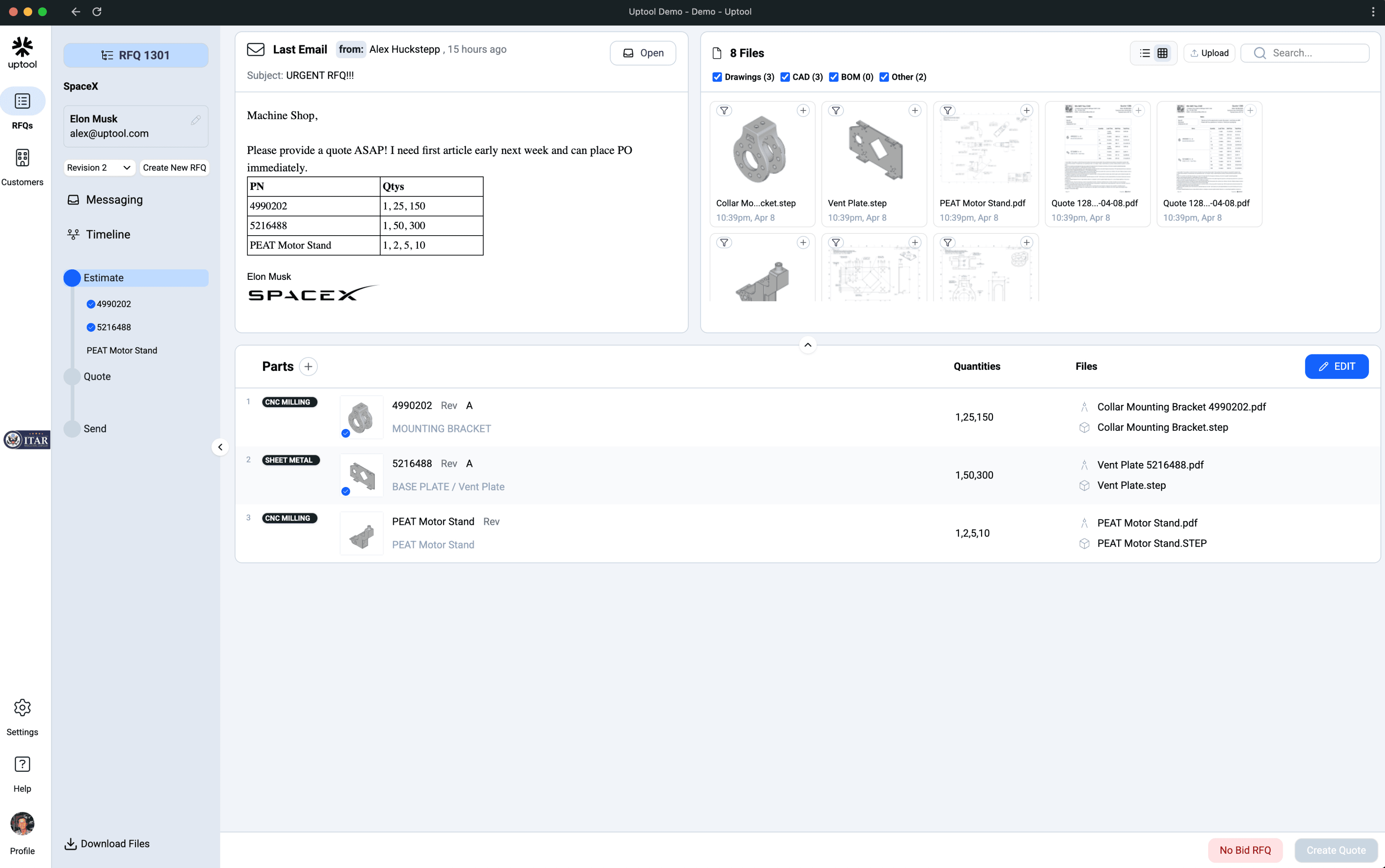
Rather than spend time sorting through files and compiling the information in a spreadsheet, the manufacturer is then served the relevant information within the Uptool dashboard. Assemblies are broken down into discrete parts as needed, and all the relevant information is organized with each part number.
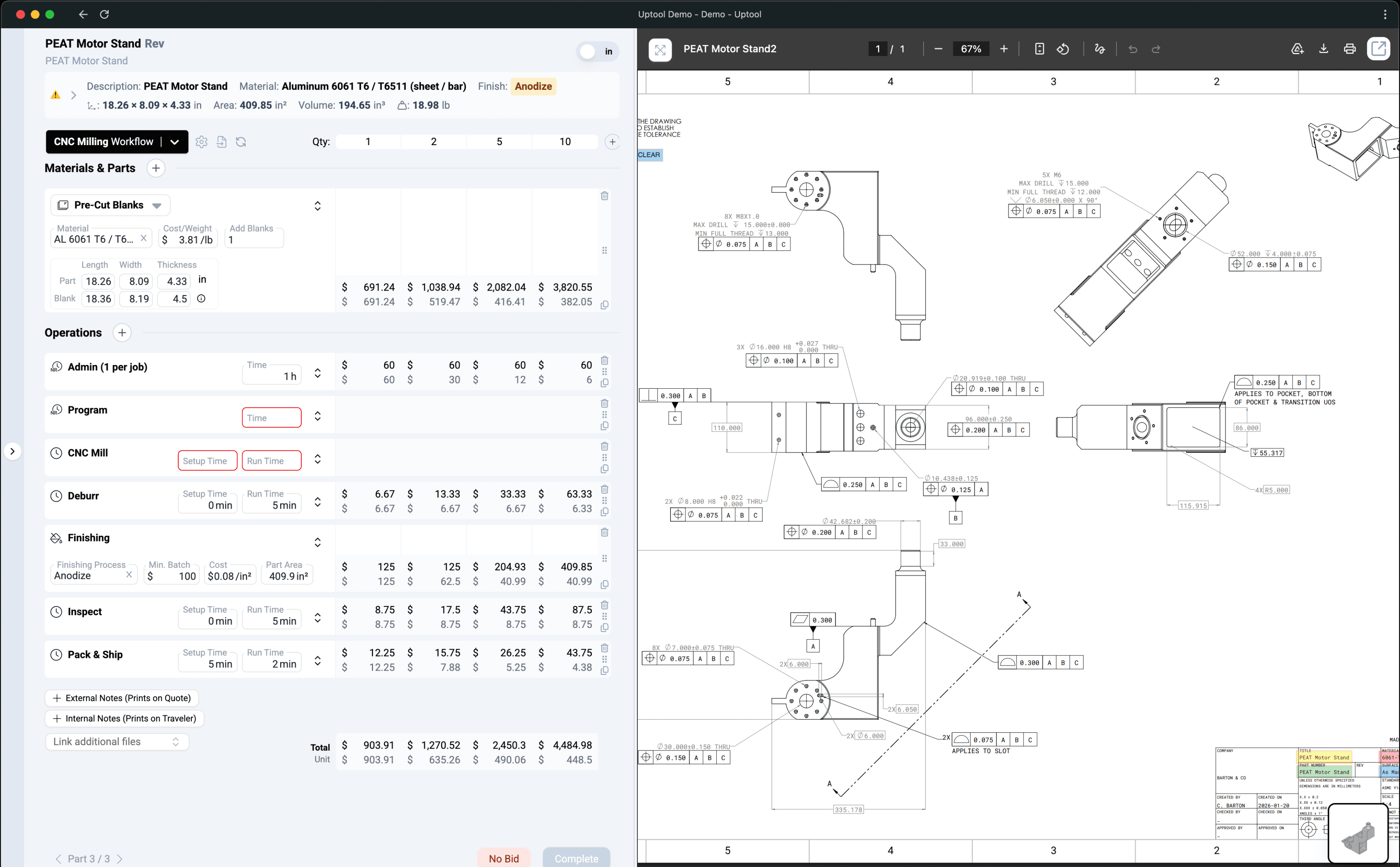
From there, Uptool automates estimated material and finishing costs plus simple internal processes, and the user can quickly provide time estimates for any remaining steps (such as setup, programming and CNC milling). The software applies the shop’s rates and markup accordingly, and generates prices and lead time estimates so that a quote can be ready for the customer and sent through the platform at an accelerated rate.
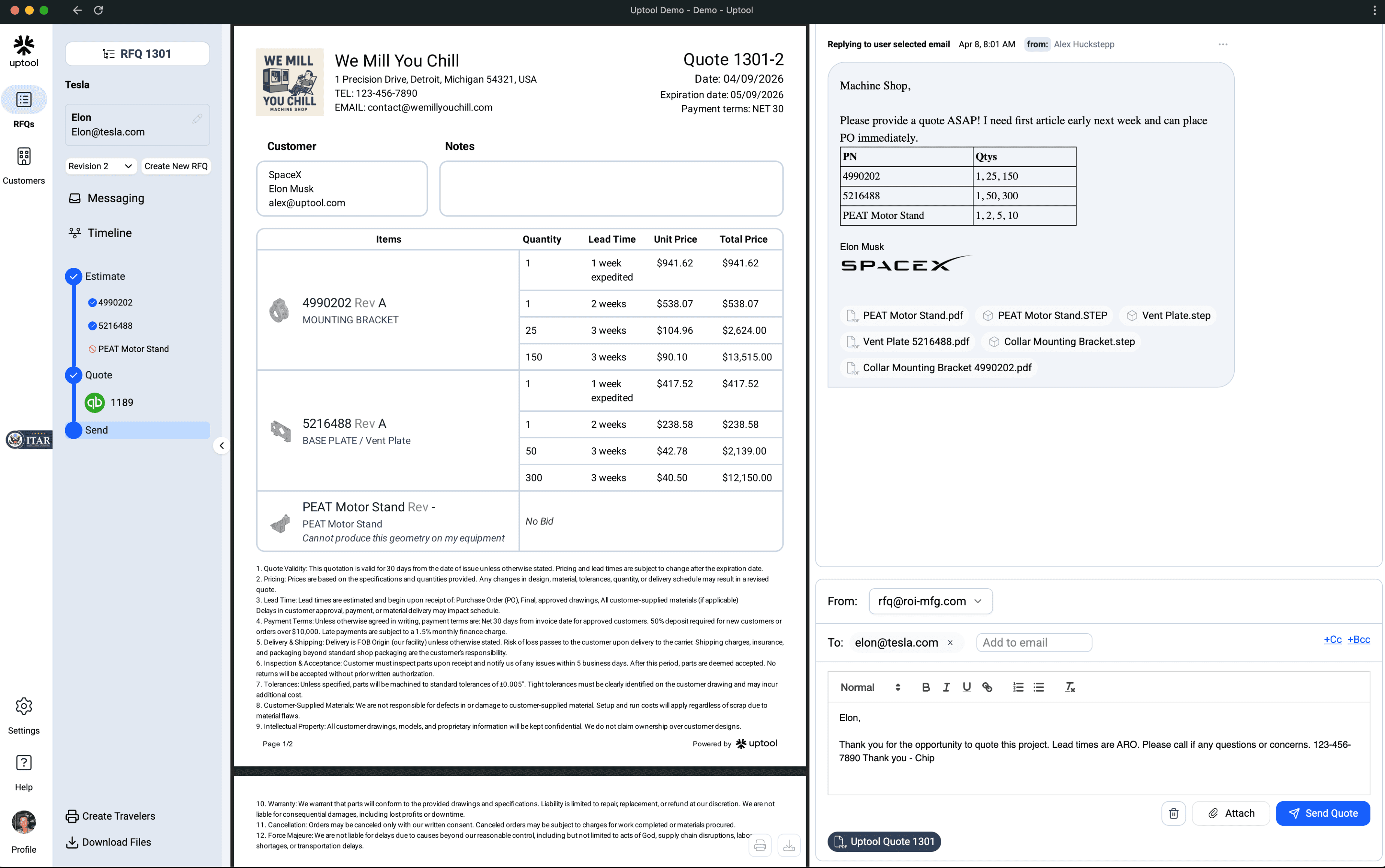
“Shops are going from quoting at a rate of 15 to 20 minutes per part to about a minute and a half,” Huckstepp says.
Humans in a Faster Loop
While Uptool’s artificial intelligence has been trained on and learns from real quoting information, it is still intentionally a human-in-the-loop approach. Every business is different, and there are some details left to the manufacturer. The tool works much like an administrative assistant that handles information intake and organization, so that the human can focus on the nuances of the quote.
“The key piece we’re not doing yet is trying to figure out exactly the run time of this part and which CNC machine it’s going on and if you have the tools to do it,” Huckstepp says. “That’s a very complex thing that other companies are trying to solve and hopefully they do. But everything around that, we’ve automated.”
Customers pay no upfront cost to implement the software, just a monthly subscription fee dependent on the size of the business. The AI is currently best suited to small, high-mix machine and fabrication shops, though the company is building out capability to support finishing, stamping, casting, additive manufacturing and forging operations as well.
Going forward, Uptool plans to expand beyond quoting to offer an end-to-end operating system for shops. The very next extension planned will be enhanced CRM and job tracking to enable shops to track customer jobs from start to finish. Future additions will include support for purchasing and inventory, machine monitoring, scheduling, and shipping — all areas that augment core manufacturing capabilities and know-how but have major impacts on a shop’s speed and competitiveness beyond the quote.
“Time is the only resource that is even more precious than money,” Buller says. “Being able to shorten lead times compared to getting things from overseas is really critical. That’s a huge advantage.”
“This [quoting] is a key bottleneck between customer and supplier that we need to solve first before we can help them do other things faster,” Huckstepp says. “Because if they’re not winning enough work, nothing else really matters.”
