Monday morning starts with three RFQs, three drawing packages, and the same three questions written on a sticky note: Can we make it? How long will it take? What should we charge? The estimator who answers those questions from a quick scroll is not quoting the part. They're guessing at the work hidden inside the print.
Reviewing engineering drawings for a CNC machining or sheet metal job is a quoting-readiness exercise. The title block, material callout, datum scheme, tolerance stack, revision cloud, BOM, and finishing note all have to become shop decisions. If the review misses one of them, the cost usually appears later as an extra setup, an outside process, an inspection delay, a rushed material order, or a job that earns less than planned.
Engineering shop drawing review can take an average of 6.98 days, with individual cases ranging from 0.16 days to 24.25 days, according to a study of engineering shop drawings from the Lean Construction Institute UK. A small shop doesn't need to turn every estimate into a week-long design review, but it does need a repeatable way to identify risk before sending a number to the customer.
Table of Contents
Turning Materials, Operations, and Finishing Into Routing and Price
A Repeatable Pre-Quote Checklist and a Defensible Final Quote
Why Drawing Review Is Really a Quoting Question
An estimator's first job isn't to prove that a drawing looks complete. It's to determine whether the shop can turn the requirements into a controlled route through purchasing, cutting, machining, fabrication, finishing, inspection, and delivery.
That route starts with three answers:
Can we make it? Do the available machines, tooling, fixtures, weld capability, forming equipment, and inspection resources match the part?
How long will it take? What material, setup, programming, cycle, queue, subcontract, inspection, and delivery steps sit between the RFQ and the finished part?
What should we charge? What should the customer pay for the actual work, risk, outside services, handling, and margin?
A quick scroll often catches the obvious geometry and misses the expensive details. The estimator sees a machined block, assumes a standard aluminum alloy, and prices a familiar three-axis route. Later, a note requires a different temper, a tight positional relationship demands a coordinated fixture, and a surface finish instruction sends the part to an outside finisher. The original price never had a chance.
Practical rule: If a drawing requirement can't be assigned to a routing step, a responsible person, or a quote line, it hasn't been reviewed deeply enough.
The consequences move downstream quickly. Purchasing may order the wrong stock. Programming may build the wrong revision. Production may discover that a hole pattern needs another setup. Inspection may need equipment or documentation that wasn't included in the estimate. By then, recovering the margin is difficult because the customer sees the added work as a shop problem, not a quoting assumption.
The pressure is real for small shops. Slow quoting can cost opportunities before the work reaches the floor, which is why it helps to treat review speed and review discipline as connected issues, as discussed in why slow quoting is costing U.S. machine shops work. The answer isn't to skip the review. It's to make the review follow the same commercial logic as the quote.
The First-Pass Sweep Every Estimator Should Run
The first pass should be fast, structured, and intentionally shallow. Don't start by studying every feature. Sweep the document in the order that exposes quoting risk earliest.

Start with identity, not geometry
Read the title block before the part. Confirm the part number, description, customer, units, scale, sheet count, drawing status, and revision. Compare those fields with the RFQ email, attached filename, customer portal entry, and any model or BOM supplied with the request.
A missing or conflicting revision is a stop sign. Don't price Rev B because the filename says Rev B if the title block says Rev A. Don't assume the latest-looking PDF is the approved issue. Ask the customer to confirm the governing revision and record that assumption in the quote file.
Scale matters less for a dimensioned CNC part than the written values, but an unusual scale or crowded sheet can signal that the drawing has been reduced, exported poorly, or assembled from incomplete views. That affects how much interpretation the estimator will need.
Scan the views and dimensions together
Look at the view layout as a map. Are the front, top, side, section, and detail views present? Do the projected views agree? Does every feature visible in one view have a dimension, a reference, or a clear relationship somewhere else?
You aren't measuring the part with a ruler. You're checking whether the print tells the machinist or fabricator what must be made without forcing assumptions. A missing section view may hide a counterbore. An omitted detail may leave a bend relief unclear. A dimension that appears to reference the wrong edge can change both the process and the price.
Read notes and revisions as manufacturing instructions
General notes often contain the requirements that don't appear beside individual features. Read them in plain language and translate each one into a shop action. Material, deburr, edge break, heat treatment, weld procedure, masking, inspection, packaging, and certification notes all belong in the estimate.
Then find every revision cloud and compare the marked change with the current geometry. A revision block tells you that something changed. The cloud tells you where to look. If the cloud is buried inside a dense layout, zoom in and verify the feature, dimension, note, or BOM line it affects.
A drawing that needs interpretation before pricing needs a customer question before the estimate leaves the desk. That isn't a failure of estimating. It's protection against converting ambiguity into an unpaid operation.
Reading GD&T, Datums, and Tolerances Like a Shop Floor
GD&T becomes expensive when the estimator reads symbols as isolated requirements instead of as a manufacturing system. A feature control frame can change the fixture, setup sequence, machine choice, probing strategy, inspection method, and time required to prove the result.
Start with the datum reference frame. The primary, secondary, and tertiary datums should constrain the degrees of freedom that matter to the part's functional interfaces. If the datum scheme is incomplete, inaccessible, or unrelated to how the part will be held, the shop may struggle to fixture and measure the feature consistently. That interpretation risk affects both quoting and downstream inspection, as outlined in this drawing review guidance on datum reference frames.
A positional tolerance on a hole pattern may require a coordinated fixture, probing, or a controlled relationship to a machined datum. A flatness requirement on a large face may push the route toward a finishing or grinding operation rather than a simple mill pass. A surface finish requirement may require a secondary finishing vendor, masking, cleaning, and a final inspection after the part returns.
The estimator's question isn't only, “Can the tolerance be met?” It's, “What must happen to demonstrate that it was met?”
Drawing Callout | Shop Floor Effect | Quote Cost Driver |
|---|---|---|
Positional tolerance tied to datums | Requires controlled setup, fixture alignment, and verification | Fixture design, setup time, probing, inspection |
Tight profile requirement | May require multi-axis machining or a more capable machine | Machine selection, programming, cycle time, prove-out |
Flatness on a broad face | May require a stable finishing operation after roughing | Additional operation, handling, inspection |
Fine surface finish | May require a finishing pass, abrasive process, or outside vendor | Tooling, secondary process, transport, final check |
Tight size tolerance | Reduces process margin and may require in-process checks | Tool wear management, first-article work, inspection minutes |
Price inspection as production work
Inspection isn't a free confirmation at the end. The inspector may need a CMM program, calibrated gauges, surface-finish verification, material certificates, or a documented report. When a drawing contains many critical features, the estimate should carry inspection labor and the administrative time needed to compile results.
ASME Y14.5-2018 remains the central U.S. mechanical drawing reference for geometric dimensioning and tolerancing, with a 2024 reaffirmation noted by ANSI, while ASME Y14.35-2014 addresses engineering drawing revision practices. These standards matter commercially because the drawing must communicate shape, size, form, orientation, and location clearly to manufacturing and inspection teams, not merely look consistent on screen. The standards context and revision history are summarized by ANSI's overview of ASME Y14.5 and ASME Y14.100.
Turning Materials, Operations, and Finishing Into Routing and Price
A good estimate can be read backward from the drawing. Every requirement should appear as a material choice, operation, outside service, inspection task, handling step, or explicit assumption.
Start with the material callout
Don't stop at “stainless” or “aluminum.” Identify the alloy, temper, thickness or stock size, heat-treatment state, and any certification requirement. Those details influence what must be purchased, how much excess material is needed, which tools are suitable, how the material will move through the machine, and whether a post-process is required.
For sheet metal, read the thickness, bend information, grain direction if specified, bend radius, relief, weld notes, and hardware callouts. For CNC work, look for deep pockets, thin walls, long tool reach, interrupted cuts, threads, counterbores, reamed holes, and surfaces that need a separate finishing strategy.
Convert features into operations
A hole isn't one operation by default. It may require spotting, drilling, boring, reaming, tapping, thread milling, deburring, and inspection. A counterbore adds a tool and a depth-control concern. A weld prep adds cutting or machining before fit-up, then welding, cleanup, distortion control, and possibly inspection.
Build the route before assigning a price. A simple route might read:
Purchase certified material and verify incoming stock.
Saw or laser cut blank.
Face and establish datum surfaces.
Rough and finish mill primary features.
Drill, ream, tap, or thread mill holes.
Deburr and clean.
Send for specified treatment or coating.
Inspect critical dimensions and finish.
Package and ship.
That sequence gives you a practical basis for cycle time, outside-service timing, and delivery commitment. The material cost estimating resource can support the stock side of that calculation, but the estimator still needs to validate the actual size, yield, remnant policy, and supplier availability.
Drawing Clue | Routing Line Item | Cycle-Time Factor | Pricing Lever |
|---|---|---|---|
Alloy, temper, or certified material | Purchase and incoming verification | Availability, stock size, certification handling | Material markup, purchasing labor |
Threaded holes | Drill, tap or thread mill, inspect | Hole count, depth, tool access | Machine time, tooling, inspection |
Counterbores or countersinks | Secondary hole operation | Tool changes, depth control, access | Setup and cycle allowance |
Weld preparation | Cut, bevel, fit, weld, clean | Joint length, distortion, access | Fabrication labor, fixtures, inspection |
Anodize, powder coat, or passivation | Outside processing and post-finish check | Vendor queue, masking, transport | Outside-service price, handling, lead time |
Masking or selective finish | Mask, process, unmask, inspect | Surface area and feature protection | Manual labor, risk allowance |
Treat finishing as part of the route
Anodize, powder coat, passivation, plating, paint, heat treatment, and other finishes shouldn't sit in a vague “to be determined” note. Add the process, preparation, masking, vendor communication, transport, expected return timing, and inspection after finishing.
Finishing can also change the dimensional plan. A coating may affect fits, threads, masking boundaries, or final appearance. If the drawing calls for selective finishing, identify which surfaces stay bare and how the finisher will protect them. If the note is unclear, ask before quoting instead of burying the risk in a general contingency.
Package-Level Review Across Drawings, BOMs, and Revisions
A single drawing can be correct in isolation and still produce a wrong quote. The failure often sits between files. The assembly may identify a detail at one revision, the detail sheet may carry another, and the BOM may show a quantity or material that doesn't match either document.

Establish the governing package
Start with the RFQ email thread and identify what the buyer says is current. Then compare that instruction with the issue date, revision letter, approval status, and filenames on every drawing, model, BOM, specification, and material list.
Don't let email chronology decide the revision by itself. A later email may forward an older attachment. A file may have been renamed without changing the title block. Record the governing package in the estimate and archive the files used to build the number.
Reconcile relationships, not just filenames
Check the assembly against its detail drawings. Confirm that referenced part numbers exist, mating geometry still makes sense, and the BOM quantity matches the cover note and assembly structure. Look for conflicting material notes, different finish requirements, missing inspection instructions, and section views that no longer align with the referenced geometry.
A package-level checklist earns its keep:
Revision match: Does the assembly revision agree with every detail drawing used for pricing?
Quantity match: Does the BOM agree with the RFQ quantity and any customer note?
Geometry match: Does the drawing reference a feature, model, or mating part that still exists?
Requirement match: Do notes, specifications, and inspection requirements agree across files?
Hardware match: Are purchased components, fasteners, inserts, and finishing requirements included?
Assign one owner
When several estimators touch the same RFQ, cross-document review needs one owner. That person doesn't have to perform every calculation, but they should control the package list, resolve conflicts, and approve the revision set used for pricing.
Public drawing checklists often mention BOM and revision consistency, but this package-level mechanical drawing checklist captures the practical discrepancies that cause trouble, including BOM-versus-drawing mismatches, conflicting notes, missing inspection requirements, and section-view inconsistencies. The commercial impact is straightforward. A wrong package can distort material, operations, lead time, and price even when the individual sheet looks polished.
Manual Review Versus Software-Assisted Review
A red pen, spreadsheet, and experienced estimator can still produce a strong review. Manual work is flexible, especially when a drawing contains unusual fabrication instructions or a tolerance stack that depends on the shop's particular machines and fixtures. The weakness is consistency. Different estimators may record assumptions differently, miss different details, and leave little trace of why a quote was priced a certain way.
Software-assisted review helps with the repetitive parts. It can organize RFQ emails, extract part numbers and revisions, compare document versions, identify drawing fields, capture BOM entries, and surface tight tolerances for a human to examine. It can also give every estimator the same review envelope and create a record of edits and decisions.
Dimension | Manual Review | Software-Assisted Review |
|---|---|---|
Initial document triage | Flexible but dependent on who opens the package | Structured intake and routing |
Revision comparison | Requires deliberate file-by-file checking | Can surface version differences for review |
BOM extraction | Hand entry and visual cross-check | Structured capture with human verification |
GD&T attention points | Depends on estimator experience | Can flag tolerance and datum information |
Manufacturability judgment | Strong when the estimator knows the equipment | Still requires shop-specific human judgment |
Traceability | Notes may remain in email or spreadsheets | Review decisions can stay with the RFQ record |
High-volume quoting | Becomes difficult as workload rises | Useful as a consistency and throughput layer |
Use automation where repetition dominates
A system should reduce hand entry and make missing information visible. It shouldn't decide that a tight profile is easy because the geometry resembles a familiar part. It shouldn't assume a coating vendor can meet a date without checking the actual service route. It can't know whether your older mill can hold a requirement that a newer machine handles routinely.
That distinction matters when evaluating engineering AI products. For example, Cyndra's engineering AI solutions are relevant to teams exploring software that can assist with engineering-document analysis, but a shop still needs a human review of machine capability, fixturing, tooling, and inspection strategy.
A quoting platform belongs above estimator judgment, not in place of it. Tools such as CNC estimating software for shop quoting can help organize CAD, drawing, BOM, email, material, operation, and revision data into a more consistent workflow. The estimator remains responsible for deciding whether the proposed route reflects the equipment and labor available.
Invest in both tooling and training
Software is useful when the bottleneck is document handling, duplicate entry, revision chasing, or inconsistent quote records. Training is the better investment when estimators can't translate GD&T into setups, finishing into outside-service timing, or material specifications into purchasing risk.
The strongest workflow pairs them. The software finds and structures information. The estimator tests that information against the shop floor.
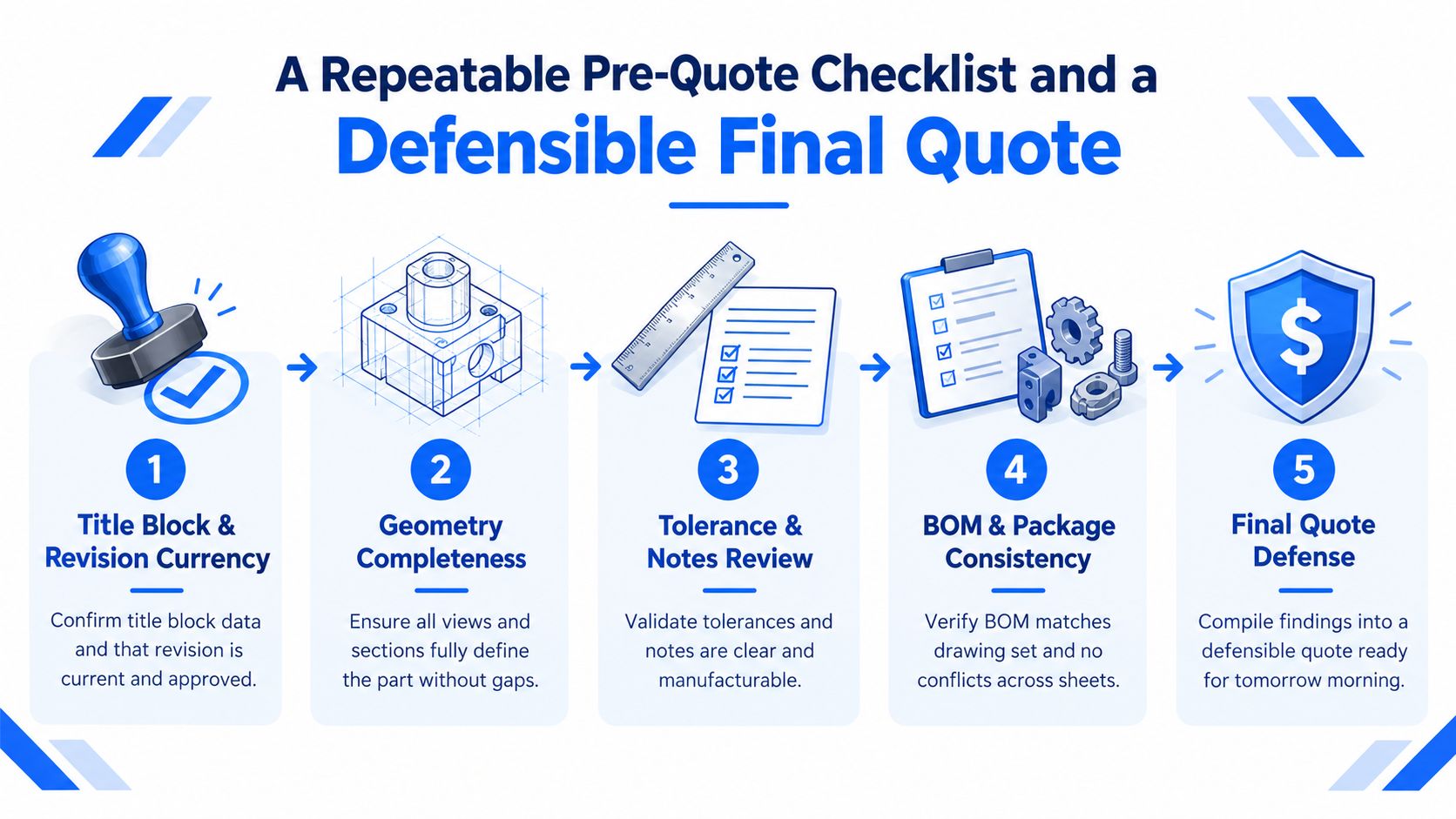
A Repeatable Pre-Quote Checklist and a Defensible Final Quote
A familiar part can still produce a bad quote if the estimator misses a revision, an inspection requirement, or an outside process. Run the checklist below before assigning a price. Each answer should support three decisions: can we make it, how long will it take, and what should we charge. If a finding changes the route, lead time, price, or stated assumption, record it.
Run the review in quoting order
Title block and revision currency.
Confirm that the RFQ, filename, title block, model, and customer-approved revision match. Any mismatch requires clarification before pricing. Check the effect on material, programming, setup, and operations tied to changed geometry.Geometry completeness.
Ask whether a machinist or fabricator can define the part without guessing. Missing views, incomplete dimensions, unclear sections, or ambiguous bend and weld details affect programming, setup, cycle time, fabrication labor, and risk allowance. Send a focused question rather than pricing an interpretation.GD&T and datum strategy.
Test whether the shop can fixture, produce, and inspect the requirement with available equipment. An inaccessible datum, unclear tolerance relationship, or undefined surface condition may require additional fixtures, setups, probing, inspection, machine capability review, or outside processing.Material and stock callout.
Confirm the exact alloy, temper, thickness, heat treatment, certification, and grain direction where specified. Missing conditions should trigger a purchasing clarification. Price the resulting material exposure, yield, supplier lead time, handling, and certification labor.Operations and finishing clues.
Convert every note into a physical action. Threads, counterbores, weld preparations, masking, anodize, powder coat, passivation, and inspection requirements belong in the routing. Include cycle time, tooling, outside services, transport, finishing labor, and post-process inspection.BOM and package consistency.
Compare the assembly, detail drawings, BOM, specifications, RFQ correspondence, and revisions. Quantity conflicts, stale files, missing hardware, or incompatible finishes require package-level clarification. Recheck purchased parts, assembly labor, material quantity, delivery, and rework exposure.Final margin sanity check.
Put the proposed route beside machine time, setup hours, inspection time, outside-service costs, material exposure, and the promised delivery date. The price must still make sense when every stated requirement reaches the floor. Write down any assumption that the quote depends on before sending it.
Turn findings into quote protection
A defensible quote tells the customer what is included and gives the shop a usable record of what it priced. Log the drawing revision, material assumption, included operations, finishing route, inspection scope, quantities, and exclusions. Put tolerance-related setup and inspection cost into the estimate instead of leaving production to absorb it.
Write change-order triggers in plain language. A revised drawing, changed material condition, added inspection report, new certification, altered finish, or requested delivery acceleration should trigger a review before the shop accepts the old price.
The response window should match the package. A straightforward part may follow a standard route. A multi-file assembly with unclear revisions or demanding inspection needs time for clarification before the delivery promise is made.
High redline rates during drafting-checking and engineering review show why the review record protects margin when the route, delivery date, or price changes. Keep the questions, answers, revision reviewed, and assumptions with the quote so the team can explain the commercial decision later.
Uptool helps CNC machining and fabrication shops organize RFQs, analyze drawings and BOMs, extract material and finishing requirements, manage revisions, and turn review findings into structured estimates and quotes. Visit Uptool to see how a quoting workflow can keep estimator judgment in control while reducing repetitive work around engineering drawing review.