The worst advice in quoting 5 axis cnc milling is still the most common, treat it like a bigger 3-axis job and price it off machine time. That shortcut misses the key cost centers, and it's why so many shops win the order and lose money on the back end. The part may spend time on the spindle, but the quote gets blown up by programming, fixturing, validation, and the risk of missing a tolerance that spans more than one axis.
Table of Contents
Why Most 5-Axis Quotes Lose Money Before the First Chip
Most underquotes start with a lazy assumption, that the machine rate is the quote. It isn't. 5-axis work has a longer history of complexity than simple milling, with roots tracing back to an early feasibility project in 1958 and broader commercial usefulness not becoming common until the late 1990s, after software and numerical-control improvements made simultaneous 5-axis practical 3ERP's 5-axis machining history.
That timing matters because the quoting culture around 5-axis grew up around advanced capability, not commodity throughput. Shops that quote it like a simple bracket job usually ignore the parts of the process that don't show up in a feed-and-speed calculation. They also miss why aerospace, die and mold, and other high-value work tolerate a higher process cost when the setup count drops and the risk of manual re-indicating falls.
Practical rule: if the RFQ doesn't spell out fixture assumptions, inspection scope, and tolerance sensitivity, the quote is already incomplete.
The cheapest-looking number often comes from the shop that hasn't priced the work fairly. When a part needs CAM strategy, collision checking, and first-part verification, the estimator is really selling process control, not spindle minutes. That's why a smart quote protects margin before the first chip, instead of trying to recover it after a revision or a rework cycle.
Cost Structure of 5-Axis Milling Work
The cleanest quote starts with a simple split, Total Cycle Time = Cutting Time + Non-Cutting Time + Setup Time/Batch Size. The trap is obvious: many shops price only cutting time and treat the rest as a loose estimate. In job-shop work, non-cutting activities can account for 20–30% of total cycle time Hymson cycle time guidance.
That gap gets wider because job shops usually spend only 25–40% of cycle time cutting, versus 50–65% in production shops Hymson cycle time guidance. If you quote 5-axis work with one blended shop rate and a tidy spindle estimate, the labor stack is still incomplete. A practical review of how to calculate overhead cost for business keeps machine burden, indirect labor, and shop support from disappearing into the hourly rate.
Cost Component | 3-Axis Typical % | 5-Axis Typical % | Impact on Quote |
|---|---|---|---|
Cutting time | Higher share of the job in many simple parts | Lower share once setup and validation are counted | Lower apparent machine time can hide more engineering labor |
Non-cutting time | Materially present, but often simpler | 20–30% in job-shop environments Hymson cycle time guidance | Raises true cost even during active machining |
Setup amortization | Often spread across easier batches | Strongly affected by batch size and fixture reuse | Small lots get expensive fast |
Re-indicating and handling | More likely between ops | Reduced when 5-axis consolidates setups | Can justify a higher machine rate |
Risk of tolerance miss | Lower on straightforward parts | Higher across multiple axes and surfaces | Needs a risk buffer, not wishful thinking |
Cutting time is only part of the story. The hidden cost usually shows up in CAM programming, fixture development, and first-part validation, especially when the RFQ leaves setup assumptions vague. Even material pricing needs careful handling, so a reference like estimating material cost belongs in the quote process, not as an afterthought.
A good estimator separates spindle time from auxiliary time, then asks how much setup gets spread across the batch. That is the difference between quoting a part and quoting a process. When a quote only works if every setup goes perfectly, it is not a quote, it is a gamble.
Setup and Programming Differences That Drive Pricing
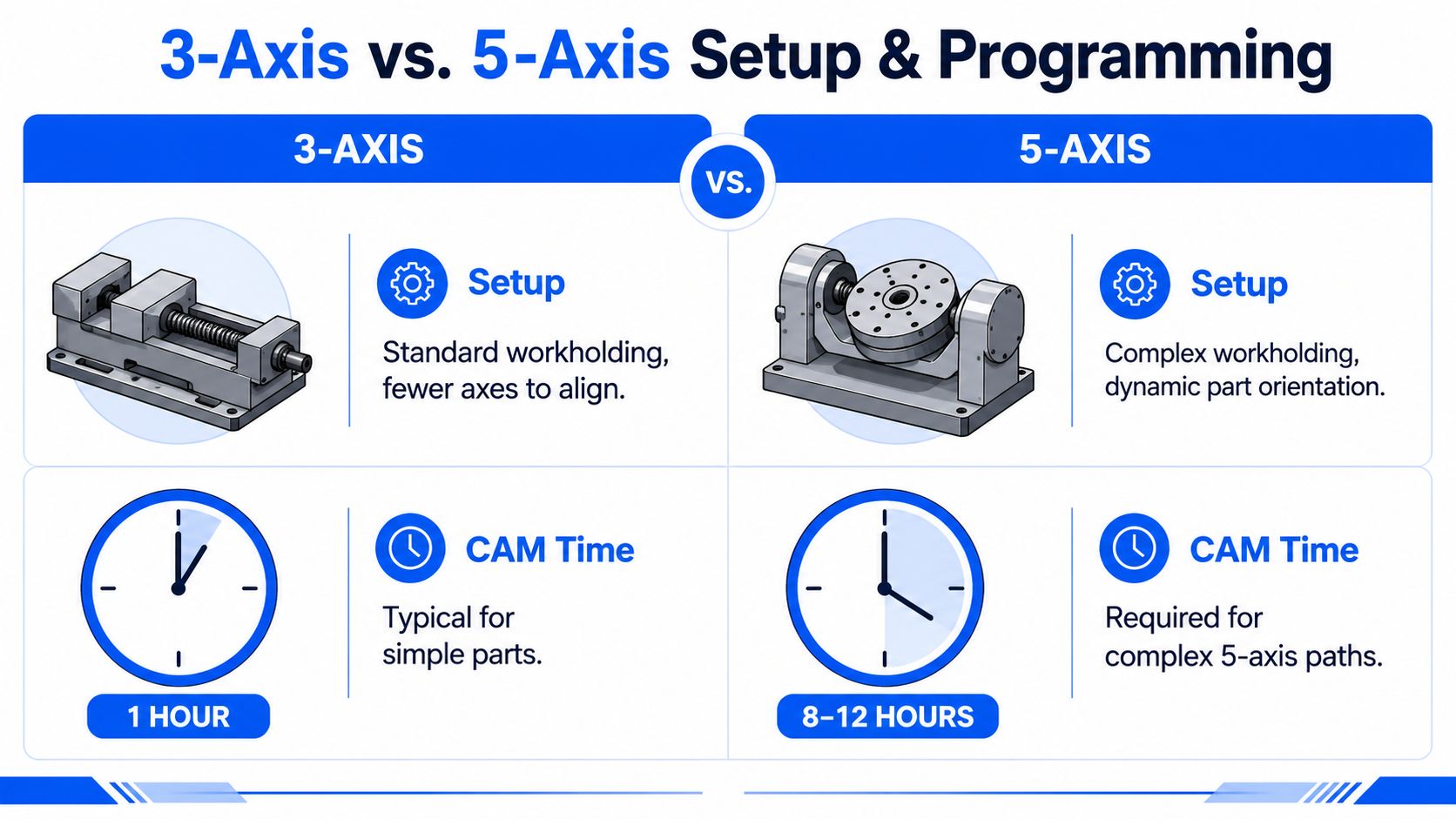
A simple 3-axis part can often be programmed, post-processed, and run with a predictable routine. 5-axis setup is a different animal. The toolpath has to stay collision-free while the part, fixture, spindle, and holder all move through changing orientations, and that takes real CAM time, not a quick edit.
Where the hours disappear
A small bracket with one critical finish may still need several rounds of simulation and post review. That's where the quote starts to separate from the sticker price. In real shops, the difference isn't just the machine, it's the time spent proving that the machine can run the part without a crash or a tolerance surprise.
Custom workholding is another place where the budget gets strained early. A fixture that is rigid enough for a 5-axis job, but still gives access to the needed surfaces, can push the quote up before production even starts. For complex parts, first-part validation can take longer than the actual run, especially when the buyer needs documented confidence on a high-value component.
A useful way to explain it to a customer is simple:
3-axis thinking: move the part to the tool.
5-axis thinking: move the tool and the part together without creating a new problem.
Quoting consequence: the engineering and validation effort becomes part of the part price.
CAM time often surprises people. Complex 5-axis paths can take multiple hours to build correctly, and the programming effort grows fast when the part has deep pockets, undercuts, or surfaces that only open up at certain angles. If the customer wants the work done right the first time, that setup and programming cost belongs in the quote, not buried in a vague markup.
Building Accurate 5-Axis Quotes From Incomplete RFQs
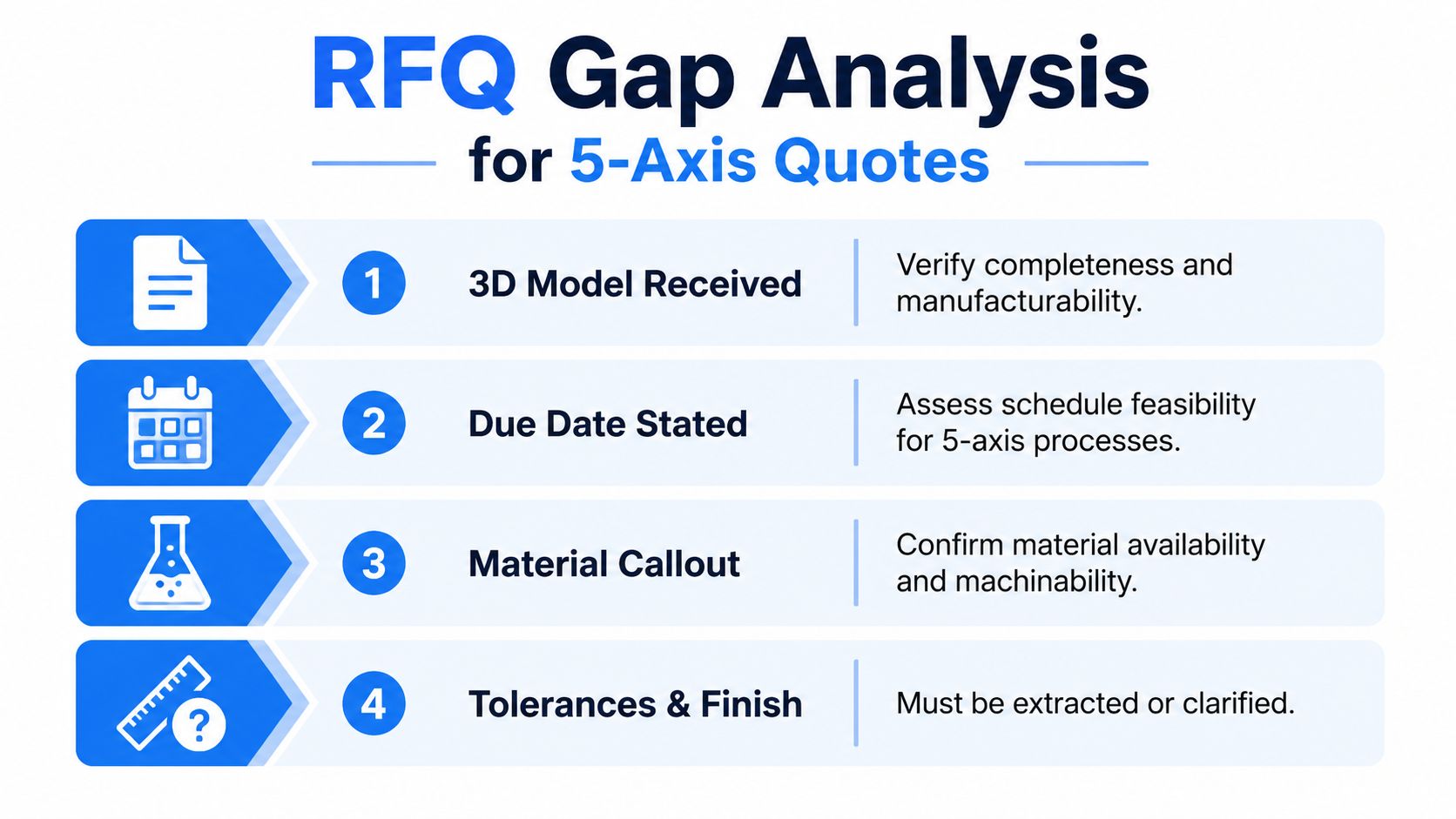
Most RFQs arrive thin, a model, a due date, and maybe a material callout. That's not enough for reliable quoting 5 axis cnc milling work. A complete package needs the details that control process risk, because the model alone won't tell you how hard the part is to hold, inspect, or finish.
What to ask before you price it
Start with tolerance, finish, and inspection expectations. If those are missing, the quote is incomplete no matter how clean the CAD file looks. Then check batch size and delivery schedule, because a one-off prototype and a repeat lot can justify very different setup assumptions.
Use the model to hunt for hidden complexity. Undercuts, deep pockets, and surfaces that disappear behind the primary orientation often force true 5-axis strategies instead of indexed 3-plus-2 work. If the geometry suggests custom tooling or special fixturing, price that effort explicitly, don't assume it will vanish into normal machine time.
A practical qualification workflow looks like this:
Confirm the material and stock form. If the alloy is hard to source or difficult to machine, the quote needs that burden reflected.
Pin down the drawing requirements. Tolerances, surface finish, and inspection notes change the job scope.
Test the setup logic. Ask how the part will be held and whether the customer has fixturing preferences.
Estimate risk. If the RFQ is vague, build in room for clarification, revision, and validation.
For shops that want a formal system to manage this intake, a platform like Uptool, Inc. can parse emails, CAD, drawings, and BOMs into a more organized estimate workflow. A quoting system won't remove judgment, but it can stop important RFQs from getting lost in inbox chaos, and that matters when a late response turns into a lost order.
If you want the internal process to stay consistent, tools that organize estimate inputs help. An internal reference on manufacturing quoting software is useful when you're standardizing how your shop captures model, material, and revision data before pricing.
A vague RFQ is never a free RFQ. It just pushes the cost of uncertainty onto the shop unless you ask the hard questions early.
Why Transparent Pricing Wins Better Customers
Transparent pricing does something the low-bid approach never does, it separates serious buyers from price shoppers. When a customer sees setup, programming, fixture development, machine time, inspection, and finishing laid out clearly, the conversation shifts from “why are you expensive?” to “what makes this process reliable?” That's the customer you want on a 5-axis job.
The worst disputes happen when the quote hides the actual work. If a job needs validation, extra fixture design, or special inspection, those items should be visible before the purchase order is issued. Otherwise, every clarification becomes a change order argument, and every change order argument eats time on both sides.
A useful mindset is to quote like a production partner, not a commodity vendor. Customers who buy complex parts usually care about delivery certainty, repeatability, and how well the shop controls process variation. A short note on how to evaluate pricing transparency KPIs can be handy if you're tightening your quoting process around clarity, response time, and close rate.
Clear quotes reduce friction later. Hidden scope always comes back as a margin problem or a trust problem.
This is also where shop owners need to stop apologizing for the work. If a competitor is only cheaper because they left programming or validation out of the estimate, that isn't a better quote. It's a deferred problem. Customers who value precision usually understand the difference once you show them the structure.
Lead Time and Rush Order Pricing Strategies
Lead time is a pricing lever, not just a promise date. Standard 7 to 10 business day lead times are usually the most economical, while 1 to 3 day rush turnaround can justify 25% to 50% premiums or more because the shop has to reprioritize work and may need overtime Shao-Yi CNC machining quote guidance. That's not gouging, it's the cost of schedule disruption.
The mistake is applying rush pricing inconsistently. If the shop takes a rush job, moves two other orders, and eats the overtime without charging for it, the rush customer got a discount at everyone else's expense. The quote should reflect what the schedule costs, not what the buyer hopes to pay.
A smart estimator also protects time for first-article inspection on complex parts. That buffer matters because a late inspection can create a domino effect across the rest of the week. If the schedule is tight and the RFQ is incomplete, a conservative lead time is usually cheaper than an optimistic one that forces rework under pressure.
For shops trying to tighten response time, an internal guide on why slow quoting is costing U.S. machine shops work is worth reviewing alongside your own quoting queue. Fast quoting matters, but fast and wrong is worse than slow and accurate.
When to Invest in 5-Axis Capability Versus Outsourcing
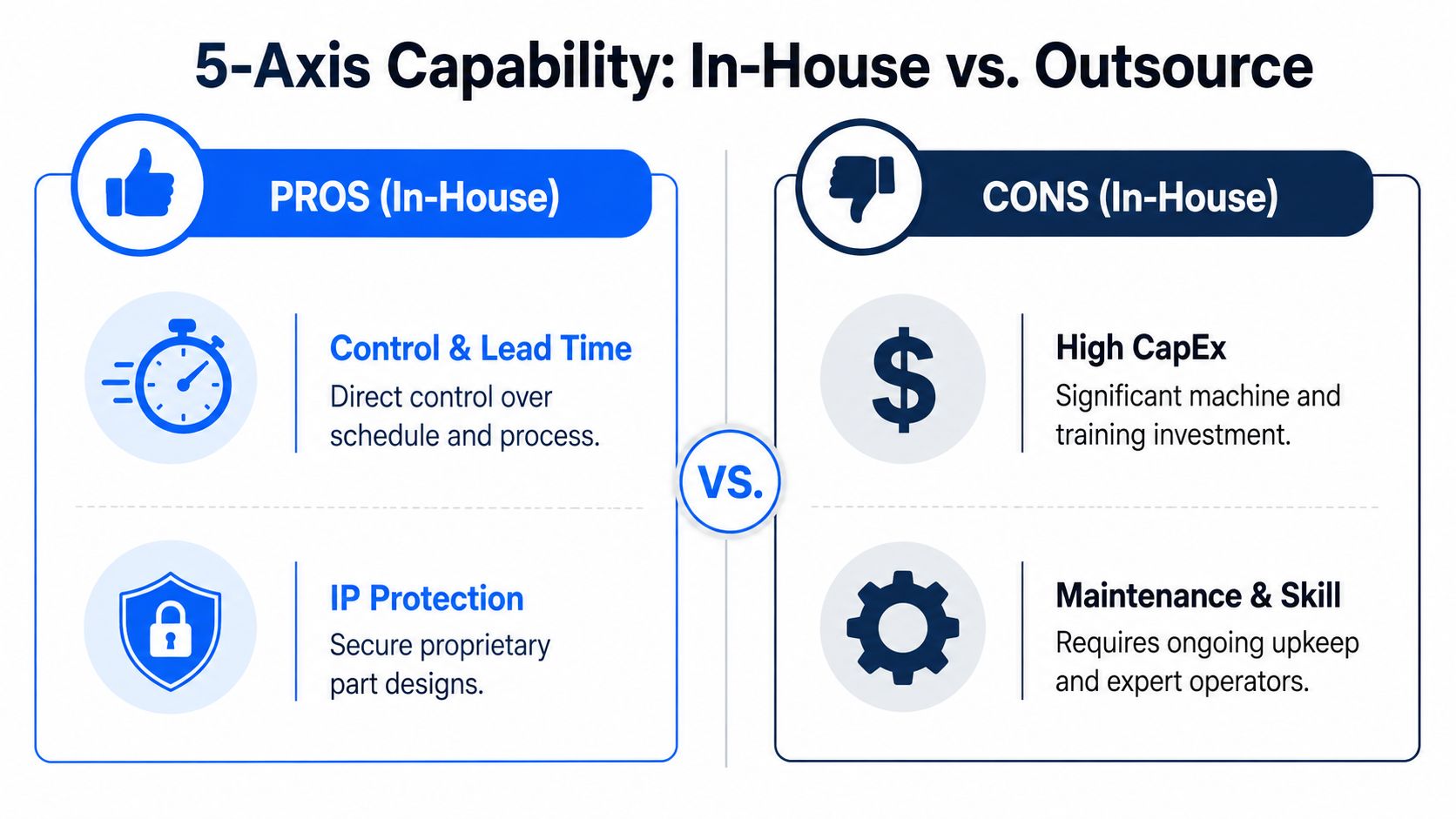
Not every shop should buy a 5-axis machine, and not every 5-axis part belongs outside the building. The decision comes down to frequency, part mix, and whether the work is strategic or incidental. If you're only seeing occasional complex parts, outsourcing can protect cash and keep the floor from getting crowded with expensive assets you don't fully use.
A practical decision test
Ask three questions before you invest:
Is the work repeatable? One-off complexity is different from recurring demand.
Do we have the programming skill? A machine without an experienced programmer just becomes a costly decoration.
Will the capability change our customer mix? If the answer is no, outsourcing may be smarter.
Ownership brings control, schedule certainty, and better protection of proprietary part data. It also brings the obvious burden, capital expense, maintenance, tooling inventory, floor space, and the need for operators who can think in multiple axes at once. Those hidden costs are why some shops buy the machine too early and then quote conservatively forever to protect the investment.
Outsourcing makes sense when the shop's strength is in simpler milling, sheet metal fabrication, finishing, or high-mix coordination rather than advanced multi-axis execution. It can also be the right move when a part needs capability you only use a few times a year. The danger is strategic dependence, if the work becomes important to your customers and you don't own the process, you've handed power to someone else.
Buy the capability when it changes your business. Outsource it when it only changes one job.
If your shop is trying to decide whether to quote more of this work internally or route it through a partner, Uptool, Inc. helps machine and fabrication shops organize RFQs, parse models and drawings, and turn estimate inputs into a cleaner quoting workflow. Visit Uptool, Inc. if you want a faster way to capture setup, material, finishing, and revision details before they turn into margin loss.