Twelve RFQs can land overnight, and by 7 a.m. two customers already want a price by lunch. If you're running a small CNC or sheet metal shop, you don't need a lecture on artificial intelligence. You need to know which quotes estimator machine learning can move off your desk safely, and which ones will cost you money if a model guesses wrong. That's the decision this guide breaks down, part by part and input by input.
Table of Contents
A Tuesday Morning at a Twenty-Person Job Shop
It's Tuesday. You've got a lathe operator out sick, a hot job on the VMC, and an inbox full of quote requests. Three are 2D drawings. One is a STEP file with a note that says, roughly, price this like the last one. Two customers want numbers by noon.
You triage the way every owner triages. The repeat bracket in mild steel gets a real estimate because you know it. The simple turned bushing gets a quick look. The stainless enclosure with four bends, a finish you've never quoted, and holes sitting close to a bend line gets pushed to your best estimator, who's already backed up.
The rest get a polite holding reply. Some of those customers will wait. Some won't.
Where the Morning Actually Breaks Down
The bottleneck isn't typing a quote. It's the work before the quote exists.
Reading the inputs: Pulling material, thickness, tolerance, and finish out of emails, CAD, drawings, and BOMs.
Deciding the route: Which machine, how many setups, what operations, and whether finishing goes outside.
Pricing with confidence: Knowing whether this part looks like work you've run, or looks close but isn't.
An ML estimator helps most on the first two steps for routine parts. It can pull features, match them against your history, and draft a price fast. It hurts when it does that same confident thing on a part your shop hasn't really seen before, with a tight tolerance or an odd bend, and nobody slows down to check it.
A fast wrong quote doesn't save a morning. It buys you an unprofitable job.
That's the boundary that matters. Not whether the software uses machine learning, but whether it knows when to fast-track a quote and when to hand it to a person.
What an Estimator Powered by Machine Learning Actually Is
Strip away the sales language and an ML estimator is simple. It's a function learned from past jobs. The system looks at inputs you've seen before, such as material, geometry, operations, finishing, quantity, and lead time, and learns how those inputs related to actual cost or price. When a new part arrives, it applies that learned relationship and predicts a number.
That pattern is old. The term machine learning was coined by IBM researcher Arthur Samuel in 1959, from work on a checkers program that improved through experience and eventually played better than its programmer, as IBM's history of Samuel's checkers program describes. Samuel's program didn't use modern neural networks. It estimated the value of a position and picked moves based on those estimates.
Your quoting problem follows the same shape. Instead of board positions, the inputs are part features. Instead of a move value, the output is predicted cost, cycle time, or lead time.

What It's Not
There's no experienced estimator living inside the software. The model doesn't understand why a customer always revises a hole pattern, or why a certain deburr requirement eats a shift. It finds patterns in the history you feed it, including bad patterns if that history is messy.
During the 1990s, machine learning moved toward statistics, probability, and optimization. That's a useful way to think about it today. Estimator machine learning is closer to disciplined statistical prediction than to independent reasoning.
So you don't need technical training to evaluate one. Ask two plain questions. What history is it learning from, and exactly what is it predicting? If a vendor can't answer those clearly, you can't judge whether the output fits your shop.
The Three Jobs an Estimator Learns to Do
Good systems don't do one vague thing called AI estimating. They do three separate jobs, and it's worth judging each one on its own.
Pull the Features Out of the File
First is geometry extraction. From a CAD model or a 2D drawing, the system reads the bounding box, hole count, bend count, feature count, stock thickness, and tolerance callouts. This saves your estimator from re-measuring a part by hand and retyping numbers into a spreadsheet.
On a sheet metal part, that means capturing more than outside dimensions. The model needs wall thickness, bend locations, and hole spacing, because those details decide whether the part is a simple cut and bend or a manufacturing review.

Turn Features Into a Predicted Cost
Second is cost prediction. The extracted features get combined with material, quantity, finishing, and machine routing, then mapped to material cost, cycle time, and total price based on past jobs.
This matters for CNC work because size and alloy alone don't determine cost. The U.S. Department of Energy describes CNC machines as controlling cutting tool speed and performing the necessary cuts to create a part, in its Department of Energy description of CNC machining work. Two parts with the same bounding box can need very different toolpaths, pockets, setups, and cycle times. The model has to price the operations, not just the blank.
One common method here is a random forest, which fits many decision trees on subsamples of the data and averages their outputs. You'll find that approach detailed in scikit-learn's RandomForestRegressor documentation. Averaging many trees helps when cost is driven by combinations, such as tolerance plus batch size plus setup count, instead of one simple formula.
Flag the Part That Doesn't Belong
Third is anomaly detection, and for a small shop it may be the most valuable job of the three. The system flags a part that doesn't resemble your quoted history. Maybe the geometry is new. Maybe the material is one you rarely run. Maybe the tolerance is tighter than your normal work.
That flag is not a failure. It's the system doing the one thing a busy morning needs, sending the risky quote to a person before it goes out the door low.
What the Estimator Handles and What the Human Still Owns
Think of the split as routine work on one side and judgment on the other. The model is strong at repetition. Your estimator is strong at noticing the one detail that makes a standard looking part expensive.
RFQ-to-Quote Step | ML Estimator Handles | Human Estimator Still Decides |
|---|---|---|
Reading files | Extract geometry, quantities, and notes | Whether the drawing is complete enough to quote |
Material | Look up grade, thickness, and stock cost | Substitutions, availability, and scrap risk |
Operations | Suggest routing and standard times | Setup strategy and machine choice on odd geometry |
Finishing | Apply known finishing cost inputs | Whether an outside finish is realistic at that lead time |
Pricing | Draft cost, markup, and lead time | Final margin, customer context, and exceptions |
Risk check | Flag parts outside past experience | Whether to quote, no-quote, or ask questions |
Sheet metal shows why the human column exists. Common stock ranges from 0.024 to 0.250 inches (0.609 to 6.35 mm), and bend to hole spacing guidelines rise from 0.015 inches for thinner material to 0.025 inches for thicker material, per Protolabs sheet metal design guidelines. A model can measure that spacing. Your estimator decides whether your tooling and operators can hold it without extra handling.
The Point of the Split
You're not removing the estimator. You're moving them off data entry and onto the jobs where experience changes the margin. That's the same discipline shops apply when they keep human control over ERP AI elsewhere in the business, letting software draft and route while people keep authority over decisions that carry real cost.
Why a Number Without an Uncertainty Band Is a Trap
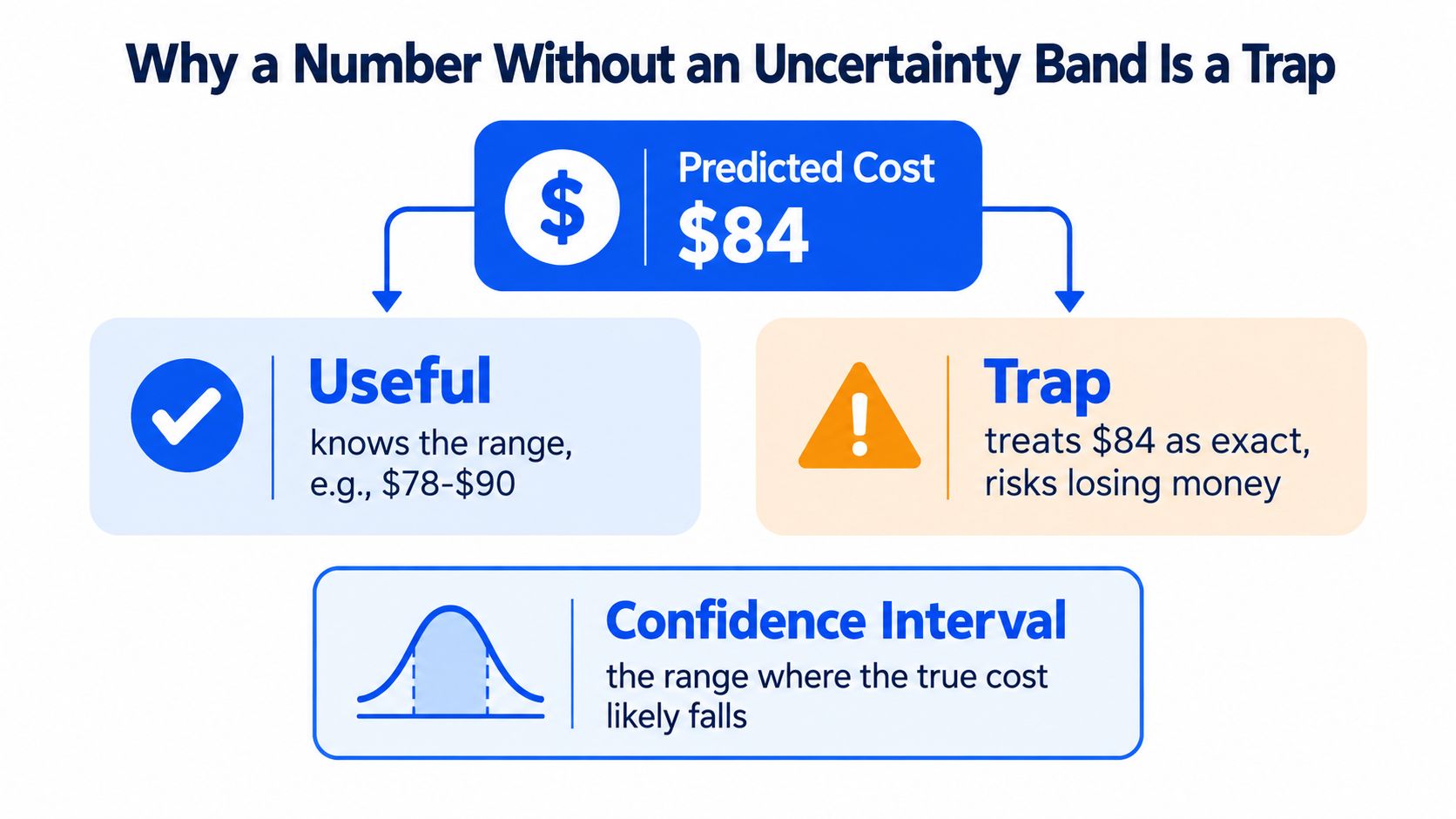
A model that prints one price and nothing else is hiding the most useful information. You don't just need a predicted cost. You need to know how far that prediction might move.
Say the model predicts a part at $84. If its range is tight, you can probably quote it quickly. If the range is wide, treating $84 as exact is how a shop wins work and loses money on it.
What a Confidence Range Tells You
The U.S. National Institute of Standards and Technology makes the point that an estimation method should assess how much an estimated value may fluctuate because of noise in the data, and that estimates can carry confidence intervals, in NIST guidance on estimation and uncertainty. In plain language, the estimate and your confidence in the estimate are two different things. You need both before you send a price.
When you break a quote into material, machine time, labor, finishing, and overhead, uncertainty usually lives in one or two of those buckets. A clear breakdown of your cost structure makes it easier to see which bucket is creating the risk.
Calibration Is the Follow-Up Question
Then ask whether the model's confidence means anything. That's calibration. If the system treats a group of quotes as high confidence, did past jobs in that group land close to the estimate? Scikit-learn identifies proper scoring rules such as Brier score and log loss as measures that assess calibration and discrimination together, and notes cross-validation is used to generate unbiased predictions for fitting a calibrator, in scikit-learn's calibration documentation.
Shop rule: Narrow band plus a well calibrated history means fast-track it. Wide band, new material, or thin history means a human reviews it first.
Check calibration by material family, machine group, and order quantity, not just in total. An overall average can hide a model that's reliable on aluminum brackets and shaky on stainless work.
Three Real Parts and What the Estimator Sees
Abstract ideas get clearer when you put real parts on the bench. Here are three jobs a mixed CNC and fab shop sees every week.
A Turned 6061-T6 Bushing With a Tight Inside Diameter
The drawing shows a small cylindrical sleeve in 6061-T6 aluminum. Geometry extraction reads the diameter, length, and the tight ID tolerance. The cost model predicts a short turning cycle, which is reasonable. Then it flags tolerance as a cost driver, because finishing, rework risk, and inspection effort rise even when cutting time stays low.

A human makes the final call here. Can your lathe and your inspection process hold that ID at the quoted quantity, or does the quote need added time? The model surfaced the driver. Your estimator owns the answer.
A 304 Stainless Bracket With Four Bends
This one's sheet metal, 0.062 inch 304 stainless, with two holes sitting near an edge. Material selection alone changes the estimating range. Guidelines list stainless steels 304 and 316 from approximately 0.024 to 0.119 inches, and for material over 0.036 inches the recommended hole distance from an edge rises to 0.125 inches to reduce distortion, according to FacFox sheet fabrication guidelines.
Getting the material inputs right is where a structured approach to estimating material cost inputs pays off. The model reads thickness and hole spacing, notices the part sits outside your usual bracket mix, and routes it for review instead of auto-pricing it.
A Precision Housing That Needs Outside Anodize
The third job is a machined housing with a specified anodize finish. Extraction picks up material and finish codes. The prediction comes back with finishing, not machining, as the dominant driver, because outside processing adds cost, handling, and lead time risk.
Tolerance makes that gap wider. One precision metal guide notes new sheet equipment typically holds dimensions within 0.005 inches and bends within 0.5 degrees, while another allows about ±0.030 inches across multiple bends, in H&S Manufacturing's guide to precision metal cost drivers. If the drawing demands tighter results than your normal process, your estimator needs to see that before the quote promises it.
In all three cases, estimator machine learning drafts and flags. The person still decides.
Where Machine Learning Estimating Quietly Goes Wrong
The dangerous failure isn't one bad quote. It's a model that learns the wrong lesson from your history and repeats it efficiently.
Your quote log probably contains relationship pricing, rush jobs priced without a real cycle estimate, and old material rates. It may also lump different machines, operators, and setups into the same column. NIST identifies industrial big data complexity, heterogeneous systems, and trustworthy operation as central barriers to manufacturing AI adoption, in its NIST roadmap for AI in smart manufacturing. That description fits a typical job shop spreadsheet uncomfortably well.
Fixes You Can Make Before You Trust the Output
Separate machine groups: Don't let a VMC job and a Swiss lathe job teach the model the same cost lesson.
Mark exception jobs: Tag rush work and loss leaders so they don't become normal pricing.
Keep material rates current: Old rates produce confident, outdated quotes.
Exclude incomplete records: Jobs missing operations or finish data shouldn't train anything.
Careful review of engineering drawings before a quote enters your history keeps bad geometry and missing notes from becoming bad training data later.
More automation isn't always the goal. A model that auto-quotes every RFQ can amplify bad historical pricing. A model that flags novel parts often protects margin better.
NIST also distinguishes explainability from interpretability, stressing visibility into training data and model behavior so organizations can explain AI actions to end users, in NIST guidance on trustworthy AI characteristics. For quoting, that means editable assumptions and a version history, not one unexplained AI price.
A Shop Owner's Checklist for Trusting an ML Estimator
Before you turn any system loose on live RFQs, run five checks.
Visible inputs: Can you see what the model is predicting from, including material, operations, and finish?
Editable assumptions: Can your estimator change extracted inputs without fighting the software?
Confidence range: Does every prediction show a band, not just a single number?
Escalation path: Do low confidence quotes route to a human automatically?
Version history: Can you show a customer what changed between quote revisions?
If those five hold, estimator machine learning becomes a way to clear standard parts quickly and put your estimator on the jobs that need judgment.
If your Tuesday mornings look like the one described here, Uptool can help you parse incoming emails, CAD files, drawings, and BOMs into organized, editable estimates with your materials, operations, markups, and revision history kept in one place. Visit the site to see how the RFQ to quote workflow works with your estimators still in control of the final price.
