Friday afternoon, a 200-piece aluminum bracket quote goes out before the shop closes. The blank price came from a quick supplier check, cycle time was estimated from a similar job, and overhead received the same multiplier used on last week's quote. The shop wins the order, then discovers that setup, scrap, tooling, and finishing have turned a profitable-looking part into a loss.
That situation isn't caused by one bad calculation. It comes from treating a cost structure breakdown as a list of percentages instead of a quoting allocation model. The useful question isn't only, “What share belongs to material or labor?” It's, “Which cost moves with quantity, which cost is fixed, and where have we hidden the burden?”
Table of Contents
Why a Cost Structure Breakdown Matters Before You Quote
A quote can look reasonable and still be wrong at the moment it leaves your inbox. On the bracket above, a guessed machine time and a familiar overhead multiplier created a price that appeared defensible. The loss emerged later, when the team charged the job with its actual setup time, material yield, scrap, tool consumption, and outside finishing.
That's why the breakdown has to come before the selling price. It forces the estimator to record the assumptions that usually disappear inside a single unit price:
Material yield: What stock size must be purchased, and how much becomes usable parts?
Setup allocation: How many programming, fixturing, and first-piece hours are spread across the run?
Process time: What does the machine run, including loading, probing, tool changes, and handling?
Quality exposure: What scrap and rework allowance fits the tolerance, material, and process?
Outside operations: Are anodizing, powder coating, deburring, plating, or inspection included?
Commercial burden: Which overhead costs are recovered through the quote, and on what base?
A manufacturing cost structure traditionally centers on materials, labor, and overhead. In practice, shops also need separate visibility for energy, tooling, maintenance, depreciation, scrap, and rework, especially in metal forming and machining. A manufacturing cost breakdown guide places direct materials at 40% to 60% of total manufacturing costs, direct labor at 10% to 20%, and manufacturing overhead at 30% to 40%. Its metal forming breakdown also separates material, labor, energy, depreciation, tooling, maintenance, scrap, and plant overhead, showing why a generic three-line estimate can conceal real process risk. This manufacturing cost structure reference provides the underlying framework.
Practical rule: If a cost affects the job but doesn't have a line on the estimate, it hasn't been managed. It's merely being hoped away.
The breakdown also gives the owner a clear answer when a customer asks why a quote changed. You can point to a material grade, a revised batch size, a new finishing requirement, or a cycle-time assumption instead of defending a mysterious price. It separates earned margin from accidental margin. A job that makes money because scrap happened to be low isn't priced the same way as a job whose process was modeled correctly.
The Building Blocks of a Shop Cost Structure
Build the estimate the way a machinist builds the part, one operation at a time. Start with the inputs that physically enter the job, then add the resources required to convert them, followed by the burden needed to keep the shop available.
Start with what the job consumes
Direct material is the stock that becomes the part, plus the purchasing reality around it. For CNC work, use the actual bar, billet, plate, or blank size rather than the finished volume. For sheet metal, account for the purchased sheet, nesting yield, remnant loss, dropped parts, and any buy-to-forge or saw-cut waste. A material calculator such as Uptool's estimating material cost resource can help standardize the input rather than relying on a memory-based allowance.
Direct labor covers the people doing identifiable work for the job. That may include programming, setup, loading, deburring, welding, inspection, and packing. Use a loaded labor rate that includes the employment burden. A wage-only number makes labor look cheaper than it is.
Machine time deserves its own line. The rate should reflect the machine's depreciation, energy, coolant, maintenance, and machine-specific consumables. A CNC lathe, a three-axis VMC, and a horizontal machining center don't create the same hourly economics, even if the operator wage is identical.
Keep job-specific costs visible
Tooling belongs beside the process that consumes it. Inserts, drills, end mills, taps, forming tools, saw blades, and dedicated fixtures shouldn't disappear inside general overhead. If one job consumes a costly face mill or requires a special form tool, assigning that expense to the month hides the job's actual margin.
Scrap and rework also need explicit treatment. A scrap allowance isn't a promise that parts will fail. It's a controlled estimate of process exposure, based on material, tolerance, setup complexity, inspection requirements, and the shop's own history. Finishing should be separated into deburr, anodize, powder coat, plating, blasting, brushing, or other operations, then priced as an outside-service cost plus any handling and inspection.
The remaining indirect expenses roll into overhead. That bucket can include supervision, rent, insurance, software, sales activity, estimating time, administration, preventive maintenance contracts, and unused capacity. The mistake isn't having overhead. The mistake is making it impossible to see what overhead contains.
Cost Component | What It Captures | Typical Share of Quote |
|---|---|---|
Direct material | Purchased stock, yield, remnant loss, and material scrap | Job-dependent |
Direct labor | Programming, setup, operation, welding, deburring, and inspection labor | Job-dependent |
Machine time | Spindle or processing time plus machine burden | Job-dependent |
Tooling | Inserts, drills, mills, taps, forming tools, and dedicated fixtures | Job-dependent |
Scrap and rework | Expected process loss and correction work | Job-dependent |
Finishing | Anodizing, powder coating, blasting, plating, deburr, and handling | Job-dependent |
Overhead | Rent, supervision, software, insurance, sales, estimating, and idle capacity | Allocated |
The table is useful only if the shop defines each line consistently. A “machine” line that includes labor in one quote and excludes it in another isn't a rate. It's bookkeeping theater.
Fixed Costs vs Variable Costs in a Job Shop
The fixed-versus-variable split controls how a quote behaves as quantity changes. Percentage labels can describe the past, but this classification helps you price the next job.
Fixed costs generally don't move with quantity in the short term. Rent, CAM seats, ERP subscriptions, salaried estimating, depreciation, and maintenance contracts continue whether a machine runs lightly or heavily. A $400,000 horizontal machining center has the same purchase burden whether it cuts chips for one shift or three, even though utilization changes the amount recovered per productive hour.
Variable costs rise with production. Raw material, cutting tools, inspection effort, finishing, packaging, and actual spindle hours belong here. Some costs sit between the two. An operator may be a fixed short-term payroll cost during a quiet week, then become variable when a long production run requires overtime or another shift.
The bracket setup shows why this matters. A three-hour setup allocated across 200 parts adds $6 per part, while the same setup spread across 2,000 parts adds $0.60 per part. Those figures come directly from setup hours divided by quantity, not from a universal shop percentage. Tooling can behave like a step cost too. If one insert handles roughly 800 parts, the tooling allocation changes when the run crosses that practical consumption threshold. The machining estimator framework from DFMA separates material, setup amortized over batch size, machine rate multiplied by cycle time, tool wear, and secondary operations for precisely this reason.

Tag each spreadsheet line as fixed, variable, step, or mixed. Then test the same process at prototype, repeat, and production quantities. If the unit price barely changes when the batch grows, the model probably isn't allocating setup, tooling, or outside services correctly.
Worked Example One, CNC Machined Bracket
A 6061 aluminum bracket can look inexpensive until the quote includes setup, inspection, tooling, and handling. Start with a $18.50 4 x 4 x 1 inch blank. The CNC cycle is 22 minutes at $1.40 per minute, including spindle time, coolant, and depreciation. Direct labor takes 12 minutes at $1.05 per minute for the programmer-operator's work before and after cutting.
The tooling package includes one 3/8-inch carbide end mill amortized over 400 parts, a spot drill, and two taps. Setup takes 75 minutes and must be allocated across the lot rather than hidden in a general percentage. Material allowance, tool cost, scrap exposure, secondary work, overhead, and margin remain separate inputs. Use the shop's rate card and process history for those values.
The arithmetic that changes the quote
Direct machine cost is 22 × $1.40 = $30.80 per part. Direct labor is 12 × $1.05 = $12.60 per part. The blank adds $18.50, before the shop applies its yield or scrap allowance.
Setup allocation changes with quantity:
10 pieces: 75 minutes divided by 10, or 7.5 setup minutes per part.
50 pieces: 75 minutes divided by 50, or 1.5 setup minutes per part.
250 pieces: 75 minutes divided by 250, or 0.3 setup minutes per part.
The end mill and smaller tools also cost less per part as the run grows, provided the estimator allocates them by expected consumption. Folding them into blanket overhead hides the lot-size effect. A machining model should keep material, labor, tooling, machine time, setup, overhead, inspection, and scrap visible. Overhead may be applied as a surcharge on direct costs, but the method changes the final price more than a generic percentage does. As noted earlier, manufacturing overhead can be substantial relative to direct labor, so a labor-only quote can understate the job.
Cost Component | 10 pcs ($) | 50 pcs ($) | 250 pcs ($) |
|---|---|---|---|
Material blank | 18.50 | 18.50 | 18.50 |
Machine time | 30.80 | 30.80 | 30.80 |
Direct labor | 12.60 | 12.60 | 12.60 |
Setup allocation | 75-minute setup divided by 10 | 75-minute setup divided by 50 | 75-minute setup divided by 250 |
Tooling | Tool package divided by 10 | Tool package divided by 50 | Tool package divided by 250 |
Scrap and rework | Shop allowance | Shop allowance | Shop allowance |
Overhead | Applied rate | Applied rate | Applied rate |
The visible 22-minute cycle is only one part of the job. Probing, workholding, deburring, tapping, tool changes, first-piece inspection, and outside finishing can move the quote more than the blank price. If the drawing requires anodizing or another finish, include the vendor cost and handling separately rather than burying both in machine time.
For repeatable quoting, place Uptool's machining cost calculator beside CAM timing, tooling records, and approved machine rates. It does not replace estimator judgment. It gives the shop a consistent way to expose assumptions, compare lot sizes, and see which allocation choices change the selling price.
Worked Example Two, Sheet Metal Panel with Finishing
A stainless panel can look inexpensive on the flat pattern and still produce a poor quote. The cost moves through a sequence of cutting, forming, welding, masking, and finishing, so the estimate must allocate each operation to the part rather than treat sheet metal as one material bucket.
Use a 304 stainless panel with material priced at $0.18 per square inch. Add a 12% scrap allowance for remnant loss and a dropped part. Laser cutting takes 3.2 minutes at $4.20 per minute, forming requires four hits and two minutes, two spot welds take eight minutes by hand, and a grained blast with masking costs $22 flat.
Allocate the direct inputs as follows:
Material: Area × $0.18, then add the 12% scrap allowance.
Laser: 3.2 × $4.20, or $13.44.
Forming: Four hits, with two minutes of forming time assigned to the panel.
Spot welding: Eight minutes of hands-on work.
Finishing: $22 for the grained blast and masking.
Overhead: Apply the shop rate after cell work and outside finishing are captured.
For a quantity of one, the example totals near $74. Labor and finishing drive more of the result than the stainless price. One sheet metal cost calculation guide assigns materials 25% to 40%, labor for cutting, bending, and welding 40% to 55%, and surface finishing 10% to 25% of total cost. This sheet metal cost calculation guide illustrates why a material-only estimate can miss the largest cost block.
Cost Component | Amount ($) | % of Total |
|---|---|---|
Stainless material | Area × 0.18, plus 12% scrap allowance | Job-dependent |
Laser cutting | 3.2 × 4.20 = 13.44 | Job-dependent |
Forming | Four hits, two minutes | Job-dependent |
Spot welding | Eight minutes by hand | Job-dependent |
Grained blast and masking | 22 flat | Job-dependent |
Direct labor and cell handling | Included in operation time | Job-dependent |
Overhead | Applied shop rate | Job-dependent |
Two quotes for the same drawing can diverge by 30% if one estimator leaves out the finisher. Published fabrication pricing separates cutting, bending, welding, and coating rather than treating sheet metal as a single operation. A guide lists prototype laser cutting at $1.50 to $5.00 per cut, production laser cutting at $0.10 to $1.00 per cut, prototype CNC bending at $3.00 to $10.00 per bend, production bending at $0.50 to $3.00 per bend, welding at $5 to $50 per assembly, and powder coating at $1 to $20. This sheet metal fabrication cost guide supports separating each process in the allocation. The applicable figure still depends on vendor prices, batch size, geometry, and handling.
Overhead, Markup, and the Allocation Decisions That Move Margin
A CNC cell running at 60% capacity cannot recover its fixed burden the same way as one running at 90%. Rent, salaries, software, and insurance remain largely unchanged, but fewer productive hours carry those costs. The allocation model therefore changes the quote before markup enters the calculation.
Choose the denominator deliberately:
Direct labor dollars: Easy to administer, but it can load labor-light, machine-heavy work with too much overhead.
Machine hours: Fits CNC-intensive work, though it may leave office, inspection, and fabrication labor under-recovered.
Total direct cost: Covers more activity, but it can apply overhead to material the shop barely transforms.
Separate pools: Machine, fabrication labor, inspection, and administration can each use a rate closer to the resources they consume.
The same percentage can produce different selling prices when its base changes. A technical machining cost model describes overhead as a surcharge on direct costs and gives a broad manufacturing reference range of 60% to 150% of direct labor. Use that range only as a comparison point. The shop's own expenses, available hours, utilization, and process mix should set the rate.
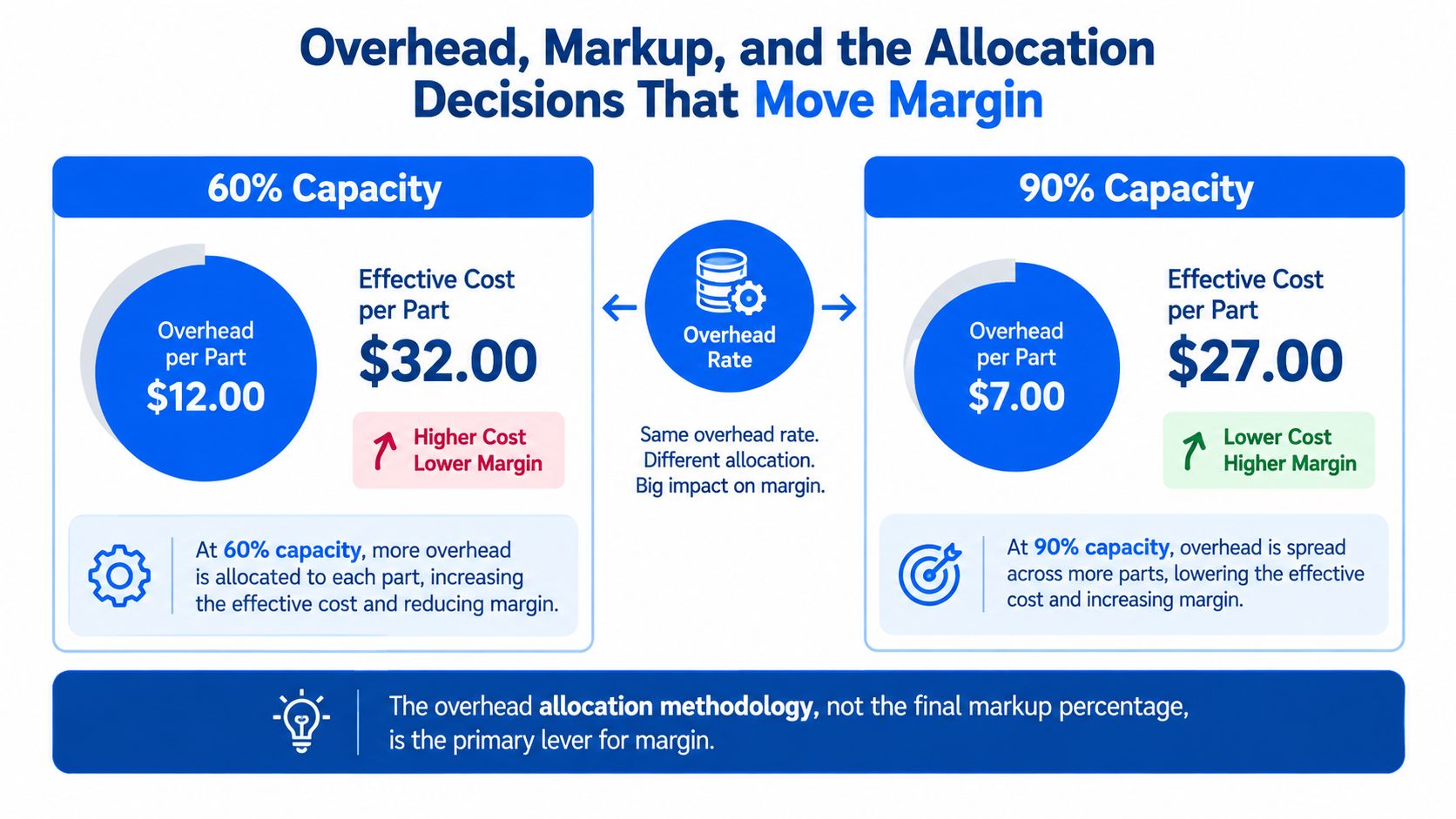
The arithmetic is easy to misread. With a $100 cost subtotal, a one-point overhead change applied to that subtotal changes cost by $1. A five-point markup change applied after costing changes the selling price by $5 on a $100 base. If overhead applies to a larger direct-cost base, however, its dollar effect may exceed the apparent markup adjustment. The allocation base and calculation sequence matter more than the headline percentage.
For the CNC bracket, keep material, machine time, labor, setup, tooling, and scrap constant. Run one scenario using the rate supported by a fuller production schedule, then another using the rate required during a quieter period. The resulting margin difference shows whether capacity recovery, rather than customer-facing markup, is moving the quote.
Broader operating practices are discussed in business cost reduction Australia. For a 10 to 30 person job shop, the usable rate still comes from local records. Include rent, supervision, software, maintenance, insurance, and realistic productive hours, then review the method when the shop's workload or process mix changes.
Making the Breakdown Fast Enough to Win the Quote
A cost structure breakdown earns its keep through traceability and speed, not maximum detail. In RFQ-heavy shops, quoting turnaround is itself a competitive variable. Recent manufacturing quoting benchmarks report average turnaround of 3.8 days for general job shops, 4.5 days for precision machining, and 2.4 days for sheet metal and fabrication, while top performers are around 1.2 days. These manufacturing quoting speed benchmarks also cite 11.5 hours spent on a complex RFQ, including 7.5 hours gathering and verifying data. Those figures explain why a perfect estimate that arrives late can lose to a sufficiently detailed estimate that arrives while the buyer is still comparing suppliers.
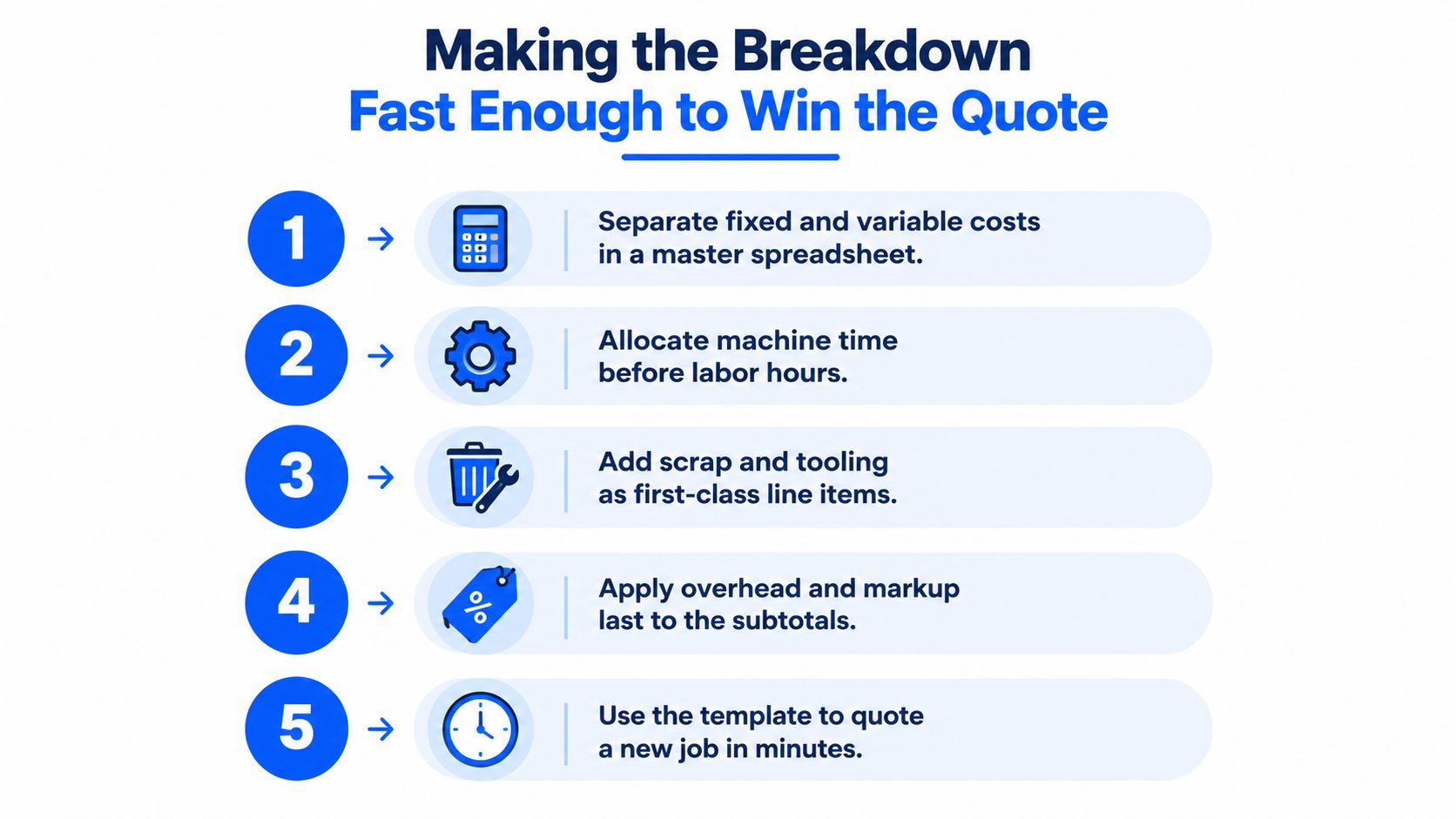
A 10 to 30 person shop can tighten the workflow without building a large costing department:
Maintain one rate card. Keep machine rates, loaded labor rates, standard outside-service prices, and approved overhead methods in one controlled file.
Standardize material yield. Create practical scrap and yield assumptions by material family, then revise them when actual jobs show a pattern.
Force the essential lines. Every quote should show material, direct labor, machine time, tooling, outside services, scrap, and overhead.
Use a review threshold. Spend extra estimating time on unusual tolerances, difficult finishes, new tooling, or uncertain cycle times. Don't overwork routine parts.
Record the assumption. Note where cycle time came from, who supplied the finish price, and what quantity was used for setup amortization.
The slowest part of many estimates isn't arithmetic. It's hunting through emails, old quotes, supplier messages, drawings, and spreadsheets. A quoting system such as Uptool can ingest RFQs from connected inboxes, analyze CAD, drawings, and BOM files, organize operations and material inputs, and produce traceable estimates and quote documents. It belongs in the tool conversation because it addresses the handoff and recordkeeping problem, not because software can replace a knowledgeable estimator.
The right target is a defensible number you can explain on a callback, not a false level of precision.
Don't spend twenty minutes debating electricity cost per spindle hour while a 15-minute setup repeats across 50 parts and remains unallocated. Fix the cost that changes the quote.
Putting It All Together and Your Next Quote
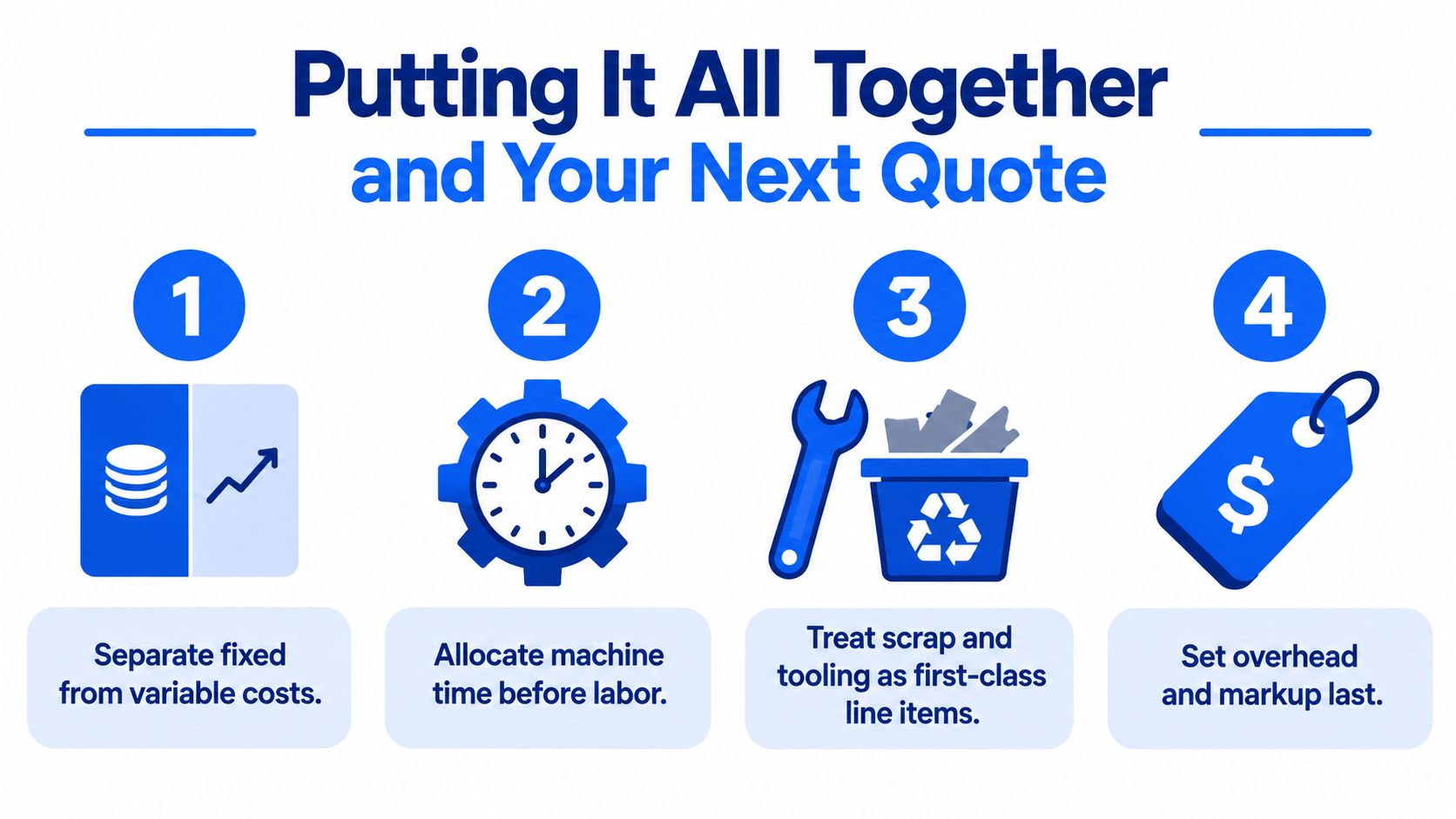
A useful cost structure breakdown makes four decisions visible. Separate fixed from variable costs, allocate machine time before labor, treat scrap and tooling as first-class lines, and set overhead and markup last. Those final percentages magnify every error underneath them, so they can't rescue a weak process model.
Before sending the next RFQ response, check:
Material: Confirm grade, buy size, yield, and remnant treatment.
Requirements: Confirm tolerance, inspection, deburr, and finish requirements.
Quantity: Confirm batch size and expected annual volume.
Time: Pull cycle time from CAM or a timed sample, not a similar-looking part.
Tooling: Allocate consumables per part or per realistic tool life.
Overhead: Apply the chosen method consistently to the intended cost base.
Margin: Adjust for risk, lead time, and uncertainty rather than hiding those factors in an unexplained multiplier.
Treat the breakdown as a repeatable shop habit. Each completed job gives you better cycle times, tooling consumption, yield assumptions, outside-service prices, and overhead evidence for the next quote.
If your shop is losing time piecing together CAD, drawings, BOMs, material prices, operations, and markups, visit Uptool to see how its AI-powered quoting workflow can organize those inputs into traceable estimates and professional quotes. Use it to build a consistent cost structure breakdown without taking estimator judgment out of the process.