Sheet metal and fabrication shops average 2.4 days per quote, while the average bid-win rate sits around 30%. A sheet metal instant quote attacks both problems by turning a qualified RFQ into a priced response in minutes, but only when the software knows which jobs it can price safely and which still need an estimator.
That distinction matters more than a polished upload screen. A fast wrong quote can lose margin faster than a slow quote loses an order. After moving from manual estimating to automated quoting, I found that the biggest change wasn't just speed. It was control over pricing rules, revisions, exceptions, and the evidence behind every number.
Table of Contents
What a Sheet Metal Instant Quote Really Means
A benchmark places average quote turnaround for sheet metal and fabrication shops at 2.4 days, compared with 3.8 days for general job shops, 4.5 days for precision machining, and 1.2 days for the top 10% across all shop types. Another industry summary puts typical fabrication quote turnaround at 3–4 days and average bid wins at about 30%. Those figures are reported in the manufacturing quoting speed benchmark.

A sheet metal instant quote is a priced response generated from an uploaded CAD file, drawing, or RFQ package. The software reads the part, identifies manufacturing features, applies the shop's material, machine, labor, finishing, markup, and lead-time rules, then produces a quote that someone can approve and send.
That's different from a form that returns a rough placeholder. A useful system should show the assumptions behind the price, retain the source files, record revisions, and distinguish a firm price from an estimate awaiting review. If the number changes after an estimator opens the drawing, the system should explain why.
What the system should actually do
A practical workflow usually follows four actions:
Read the input. The platform ingests CAD geometry, 2D drawings, BOMs, and the written RFQ.
Map geometry to operations. It identifies cutting, holes, bends, flanges, hardware, welding, inspection, and other required work.
Apply shop rules. It uses material, thickness, machine rates, setup assumptions, yields, finishing prices, and margin rules.
Return a traceable quote. The result includes price, lead time, assumptions, and a version that can be reviewed later.
The software isn't a substitute for engineering judgment on every part family. Claims about fully autonomous pricing for every geometry are hype, especially when drawings contain ambiguous tolerances, missing finish details, or revision conflicts.
Practical rule: Buy instant quoting to remove repetitive takeoff, not to remove accountability.
A strong platform makes the estimator faster and more selective. Instead of retyping dimensions from a print or copying values between spreadsheets, the estimator reviews exceptions, adjusts risk, and handles the customer conversation. A useful sheet metal fabrication quoting workflow should make that division of labor visible.
Why Quote Speed Shapes Your Win Rate
The economics are simple. If a shop spends several days preparing a quote and wins only around 30% of bids, most estimating labor doesn't become booked work. The Fabricator describes an average win-to-bid ratio around 30%, meaning roughly 70% of quoting effort becomes scrap from the estimator's perspective. Its discussion of a shop study covering 1,794 RFQs over one year also found that more than 50% of winning bids arrived within three days after the shop sent its bid. See The Fabricator's analysis of quoting and artificial intelligence.
That doesn't prove that every quote sent in minutes will win. It does show why delay is expensive. A buyer may compare several credible suppliers, and the first complete answer can shape the rest of the decision. If your quote arrives after the buyer has already aligned internally with another shop, a later price reduction may not recover the opportunity.
The hidden cost of waiting
Slow quoting creates more than an administrative burden:
Material assumptions age. A quote based on an old distributor price may protect neither margin nor customer expectations.
Lead times become less credible. Capacity changes while a quote sits in an inbox.
Engineering effort gets wasted. Your estimator can spend hours on a job the buyer has already awarded elsewhere.
Follow-up loses context. Manual threads make it harder to tell whether a revision, finish request, or customer answer was included.
The correct financial question isn't “How much does quoting software cost?” It is “How much qualified work does our current response process prevent us from pricing?”
I won't pretend the available data supports a precise revenue forecast for a typical shop. The requested comparison would require job values, quote volume, staffing, and a measured relationship between response time and win rate, and those facts aren't established here. A responsible owner should model the opportunity with actual shop data rather than insert invented revenue figures into a spreadsheet.
Response Time | Approx. Win Rate | Jobs Won / Month | Monthly Revenue |
|---|---|---|---|
2.4 days average | About 30% | Depends on actual quote volume | Depends on actual job value |
Under one hour | Must be measured in a shop pilot | Depends on actual quote volume | Depends on actual job value |
Same day | Must be measured in a shop pilot | Depends on actual quote volume | Depends on actual job value |
The useful version of this table is your own baseline. Record RFQs received, quotes issued, time to response, jobs won, average order value, and gross margin. Then compare those figures after automation. A quote-speed and win-rate measurement framework should separate faster responses from other changes, such as new customers, different work mix, or improved follow-up.
How an Automated Quoting Workflow Actually Works
An automated RFQ process should behave like a controlled production route, not a magic calculator. The sequence starts when a customer sends files and ends when an approved quote leaves the shop.
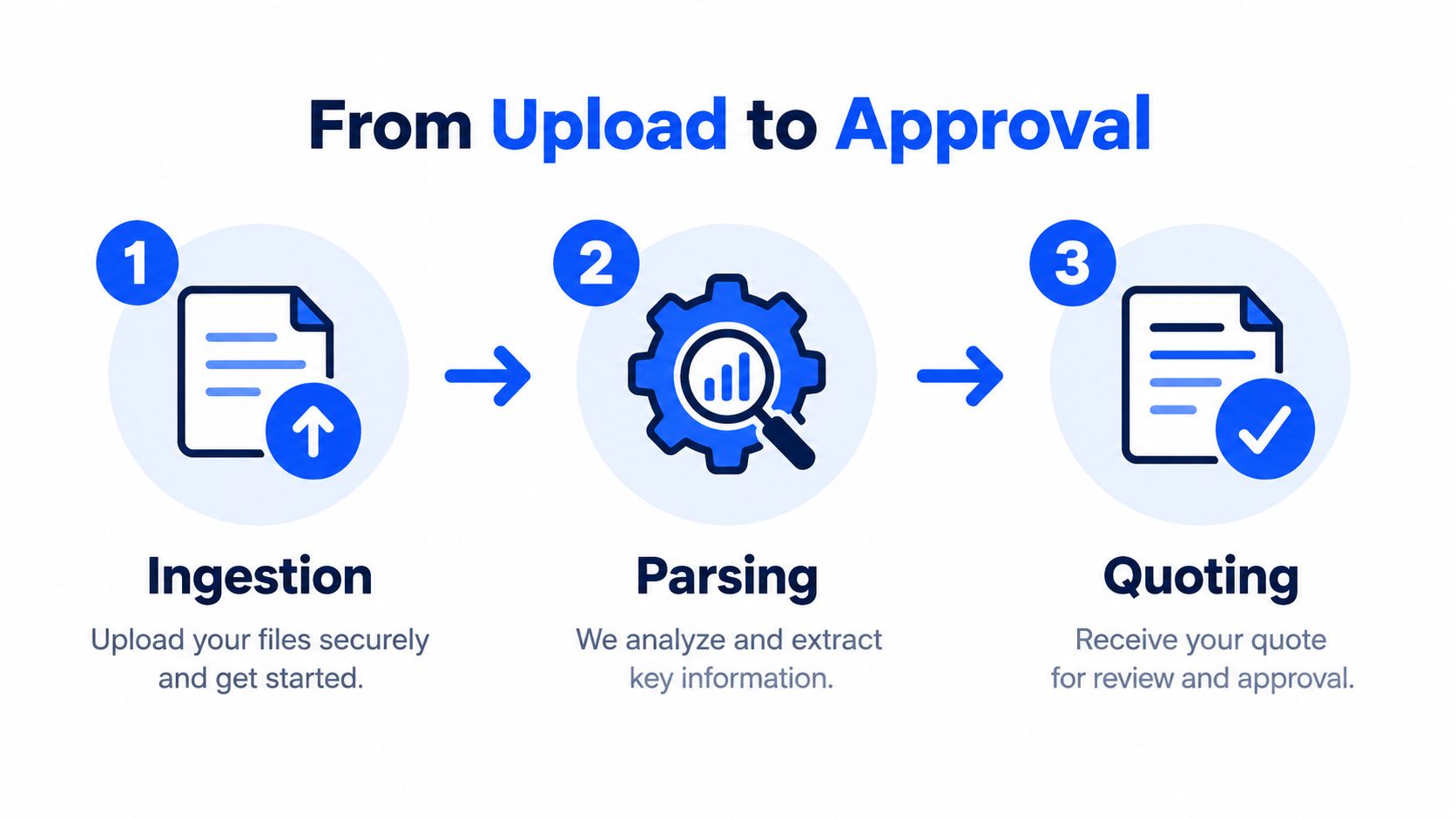
1. Ingestion creates the record
The customer uploads a STEP file, DXF, PDF, drawing, BOM, or a combination of files. The portal or connected inbox should attach those files to one RFQ, record when they arrived, and preserve the original request.
That timestamp matters. Without it, managers can't distinguish a slow estimator from an RFQ that arrived incomplete or changed several times.
2. Parsing turns geometry into manufacturing features
The software analyzes the file for bends, holes, cutouts, flanges, thickness, and other features. It should also identify uncertainty. A missing material grade, unreadable drawing note, conflicting revision, or unusual bend can route the job to review rather than produce a false sense of certainty.
File support matters. One quoting vendor describes analysis across more than 30 file formats, with processing beginning after upload and an instant quote generated from the uploaded information, as outlined on Quotation Factory's sheet metal quoting platform.
3. Costing applies the shop's economics
Geometry drives cut time, bend count, setup, material use, and yield. The engine then applies current stock prices, machine rates, labor assumptions, tooling, inspection, overhead, and margin. For CNC machining, a defensible cost model also separates setup and programming from quantity, then adds material, cycle time, tooling, inspection, finishing, packaging, logistics, yield loss, overhead, and margin, as described in this CNC machining quote cost breakdown.
4. Finishing and dispatch complete the quote
Powder coating, anodising, plating, hardware, welding, and other secondary operations should come from a maintained catalogue. The estimator then approves, edits, or holds the quote before sending a PDF or digital response.
The shift in my day was straightforward. I stopped spending most of my time on takeoff and data entry, and spent more time checking exceptions, explaining assumptions, and deciding whether a risk belonged in the price.
A practical automated quoting workflow should preserve that human checkpoint instead of hiding it.
Where Quote Accuracy Comes From in Sheet Metal
Fast pricing is only useful when the cost model reflects how the part will be made. A sheet metal engine starts with geometry, but accuracy depends on the chain from geometry to process time, material consumption, tolerances, and finishing.
Automated systems may use K-factors, bend deductions, tooling configurations, and nesting-based material optimization to convert a flat pattern and formed geometry into realistic inputs. OROOX describes these sheet-metal-specific calculations in its sheet metal quoting software overview. The point isn't the label “AI.” The point is whether the calculation matches your press brake, tooling, nesting habits, and material database.
Four rules I use to test a quote engine
First, geometry must drive operations. A simple profile shouldn't receive the same setup assumption as a part with many bends, tight hole placement, or added hardware.
Second, material needs identity. Alloy, thickness, surface condition, and stock form all affect cost. “Stainless” or “aluminum” isn't enough for a reliable price.
Third, tolerances must trigger risk. Published sheet metal guidance lists edge-to-edge and hole-to-hole minimums of 0.005 in for material under 0.13 in thick and 0.015 in for thicker stock. Bend-to-hole spacing can rise from 0.015 in to 0.025 in with thickness, according to Protolabs' sheet metal design guidelines. Those constraints can add setup, tooling, or inspection work.
Fourth, finishing can't be an afterthought. Powder coating setup, plating, cosmetic requirements, deburring, and inspection need explicit cost rules. A low cutting price can still become a losing quote after secondary operations.
Input | Typical Range | Common Error Source |
|---|---|---|
Laser cutting thickness | 0.5–10 mm | Quoting a part outside the shop's routine cutting capability |
Bending thickness | 0.5–6 mm | Applying standard press brake assumptions to unsuitable stock |
Forming tolerance | Around ±0.020 in | Treating a general tolerance as a guaranteed precision result |
Linear dimensions away from bends | Around ±0.005 in | Missing inspection effort or drawing-specific requirements |
Angularity | Around ±2 degrees | Failing to price tighter verification |
Surface roughness | Ra 125 µin max for blank material, Ra 100 µin max for timesave finishes | Ignoring cosmetic or finishing requirements |
The thickness ranges come from Hubs' sheet metal fabrication guide, while the tolerance and surface-finish references come from this sheet metal fabrication design guide. A quote is defensible when each input connects to a real operation. If the system can't show that connection, treat the result as a draft.
Manual Versus Instant Quoting Side by Side
Manual estimating gives experienced people flexibility. Automated quoting gives the shop repeatability. The decision isn't about replacing one with the other. It is about deciding which work deserves skilled attention.
Business Factor | Manual Quoting | Instant Quoting |
|---|---|---|
Response time | Often measured in days, especially for complex RFQs | Can produce routine priced responses in minutes |
Cost per quote | Estimator hours are consumed on every RFQ | Software cost is distributed across repeated workflows |
Traceability | Spreadsheets and email can fragment revisions | Versioned records can preserve files, assumptions, and approvals |
Consistency | Depends heavily on who prepares the estimate | Applies the same configured rules until someone changes them |
Exceptions | Strong when judgment and negotiation matter | Must route unusual work to a person |
Setup | Little system configuration, but much manual effort | Requires templates, libraries, rates, and ongoing tuning |
The 2.4-day average matters because every day gives the buyer more time to accept another supplier's answer. The 30% average win rate matters because a shop can't justify unlimited estimator effort on bids that don't convert. Those benchmarks are the economic case for automation, not proof that software alone will create a specific revenue increase.
The trade-offs owners should accept
Automation brings its own work. You must configure materials, thicknesses, finishing, bend rules, machine rates, lead times, and approval thresholds. Someone must maintain those rules when supplier prices, capacity, or process assumptions change.
Edge cases remain. A drawing with unclear weld requirements, a revision that changes the finish, or a high-risk tolerance callout can take longer to review than a standard part. That isn't a failure of the system. It is the correct boundary between repeatable pricing and commercial judgment.
My recommendation is firm: automate standard work aggressively, but make exception handling visible. The best system wins on speed, consistency, and auditability. A skilled estimator still wins on ambiguity, negotiation, and risk.
A Buyer's Checklist for Evaluating Instant Quote Software
Don't buy from a demonstration built around a clean sample file. Give vendors the messy RFQs your shop handles every week and score the answers.
CAD and drawing parsing
Ask whether the platform reads STEP, DXF, PDF, drawings, and BOMs, and how it handles missing or conflicting information. A strong answer includes a visible exception queue and preserved source files. A weak answer produces a number without showing which notes or features it ignored.
Pricing inputs and template depth
Check whether your team can edit materials, thicknesses, bend allowances, machine rates, nesting assumptions, tolerances, labor, and finishes without developer help. Ask how the system prices powder coating, anodising, plating, welding, hardware, inspection, and packaging.
The rules need to reflect your shop, not an average shop. If every adjustment requires a vendor ticket, the database will drift.
ERP, scheduling, and CRM integration
Find out where approved quotes go next. The useful connection includes customer records, inventory or material references, capacity and lead-time assumptions, accounting, and revision history. A disconnected quoting tool can create a faster front end and a messier handoff.
Reporting and governance
Require win and loss tracking, margin by part type, quote ageing, estimator workload, revision history, and an audit log. The platform should show who changed a rate, when the quote changed, and which version the customer received.
Security and support
Ask how uploaded CAD, drawings, customer information, and proprietary BOMs are handled. Review access controls, retention, export options, support response, implementation ownership, and the process for restoring or correcting a bad rule.
The two essentials are an editable rules engine and a real pilot using your RFQs. A vendor should let you compare automated results with historical quotes before you commit. Uptool is one option in this category. It reads RFQs from connected email, analyzes CAD, drawings, and BOMs, and supports configurable estimating and quote workflows.
When to Trust the Software and When to Keep a Human in the Loop
Instant quoting fits repeatable work best. I trust the system with simple laser-cut parts, standard brackets, repeat orders, and jobs where the material, thickness, finish, and tolerance already match a maintained template.
I don't trust an automatic price just because the file uploaded successfully. A clean-looking model can hide a missing certification, an unusual alloy, an inspection requirement, or a costly assembly assumption.
Job Characteristic | Let Software Quote | Estimator Review Required |
|---|---|---|
Geometry | Simple profiles and repeatable brackets | Complex assemblies or ambiguous features |
Material | Catalogued alloy and thickness | Exotic alloy or unstable supplier pricing |
Tolerance | Standard shop tolerance | Tight GD&T, especially below ±0.005 in |
Finish | Standard, catalogued finish | Cosmetic, special, or undefined finishing |
Compliance | Routine commercial work | AS9100, ITAR, or certification-sensitive work |
Assembly | Defined hardware and weld operations | Undefined weld, hardware, or assembly costs |
Revision status | Confirmed current revision | Revision conflicts or incomplete drawing package |
The decision rule is easy to teach. If material, thickness, finish, and tolerance all match catalogued templates, let the system prepare and send the quote under your approval policy. If any of those inputs vary, route the RFQ to an estimator.
That doesn't reduce the estimator's value. It changes the job. The estimator prices risk, exceptions, revisions, and customer-specific commitments instead of rekeying standard work.
The human checkpoint belongs where the cost of being wrong is high, not where the data entry is repetitive.
Revision handling deserves special attention. A new drawing should create a new quote version, preserve the prior assumptions, identify changed features, and prevent an old price from being sent accidentally. If the software can't do that, keep manual control until it can.
Switching to Instant Quoting Without Disrupting the Shop
Start with the rule library, not the customer portal. Load standard materials, thicknesses, finishes, bend allowances, machine rates, setup assumptions, inspection costs, and lead-time rules before sending live RFQs through the system.
Then choose a pilot made up of repeat parts. A practical pilot can cover 20 to 30 repeat parts, as specified for this rollout plan, and compare automated results with historical winners and losers. Use the comparison to find missing material codes, weak finish rules, incorrect setup assumptions, and margin gaps.
A controlled rollout
Clean the source data. Remove duplicate spreadsheet rows, standardize finish codes, resolve inconsistent material names, and separate nested BOMs into understandable operations.
Run the pilot. Compare price, lead time, operations, and assumptions against prior quotes and actual jobs.
Run both systems in parallel. For 30 to 60 days, have estimators approve every system-generated quote before it reaches the customer.
Review the exceptions. Don't just correct the price. Record why the system missed, then update the relevant rule or template.
Set the release policy. Define which part families can go straight through, which need approval, and which always require estimator review.
Track the measures that expose economics rather than vanity. Record average quote turnaround, quote-to-order ratio, estimator hours per quote, and gross margin variance. Review the results at a 90-day checkpoint and decide whether automation is improving response without weakening margin or traceability.
The change should feel boring to the shop floor. Production should receive cleaner travelers, sales should see clearer status, and estimators should spend less time hunting through email. If automation creates confusion downstream, the RFQ workflow isn't finished.
Uptool helps CNC machining and fabrication shops organize incoming RFQs, analyze CAD, drawings, and BOMs, and build traceable estimates and professional quotes. Visit Uptool to test whether its configurable workflows fit your sheet metal quoting process before you replace the parts of estimating that still require judgment.