The first vendor to respond doesn't just get attention, it gets the deal. In one manufacturing benchmark, sub-5-minute responses closed 32% of quotes, while responses that took more than 24 hours closed 7% Optif AI manufacturing benchmarks. That gap is the story behind quoting speed win rate. If your CNC shop, sheet metal shop, or finishing operation is still treating quoting like an after-hours paperwork chore, you're handing work to whoever moves first.
Table of Contents
The Quoting Speed Win Rate Connection Shop Owners Cannot Ignore
A lot of owners know quoting is slow. Fewer know how much money that slowness burns. The cleanest benchmark from the manufacturing data is simple, the win probability is highest when an RFQ is answered within the first 4 hours, then it drops sharply between 4 and 24 hours, and it approaches baseline after 48 hours Go Autonomous analysis. That's not a small process tweak. That's a threshold.
Speed is not a nice-to-have
If you run a shop, you already know the pattern. A buyer sends prints to several vendors, one shop replies fast, and the rest are fighting for leftovers. The data backs up what owners have seen for years, the first vendor to respond wins 35% to 50% of B2B sales, and in another benchmark, the first responder wins 78% of the time when multiple vendors are compared for the same service Tangle research summary. In manufacturing, best-in-class teams don't just move faster, they move into a different bracket altogether.
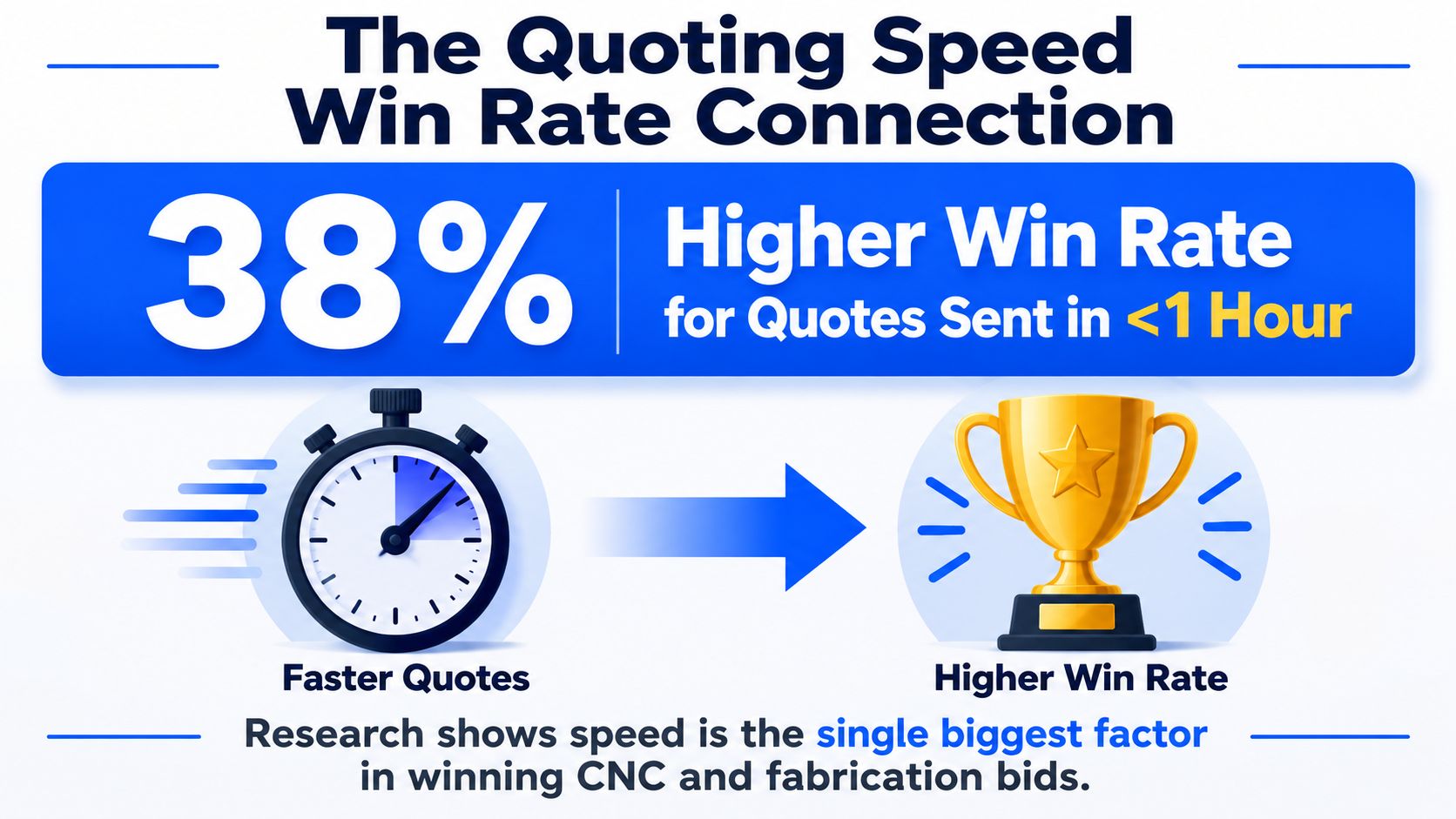
A simple example makes this real. Shop A answers a laser-cut part RFQ in two hours with a clean quote. Shop B answers the same RFQ the next day, even if its price is fine. Shop A is the one the buyer remembers as responsive, organized, and easy to work with.
Practical rule: if a quote can't get out fast, the process is broken somewhere upstream, not in the final email.
The internal link that explains the opportunity cost of delay is worth your time, too. Read why slow quoting is costing U.S. machine shops work if you want the same problem framed from a shop-floor perspective.
What Happens Between RFQ Arrival and Quote Sent
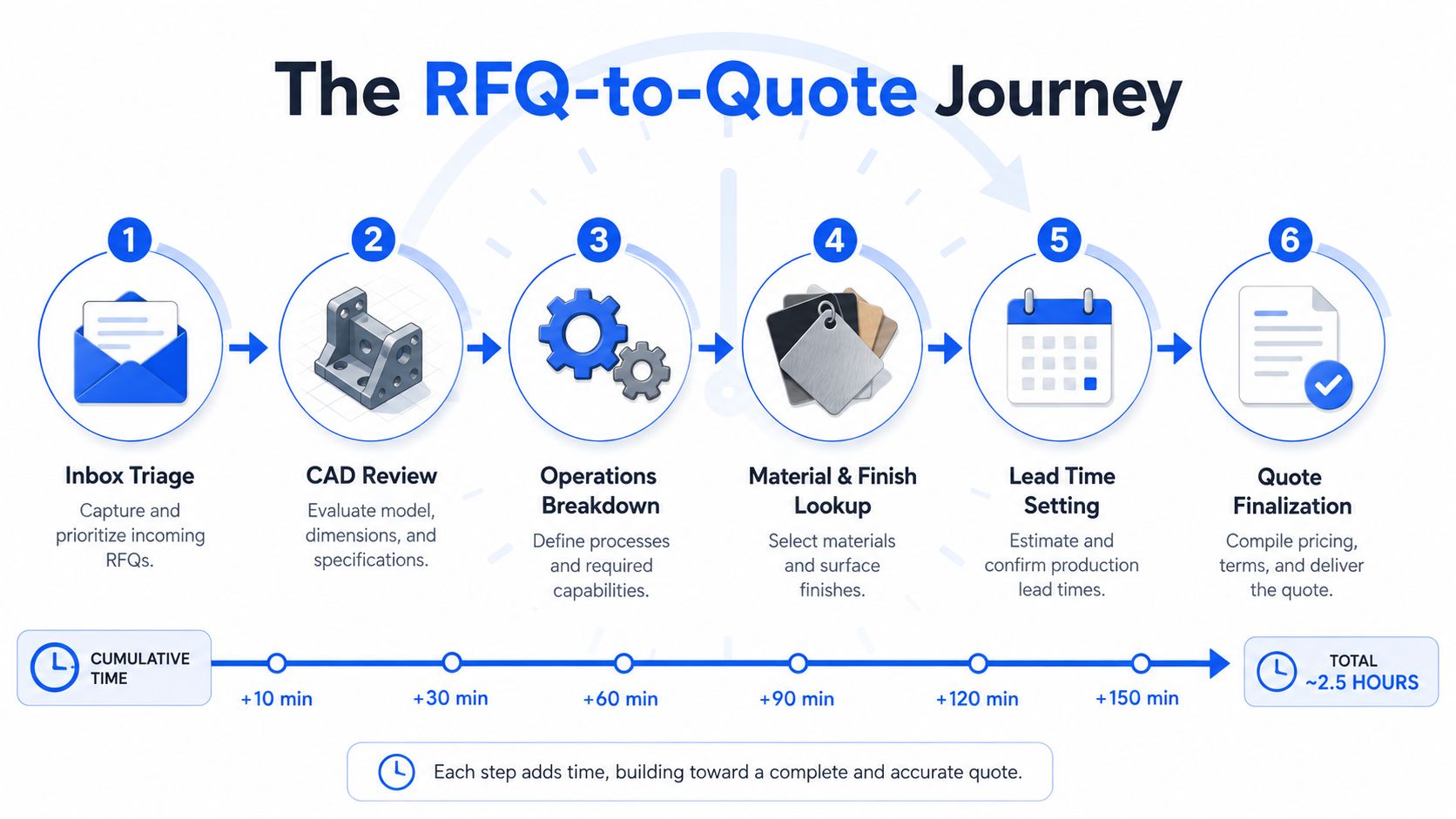
An RFQ does not stall because one person moves slowly. It stalls because the work crosses too many hands and every handoff adds waiting. The inbox gets checked, the print gets reviewed, the job gets interpreted, then someone has to chase material, finishing, lead time, and approval details.
The usual chain of small delays
First is inbox triage. Someone has to notice the RFQ, decide it is real, and assign ownership. If it lands in the wrong inbox, time is already gone before anyone opens the file.
Then comes CAD and drawing review. The estimator checks dimensions, tolerances, material callouts, revision history, and anything that changes the job. After that comes operations breakdown, where the shop decides what gets cut, bent, welded, machined, deburred, or finished in-house versus outsourced.
Material and finish lookup usually slows things down next. Stock gets checked, supplier lead times get confirmed, coating options get compared, and the finishing partner's turnaround gets added to the picture. The last step is quote assembly, where all the pieces are turned into price, lead time, and a customer-facing document.
The hidden cost is the pauses between steps
Shop owners often audit one step at a time. That misses a key bottleneck. The delay usually comes from the stack of tiny pauses, waiting for a file, waiting for clarification, waiting for someone to remember the right finishing code, waiting for the estimator to return after lunch. By the time the quote goes out, the buyer may already be talking to someone else.
That is why workflow tools matter. Platforms that centralize RFQs, parse drawings, and organize quote data remove the scavenger hunt from the front half of the job. If you are looking at AI proposal generation tools, judge them on whether they cut hand entry and speed up the first pass, not on whether they make the quote look nicer.
A good quoting workflow does not start with pricing. It starts with getting every RFQ seen, sorted, and attached to the right job fast enough to matter.
How Buyers and Engineers Actually Choose a Shop
Buyers and engineers are moving faster than they used to, and they want a fast digital procurement process. They're not patiently waiting for one shop to finish its internal debate. They're sending the same print to several vendors at once, usually through email or a procurement portal, and they're watching for who replies first with something complete and credible.
The first complete answer gets the best hearing
If you're on the buyer side, speed changes the conversation. A prompt quote signals that the shop is organized, reachable, and able to handle future changes without chaos. A late quote, even a good one, feels like extra risk because the buyer has already formed a shortlist and started mentally eliminating laggards.
That's why “complete” matters as much as “fast.” A buyer doesn't want a rough guess that creates more email back-and-forth. They want the key manufacturing details handled in one pass, material, finish, lead time, and any obvious caveats that affect the order.
What a buyer considers complete
A professional quote for CNC machining or sheet metal fab needs to do a few things at once. It has to look organized, reflect the print correctly, and show that someone understood the job. If a quote arrives fast but misses revision notes, ignores finish requirements, or leaves lead time vague, it still loses.
For shop owners, that means the job is not to “reply faster” in the abstract. The job is to deliver a credible answer before the buyer's shortlist hardens. That's the window you're trying to own.
If you work with public-sector or tender-heavy customers, the same logic shows up in procurement too. Resources like SME government contract help can be useful when you're trying to understand how buying teams compare vendors and why a timely response matters so much.
Buyers don't reward the fastest sloppy quote. They reward the first quote that feels safe to move forward with.
The Speed Windows That Move Win Rate
Owners do not need another vague claim about speed. They need the shape of the window. Research from Go Autonomous analysis shows the highest win probability lands in the first 4 hours after an RFQ arrives, then drops hard between 4 and 24 hours, and settles near baseline after 48 hours. A separate benchmark from Optif AI manufacturing benchmarks points the same way, with manufacturers seeing 38% to 42% win rates inside 24 hours and 10% to 15% by five days.
Speed wins different battles at different moments
The first hour is about presence. The buyer sees your shop, your response, and whether someone on your side is awake enough to handle the work. The rest of the day is about momentum. Once a buyer has a couple of quotes in hand, your late response has to fight for attention against vendors who already made the process easier.
That is why the target is not “same day if possible.” The target is the buyer's first decision window. UK manufacturing benchmarks show the same pattern, with top teams returning quotes in 48 minutes and closing 46% of those quotes, compared with an industry average close rate of 23% UK manufacturing quoting benchmarks. If your shop misses that early window, you are asking price and capability to do work speed should have done first.
The speed curve your shop should care about
Window | What it means in practice | Why it matters |
|---|---|---|
First 4 hours | Buyer still notices who replied fast | Best shot at staying in the shortlist |
4 to 24 hours | Buyer has started comparing vendors | Every extra hour adds friction |
24 to 48 hours | Late reply, even if accurate | Credibility starts to fade |
After 48 hours | Response looks routine, not urgent | You are no longer buying attention |
That curve is why a faster quoting workflow is not a nice-to-have. It is a shop-level decision. A team that can send a clean response inside the first business hours protects more opportunities than a team that spends all day polishing a quote no one sees until tomorrow. If you need a practical way to compress that window, this guide to quote-us AI for faster, better quotes is worth using with the person who owns quoting.
The Hidden Loss Most Shops Never Measure
Many shop owners watch average quote turnaround time and miss the bigger leak, RFQs that never turn into quotes at all. That gap costs real work, and it often hides inside a process that looks fine on the surface.
Response rate and response time are not the same thing
A shop can post decent turnaround numbers and still lose revenue if emails sit unread, drawings get misfiled, or partial replies never become complete quotes. The missing piece is response rate. That is why benchmark reporting now tracks both RFQs received vs. quotes returned and turnaround by quote outcome, since those are different failures with different fixes Bloomfield quoting speed benchmarks.
That matters in CNC machining, fabrication, and finishing work because a missing quote never gets a chance to lose on price or capability. It disappears before the buyer can compare it.
Measure the inbox, not just the estimator
The question is not, “How fast can my best estimator quote?” It is, “How many RFQs get an answer inside one business day, and how many vanish before they ever reach a quote stage?” If your inbox is split across personal accounts, shared mailboxes, and buried threads, the answer is probably worse than you think.
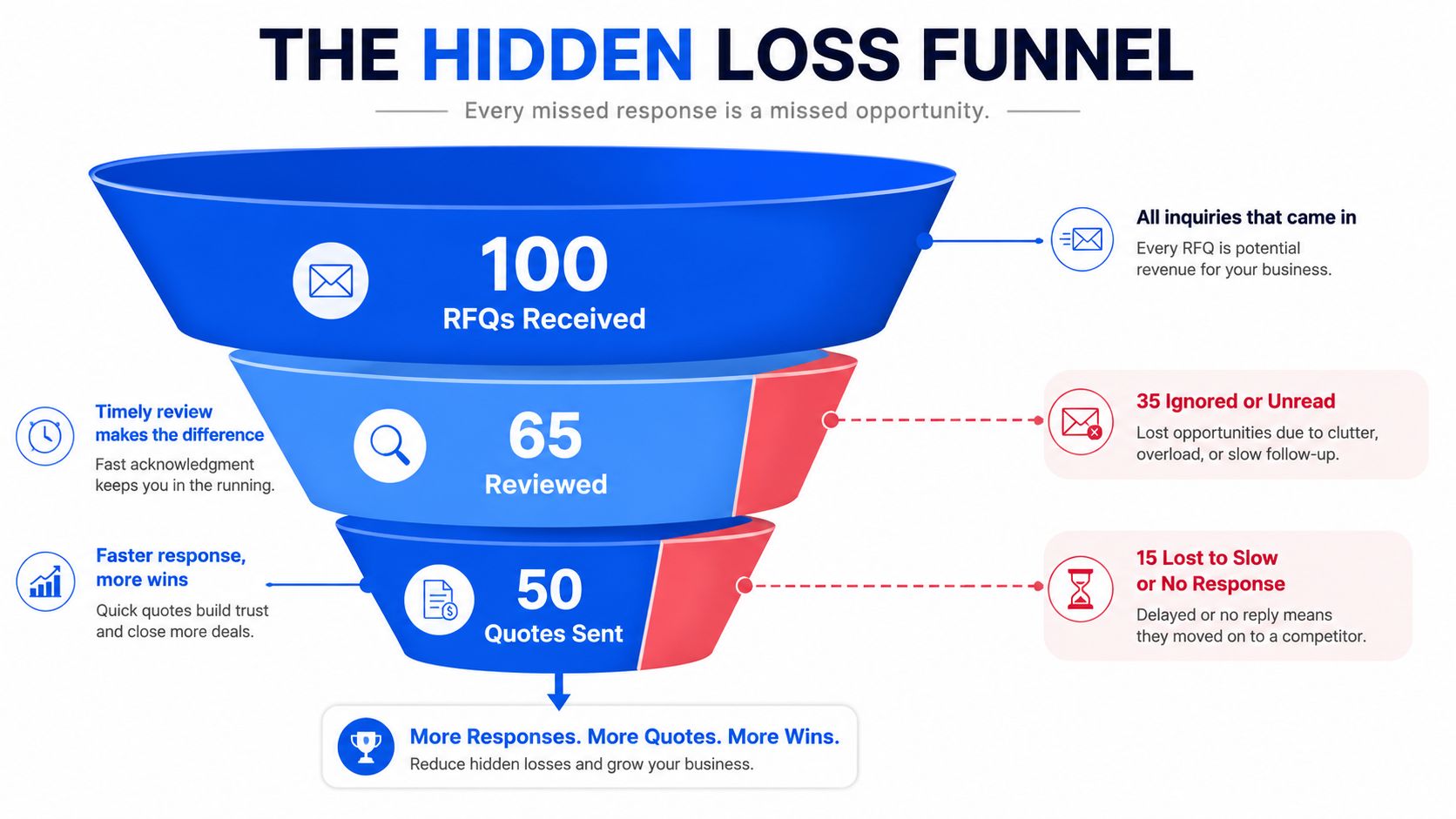
Diagnostic question: how many RFQs landed in your shop this week, and how many got a complete quote back without anyone having to chase the request twice?
Practical Ways to Move Your Shop Into the Sub-4-Hour Zone
Speed gets better when you stop treating quoting like a craft project and start treating it like an operating system. The right workflow changes don't make estimators careless. They remove the stupid delays that waste their time.
Centralize the front door
Put all inbound RFQs into one place. If quotes come through multiple email accounts, shared inboxes, and sales reps' personal addresses, you're already slowing yourself down. A single dashboard for received, in progress, and pending items gives everyone the same priority list and stops RFQs from living in someone's memory.
That's also where tools like Uptool, Inc. fit naturally, since the platform is built to ingest RFQs from connected inboxes, organize the queue, and automate a large part of the RFQ-to-quote workflow. For a machine shop or fab shop, that means fewer requests slip through the cracks while the team is buried in hand entry.
Use structure to protect accuracy
Fast quoting fails when everything depends on one person remembering how a job was quoted last time. Reusable calculators, material libraries, and finishing databases take that guesswork out of the first pass. If you quote the same materials, finishes, or operations repeatedly, build templates around those repeat patterns instead of starting from scratch.
A good system doesn't just speed up the estimate. It keeps the team from retyping the same assumptions over and over, which is where mistakes usually creep in. That's especially important when jobs involve multiple operations, outsourced finishing, or changing material availability.
Set a speed promise the team can keep
Don't promise “as fast as possible.” Promise a same-day response standard that the shop can hold. Sometimes that means an immediate acknowledgment and a fast rough pass, then a more complete quote once the details are verified. The point is to stay in the buyer's conversation while the job is still open.
If you want a reference point for building that workflow, the machine shop software stack is a useful way to think about the pieces that need to work together, from intake to estimating to handoff.
Faster quoting comes from fewer handoffs, cleaner inputs, and less time spent hunting for the same information twice.
Putting It Together and Measuring What Changes
Start with three numbers and keep the measurement honest. Track average response time, quote response rate, and win rate by response window for 60 days. If you do not segment by response window, you will miss where the losses happen.
What to watch in the first 60 days
If RFQs land in one place and the inbox clears faster, more quotes should go out. If the calculators and templates are doing their job, the estimator spends less time rebuilding repeat jobs and more time on exceptions. That is the test of a quoting system. Software that looks modern but still depends on memory does not pass.
The point is not to chase a headline number. It is to see whether cleaner intake, tighter ownership, and faster first passes move work out of the dead zone between inquiry and quote. Shops that measure only response rate miss the gap that decides whether the buyer is still paying attention when the quote arrives.
Make the first win tomorrow morning
Pick the first RFQ that comes in tomorrow and time it end to end. Who saw it, who owns it, what slowed it down, and whether it came back as a complete quote. That single request will tell you more about your quoting speed win rate than a month of opinions.
If you want a working reference, the UK manufacturing quoting benchmarks are useful as a reminder that speed and close rate move together only when the workflow behind them is disciplined. The next step is not more debate. It is tightening the path from inbox to estimate so the team can repeat it without friction.