A supplier portal says the 304 stainless plate you need is available. You price the job, promise a start date, and send the quote. Then purchasing calls back with the detail that changes everything. The plate is available, but not in the required form, thickness, temper, or certification package. The material exists somewhere in the market, yet it can't support the job on your schedule.
That's the operating reality behind today's raw materials shortage for CNC machining and sheet metal fabrication shops. The problem often isn't an empty warehouse. It's the gap between a broadly available alloy and the exact material called out on a drawing, including its grade, form, thickness, temper, heat lot, finish, and country of origin.
Table of Contents
The Quoting Moment When Material Specs Decide the Job
It's Tuesday morning, and an estimator is working through a cover made from 304 stainless plate. A service center portal shows half-inch material in stock, so the estimator builds the material line, adds cutting and finishing, and sends the quote.
The call comes later. The available plate is cold-rolled, but the drawing calls for a hot-rolled condition. The supplier can source the correct certified plate, but the delivery date no longer supports the requested production slot. The quote wasn't wrong because the estimator misread the alloy. It was wrong because “304 stainless” was treated as a complete purchasing description.
The same trap appears in familiar material families:
6061-T6 is not automatically 6061-T651. The temper and stress-relief condition can affect suitability, machining behavior, and certification.
A36 is not A572-50. Both may appear in a conversation about structural plate, but their mechanical requirements and purchasing paths differ.
DOM 1020 is not welded tubing. Outside diameter and wall thickness may look similar on a cut list, while the manufacturing process, internal condition, and documentation are different.
An estimator has to confirm more than an alloy name. The RFQ process should capture the exact grade, form, dimension, temper, finish, certification, quantity, and required arrival date before a price becomes a promise. A disciplined machine shop RFQ process makes those fields visible instead of leaving them buried in a drawing note or supplier email.
Practical rule: Treat “in stock” as a question, not an answer. Ask, “In stock in which form, condition, and certification?”
This distinction also affects scheduling. A shop may have enough material by weight but still lack the required plate size, bar diameter, or heat-lot paperwork. That's why a raw materials shortage increasingly behaves like a grade-and-form problem. The wrong material breaks lead time even when the market has plenty of metal in general.
What a Raw Materials Shortage Actually Means for a Shop
For a small or mid-sized shop, a raw materials shortage means the required input can't be purchased, received, or released to production within the cost and timing assumptions attached to the job. That definition is more useful than a national index because it reflects what the estimator and buyer must resolve before the traveler reaches the floor.
S&P Global's 2024 Global Supply Shortages Index showed broad raw-material shortfalls generally below or around its long-run average of 1.0, with readings of 0.6 in October and 0.5 in December. The same release reported that transport-related shortages were more than 3.5 times the usual level in October 2024, while aluminium and food remained above average in December. The message for a shop is clear: broad scarcity can ease while specific inputs remain difficult to move. S&P Global's shortage index release is a useful market baseline, but it can't tell you whether your 304L plate is available in the required gauge.

Read the supplier response correctly
Supplier pushback usually falls into one of three categories:
Price-driven tightness: The material can be found, but surcharges, conversion fees, or freight make the original quote obsolete.
Availability-driven tightness: The exact grade, form, or dimension is unavailable, allocated, or limited to a partial release.
Logistics-driven tightness: The material exists, but transport, port, routing, or regional inventory prevents it from arriving when needed.
Shop-level warning signs include extended mill lead times on cold-rolled sheet, surcharges on nickel-bearing stainless, plate rolling dates moving beyond the normal buying window, and aluminum billet allocation at primary producers. Those signals matter because they change purchasing confidence even before a supplier says “shortage.”
A shop owner building resilience can also use this Nexist guide on supply chain resilience for broader planning ideas. The practical takeaway is simple: confirm the exact SKU before you calculate material cost or commit a machine slot.
How Shortages Have Moved From 2021 to Today
The shortage cycle has changed shape rather than disappeared. During the 2021 to 2022 supply shock, roughly 40% of U.S. manufacturing plants reported raw-material shortages as a key impediment from Q3 2021 through Q2 2022. By Q3 2024, the figure had fallen to about 11%, but that remained more than double the roughly 5% range recorded during 2014 to 2016. These figures come from the Census Bureau survey summarized in the manufacturing raw-material shortage analysis.
The sector detail matters more than the national average. In Q3 2024, insufficient materials were reported by 37.1% of computer and electronic product plants, 31.8% of electrical equipment plants, and 10.9% of machinery plants, according to the same source. A CNC shop supplying electrical housings may therefore feel more pressure than a shop quoting general machinery work, even while the overall market sounds more stable.
Three phases, one quoting lesson
The early phase produced broad disruption. Carbon steel, stainless, aluminum, and common bar stock were all harder to secure, and service-center inventory became less dependable. Estimators often had to price material before they could confirm whether the supplier could commit to the required quantity.
The 2023 to 2024 period brought a wider cooldown, but it didn't restore uniform availability. Common grades could become easier to source while specialty plate, aerospace alloys, certified stock, and unusual dimensions continued to consume schedule buffer.
Current conditions are more selective. The IEA reports that prices for base metals including aluminium, copper, and tin rose by about one-third between January 2025 and April 2026, with copper reaching record highs, while projected supply gaps for copper and lithium still persist through 2035 in some outlooks. That doesn't mean every shop faces a universal shortage. It means a small group of constrained SKUs can still dictate the schedule.
Phase | Period | Hot-Rolled Coil Lead Time | Stainless Surcharge Trend | Constrained Grades |
|---|---|---|---|---|
Broad shock | 2021 to 2022 | Extended and difficult to confirm | Elevated and volatile | Common carbon steel, stainless, aluminum, selected bar |
Uneven cooldown | 2023 to 2024 | More stable for common items | Generally easing | Specialty plate, aerospace alloys, certified stock |
Selective constraint | 2025 to 2026 | Varies by mill, form, and origin | Sensitive to alloy and market conditions | Copper-related inputs, specialty stainless, import-dependent plate |
The shop-floor lesson is that an index can look normal while a handful of material numbers continue to delay jobs. Schedule against confirmed material, not against the average condition of the market.
Why Grade and Form Matter More Than Headline Availability
A material buyer doesn't purchase “steel” or “aluminum.” The buyer purchases a specific combination of alloy, form, size, condition, finish, certification, and quantity. Each added requirement can move the order into a different supply pool.
Hot-rolled 1018 bar and cold-finished 1018 round may share a chemistry label, but they aren't interchangeable purchasing items. Surface condition, dimensional tolerance, straightness, machinability, and certification can all change the approved source list. The same issue appears with 304 stainless sheet and 304L plate. They belong to related stainless families, yet thickness range, product form, welding requirements, and customer approval can prevent one from replacing the other.
A supplier can truthfully say that an alloy is available while still being unable to supply the material your drawing permits.
Quoting accuracy breaks when an estimator sees an available base alloy, assumes it covers several forms, and uses the same price and delivery assumption across jobs. Purchasing later discovers that the required temper or product form has a different minimum order, conversion schedule, or allocation status.
The macro picture supports this narrower view. The IEA's recent assessment points to strong movement in base-metal pricing, including aluminium, copper, and tin, while the European Parliament's review of critical raw materials found that 31 of 34 monitored materials had supply risks considered critically high. The EU framework places particular emphasis on materials such as heavy rare earths, gallium, niobium, magnesium, and rare earths because disruption risk combines with economic importance. See the European Parliament critical raw materials briefing for the framework and assessment.
Base Alloy | Common Shop Forms | Split That Creates Separate Supply Pools | Typical Buyer Impact |
|---|---|---|---|
1018 | Hot-rolled bar, cold-finished round | Surface and tolerance condition | Different price, machinability, and lead time |
304 stainless | Sheet, plate, round bar | Product form, thickness, certification | “Available” stock may not satisfy the drawing |
6061 aluminum | Plate, bar, tube | Temper, thickness, shape | Substitution may require engineering approval |
Carbon steel | A36 plate, A572-50 plate | Mechanical specification | A cheaper substitute may not be permitted |
The right question is not “Can you get 304?” Ask, “Can you get 304L plate, in this thickness, with the required certification, by the material release date?”
Lead Times by Alloy, Form, and Origin
Lead time becomes useful only when it's tied to form and origin. A domestic carbon plate order, an imported welded tube order, and a stainless sheet order can all sit under the broad label “metal,” yet they carry very different schedule risks.
Recent market updates provide concrete reference points. One subcontractor pulse report described steel lead times at approximately 22 to 24 weeks, with fabrication start dates pushed out 6 to 8 months. A separate metal-market update listed domestic carbon steel plate at 9 to 13 weeks, stainless plate at 10 to 11 weeks, and imported carbon welded tubing at 14 to 25 weeks. These aren't universal promises, but they show why a single generic material lead-time field is inadequate.
The metal market update covering plate and tubing is useful when a buyer needs to compare form and origin. For a broader structural view, the subcontractor supply-chain pulse report illustrates how purchasing delays can become fabrication-start delays.
Material | Form / Spec | Domestic Mill (weeks) | Domestic Service Center (weeks) | Imported (weeks) |
|---|---|---|---|---|
Carbon steel | Plate | 9 to 13 | Confirm stock and processing slot | Varies by origin and routing |
Stainless steel | Plate | 10 to 11 | Confirm gauge and certification | Varies by mill and freight |
Carbon steel | Welded tubing | Varies | Confirm stock and cut quantity | 14 to 25 |
Stainless steel | Sheet | Confirm mill schedule | Confirm stock, finish, and gauge | Varies by source |
Aluminum 6061 | Plate or bar | Confirm temper and size | Confirm stock and saw or plate processing | Varies by source |
Alloy steel | Cold-finished bar | Confirm grade and condition | Confirm stock and minimum buy | Varies by source |
A sheet-metal report described traditional steel order lead times rising from 5 to 6 weeks to 13 weeks during a shortage. Non-stock gauges may face 8 to 12 weeks, while non-standard specifications may reach 12 to 16 weeks with allocation risk, according to Mead Metals' industry update.
Before quoting, ask for the supplier's committed ship date, not just an inventory status. Also ask whether coil-to-plate conversion, cutting, testing, heat-lot paperwork, or a mill minimum adds time. Shops improving this process can use the supply chain visibility tips from Logivo to make supplier status easier to track and compare.
Procurement Tactics That Actually Help a Small Shop
A small shop doesn't need a giant warehouse to reduce material risk. It needs a short list of repeat material combinations, clear reorder rules, and a second option that has already been checked.
Start with usage, not theory. Pull purchasing history and identify the alloy, form, gauge, and diameter combinations that appear repeatedly on active work. For long-running combinations, establish a minimum safety stock target of 60 days, provided the material has predictable demand, reasonable storage requirements, and no rapid certification or shelf-life concern.
Build options before the shortage
Qualify a second supplier for every specification you quote regularly. That doesn't mean opening an account with every distributor that sends a sales email. It means confirming that the backup supplier can provide the exact grade, form, dimensions, documentation, and quantity your customers accept.
For materials with customer-controlled specifications, obtain approval for alternate alloys or forms before the order is urgent. Put the approval path in the customer's print, purchasing note, or quality record. An alternate that is technically suitable but not documented is not a real alternate when the job is already late.
A practical procurement file should include:
Primary source: Supplier, contact, normal lead time, minimum buy, and certification capability.
Backup source: Confirmed equivalent, available forms, and escalation contact.
Approval status: Customer or engineering approval for each substitute.
Cost basis: Current price, surcharge treatment, freight assumption, and validity period.
Release rule: The point at which a buyer must place the order rather than wait for a quote award.
Vendor diversification often beats chasing the lowest unit price. A modest premium for a qualified second source can be cheaper than a re-quote, expedited freight, idle machine time, or a missed customer commitment.
What doesn't work: Doubling purchase orders without storage, buying unverified substitutes, or chasing every distributor lead without checking certs and dimensions.
Blanket orders and price locks can help on volatile base metals, but only when the release schedule matches actual demand. Otherwise, the shop trades a supply problem for excess inventory and cash tied up in material that may not fit the next job. When expanding the supplier list, use a structured directory such as local machine shop resources to identify potential partners, then qualify them through real documentation and test orders.
Quoting and Costing When Material Data Keeps Moving
A static material line is a liability when suppliers update availability, surcharges, minimum order quantities, and delivery commitments throughout the quote cycle. The estimator may have accurate information at 9 a.m. and an unusable assumption by the time the customer responds.
The fix is a controlled costing routine with three parts.
Rebuild the cost basis
Use the current supplier sheet, portal confirmation, or written quote for every meaningful quote cycle. Don't copy the last purchase order unless the supplier has confirmed that the same price, form, and delivery condition still applies.
Separate the material assumption into visible fields:
Material identity: Grade, form, temper, thickness, diameter, finish, and certification.
Purchase condition: Stock, mill order, allocation, minimum buy, or partial availability.
Cost exposure: Base price, surcharge, processing, freight, and scrap.
Validity: Supplier quote expiry and the date when purchasing must reconfirm.
Then add a documented risk treatment for spot-market or non-stocked material. That might be a contingency allowance, a short quote validity period, a customer escalation clause, or a requirement for material approval before release. The method should be consistent, so estimators don't protect one quote while leaving another exposed.
Define automatic re-quote triggers
A vendor change should force a cost review before release. The same applies when the required grade changes, the supplier moves from stock to mill order, the minimum buy changes, or the committed delivery date passes the planned material-release date.
A quote linked to material status can also support AI-driven RFQ-to-quote workflows. Automated extraction from drawings and BOMs can identify material callouts, while a maintained material library can flag a mismatch between the quoted grade and the supplier's current stock. Rule-based alerts won't replace estimator judgment, but they can reduce the re-quote churn caused by missed changes.

For long-running contracts, separate the initial material assumption from the adjustment mechanism. A customer may accept a fixed conversion price while allowing documented material surcharges to pass through. The accounting distinction between job-specific cost capture and broad average assumptions is worth reviewing in this explanation of job costing versus average costing.
The key control is traceability. When the customer asks why the price changed, the estimator should be able to show the original material assumption, the supplier update, the approval path, and the resulting revision. Use material cost estimating resources to keep that information connected to the quote instead of scattered across email threads and spreadsheets.
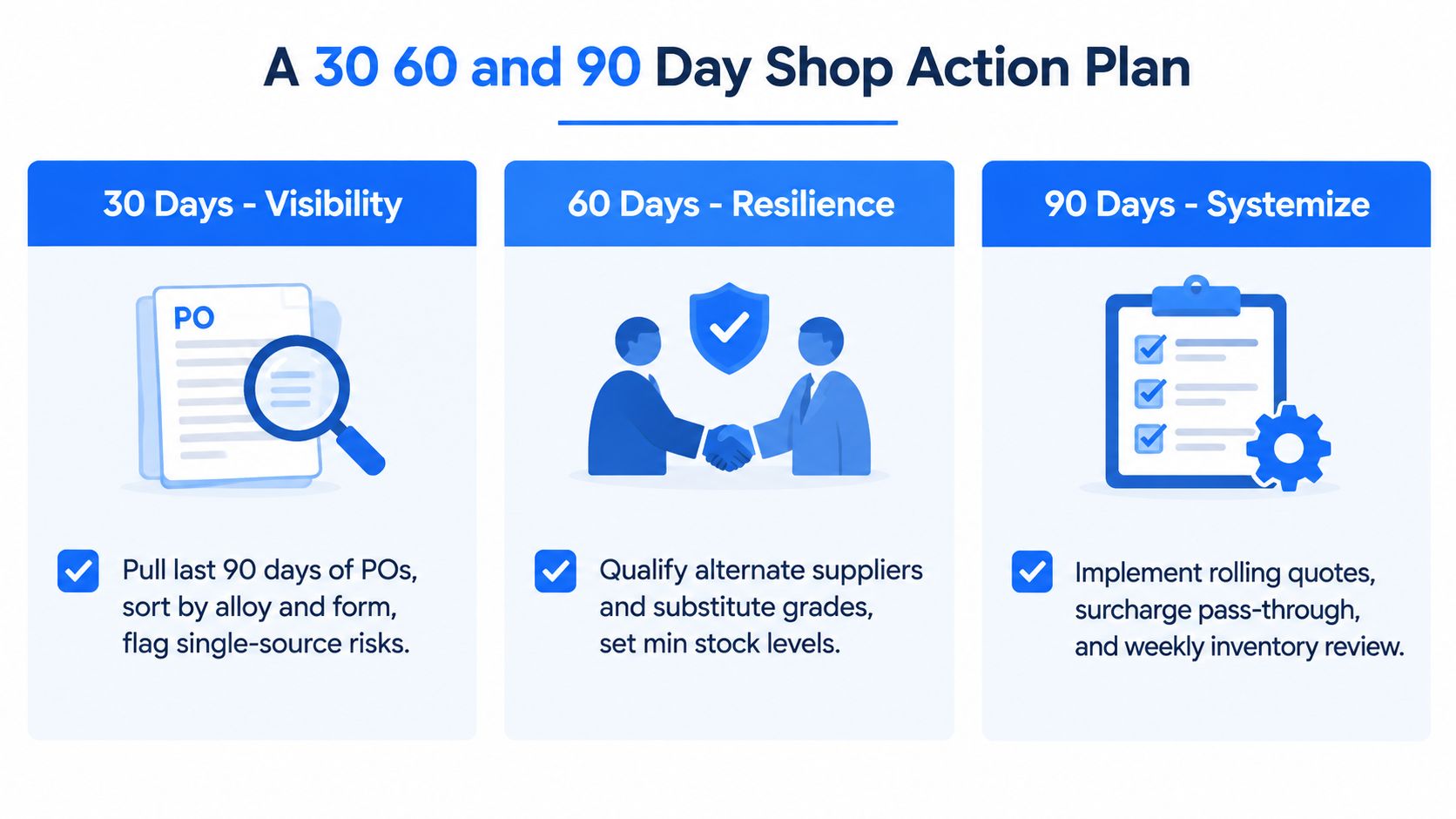
A 30 60 and 90 Day Shop Action Plan
A shop can improve material resilience without adding a buyer or filling every corner of the warehouse. The first requirement is visibility. The second is qualification. The third is a quoting and scheduling routine that uses what the team learned.
The first 30 days focus on visibility
Pull the last 90 days of purchase orders and sort them by alloy, form, gauge, diameter, and supplier. Flag every specification that has experienced more than one supplier change as a single-source risk, even if the current order is on time.
The deliverable is a one-page risk register. Include the material description, primary supplier, backup status, last confirmed lead time, minimum buy, certification requirement, and jobs currently dependent on it. This list should be reviewed by estimating, purchasing, and scheduling together.
The next 60 days build resilience
For every flagged grade, test-order two alternate alloys or thicknesses where the customer and engineering requirements allow it. Record machinability, forming behavior, surface condition, scrap impact, finishing results, and documentation quality.
Ask a backup service center for written pricing and an availability check. Don't wait until the primary supplier reports allocation. The deliverable is a qualification packet that includes the alternate specification, supplier evidence, approval status, and a clear decision on whether the alternate can be used.
By 90 days, systemize the response
Revise the costing template to include a material risk factor, supplier quote date, expiry date, and re-quote trigger. Update customer-facing lead-time assumptions so they reflect the actual material release requirement, not just machine capacity.
Run a short estimator and scheduler training session. Everyone should know when to escalate a grade mismatch, an unconfirmed ship date, a changed minimum buy, or a material substitution request. The final deliverable is a repeatable weekly review covering open quotes, inbound material, constrained SKUs, and jobs waiting for confirmation.
A raw materials shortage is manageable when the shop knows exactly what is at risk and acts before the material delay reaches the floor. Start with the PO review this week, assign owners to the highest-risk specifications, and make every new quote carry a verified grade, form, and delivery assumption.
Uptool helps CNC machining and fabrication shops turn drawings, CAD files, BOMs, and supplier material data into organized, traceable quotes with less manual re-entry. Visit Uptool to see how its AI-powered RFQ-to-quote workflow can help your team protect material assumptions, respond faster, and keep quoting decisions consistent.