A small machine shop usually does not have a lead problem in the same way a consumer business does. It has a visibility and trust problem. The right buyers are out there, engineers, sourcing managers, plant leaders, and operations teams that need CNC machining, fabrication, finishing, or overflow capacity. The challenge is getting shortlisted before they send the RFQ.
That is why marketing a small machine shop should start upstream of the quote. Before a prospect emails a drawing or asks for pricing, they need to understand what your shop does, what kinds of parts you are best at, what industries you serve, and why your team is a credible fit. If that story is vague, inconsistent, or hard to verify, the buyer moves on.
The popular advice to "post more on social media" or "run some ads" misses how industrial buying usually works. A serious prospect wants proof. They want to see capabilities, machines, materials, tolerances, quality practices, lead time expectations, and examples of similar work. They may find you through Google, LinkedIn, a directory, a referral, or an email. But no matter where they start, they are asking the same question: is this a shop I can confidently include in my supplier list?
Marketing a small machine shop should therefore be treated as a demand-capture and credibility system. Make the shop easy to find, easy to understand, and easy to contact. Build a brand that reflects your real strengths. Publish enough technical proof that a new buyer feels comfortable sending the first RFQ.
Table of Contents
Why Marketing a Small Machine Shop Starts Before the RFQ
Measuring Marketing With Shop-Side KPIs
Days 61 through 90 scale what converts
Days 31 through 60 activate proof and outreach
Days one through 30 establish the foundation
A 90-Day Marketing Plan for a Small Machine Shop
Choosing the Right Marketing Channels for a Small Shop
Proof Assets That Move Buyers From Search to RFQ
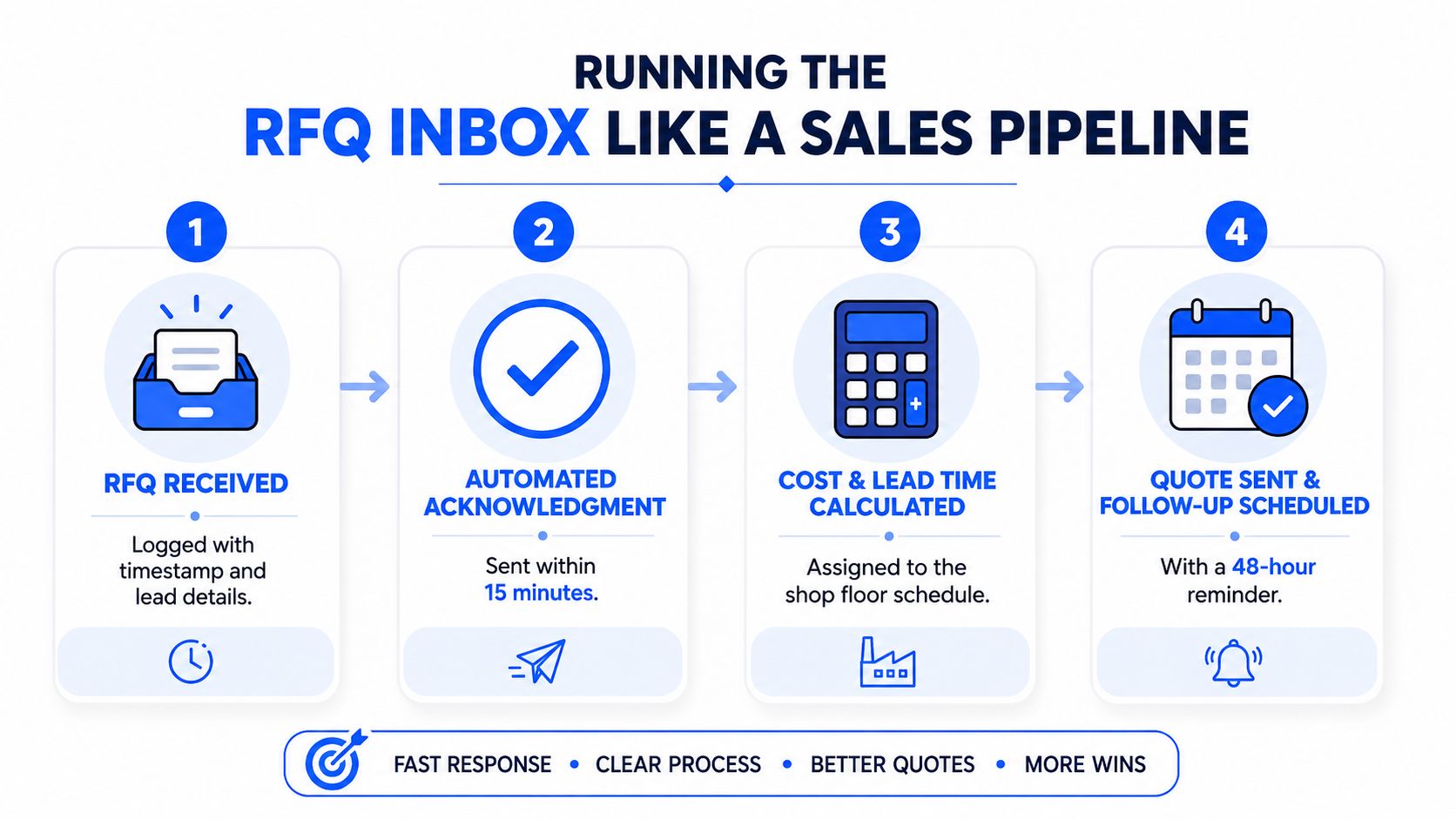
Running the RFQ Inbox Like a Sales Pipeline
Building the Local and Digital Foundations Buyers Check First
The Speed-to-Quote Window That Decides Who Wins
Why Marketing a Small Machine Shop Looks Different in 2026
Industrial buyers rarely begin with loyalty. They begin with a need.
A production team needs overflow machining capacity. An engineer needs a local fabrication partner. A sourcing manager is replacing an unreliable supplier. A startup needs a shop that can support prototype-to-production work. Before any of those buyers send an RFQ, they need to identify a short list of suppliers that appear capable and trustworthy.
That is why upstream marketing matters. One industry source reports that 84% of manufacturing buyers start supplier searches on the internet. The procurement overview from 3E Technology supports a simple conclusion: if your shop is hard to find or hard to understand online, you miss opportunities before estimating ever gets involved.
A practical guide to small-shop manufacturing also points to an important operational reality. The way a shop sells work has to match the way it actually produces work. If your marketing claims broad capability but your real strength is tight-tolerance stainless parts, short-run aluminum components, or sheet metal assemblies with finishing, the mismatch creates weak leads and wasted conversations.
Upstream marketing works when it answers four questions clearly:
What do you make best? Be specific about part types, industries, materials, tolerances, and production volumes.
Who is a good fit? Name the customer types and applications where your shop is strongest.
Why should someone trust you? Show machines, inspection tools, quality practices, case studies, and real examples.
What should a prospect do next? Offer a simple path to request capabilities, start a conversation, or send a drawing.
Shop-floor rule: The goal of marketing is to earn a place on the buyer's RFQ list.
If the website, LinkedIn presence, outreach, and sales materials all help answer those four questions, more qualified buyers will raise their hand.
The quoting-speed benchmark summarized by Uptool
Build a Clear Brand Around What the Shop Actually Does Best
For a small machine shop, brand does not mean a clever slogan or polished color palette alone. It means the market can quickly understand what kind of shop you are.
Many small shops describe themselves with generic phrases like "high quality," "precision solutions," or "customer-focused manufacturing." Those claims are too broad to help a buyer decide. A stronger brand position is grounded in actual operating strengths.
For example, a shop might be known for:
Fast-turn CNC machining for local OEMs
Tight-tolerance milling and turning in aluminum and stainless
Sheet metal fabrication for brackets, enclosures, and welded assemblies
Prototype-to-production support for hardware startups
Overflow machining for manufacturers that need dependable backup capacity
Secondary operations and finishing coordination for complete part delivery
A useful brand position combines capability + customer type + business outcome.
Instead of saying:
We provide precision manufacturing solutions.
Say something closer to:
We help regional manufacturers source low-to-mid volume CNC machined parts in aluminum, stainless, and plastics, with dependable lead times and inspection documentation.
That kind of message does two things. It filters out poor-fit inquiries, and it gives the right buyer confidence that your shop understands their world.
Your brand should show up consistently across:
Website headlines and service pages
LinkedIn company page and owner profile
Capability statements and PDF line cards
Directory listings
Email outreach messaging
Sales introductions and referral conversations
When all of those channels describe the same shop in the same language, recognition builds faster.
Turn the Website Into an RFQ-Generating Asset
A small machine shop website should not behave like an online brochure. It should help a prospect self-qualify and take the next step.
Your website matters because many buyers will check it before replying to an email, taking a call, or sending an RFQ. They are looking for evidence that the shop is real, current, organized, and technically relevant.
Start with the pages that directly support buyer intent.
Homepage: State what the shop does, who it serves, and what kinds of work fit best.
Capability pages: Create separate pages for CNC milling, CNC turning, sheet metal fabrication, laser cutting, brake press forming, finishing, assembly, or other core processes.
Industries pages: If relevant, create pages for medical, industrial equipment, electronics hardware, automotive aftermarket, food equipment, or other markets you know well.
Materials pages: Add practical detail about aluminum, stainless steel, carbon steel, brass, copper, plastics, and specialty materials you actually machine or fabricate.
Quality page: Explain inspection equipment, first-article practices, documentation, traceability support, and any certifications held.
Contact or RFQ page: Make it easy to upload drawings or ask if the part is a fit.
A buyer should be able to answer these questions in under two minutes:
Can this shop make the part?
Does this team work with my material and process needs?
Does the shop look organized and credible?
Is there a simple way to contact them?
That means your website copy should include real technical information, not empty claims. State machines, part sizes, tolerances when appropriate, material familiarity, finishing options, and whether you handle prototypes, short runs, repeat production, or assemblies.
Small machine shops also remain strongly tied to nearby customers. A 2020 machine shop marketing survey found that 69% of business came from local customers overall, while its top-growth group relied on 40% local business. The CNC Cookbook survey remains a useful reminder that local visibility still matters, especially for repeat work and relationship-driven accounts.
That local visibility should include:
A complete Google Business Profile with current photos
Consistent business name, address, and phone details
Service-area information
Reviews from real customers when available
Location references on key service pages
For practical support on profile setup and service-area visibility, use this GBP setup and reviews guide.
The website does not need to be flashy. It needs to be clear, current, mobile-friendly, and written for engineers and buyers instead of generic marketing language.
Use LinkedIn to Build Familiarity With Buyers
LinkedIn is one of the most useful upstream channels for a small machine shop because it helps create familiarity before a direct need becomes urgent.
Unlike broad social platforms, LinkedIn allows a shop owner, sales lead, or technical leader to stay visible with engineers, sourcing managers, operations leaders, and plant contacts in target industries. The goal is not to become an influencer. The goal is to stay credible and top of mind.
A practical LinkedIn approach includes three layers.
1. Optimize the company page
The company page should clearly describe:
Core processes and capabilities
Industries served
Materials and part types supported
Geographic footprint
How to contact the shop
Use real facility photos, machine photos, inspection photos, and finished-part images where confidentiality allows.
2. Use the owner or sales leader profile actively
In small industrial businesses, people often trust people before they trust brands. An owner, estimator, business development lead, or operations leader with a strong LinkedIn presence can outperform a passive company page.
That profile should explain:
What the shop specializes in
Which customer problems it solves
What kinds of introductions are welcome
A link to the capabilities or contact page
3. Post useful proof, not fluff
Strong posts include:
Photos of machines, setups, inspection, or finished work
Short explanations of materials or processes the shop handles well
Case-study style summaries of solved manufacturing problems
Hiring and equipment updates that signal growth or capacity
Observations about lead times, manufacturability, or quality practices
Weak posts include generic holidays, vague inspiration, and filler that says nothing about the work.
A good weekly rhythm might be:
RFQ management software options
One proof-oriented post from the company page
One practical post from the owner or business lead
Five to 10 thoughtful comments on posts from target customers, local manufacturers, or industry partners
A handful of new connection requests to relevant buyers and engineers
Used this way, LinkedIn supports recognition. When someone eventually needs a supplier, your shop is already familiar.
Run Targeted Email Outreach That Sounds Credible
Email outreach still works in industrial markets, but only when it is targeted, relevant, and brief.
Most small shops make one of two mistakes. They either never reach out at all, or they send a generic blast to a weak list. Neither approach builds real opportunity.
A better model is account-based outreach. Identify a defined group of prospects that fit your strengths, then send focused emails tied to a clear reason your shop may be useful.
Good prospect categories include:
Local OEMs and contract manufacturers
Companies with recurring fabricated or machined components
Plants that may need overflow capacity
Fast-growing hardware companies
Firms in industries where you already have process familiarity
Each email should answer three things quickly:
Who you are
What the shop is best at
Why the message may be relevant to that company
For example:
Hi [Name], I lead business development at [Shop]. We support low-to-mid volume CNC milling and turning for regional manufacturers, especially aluminum and stainless components that require dependable turnaround and inspection documentation. Reaching out because your team appears to build [product type], and we may be a useful overflow or secondary source. If helpful, I can send a short capability sheet or examples of similar work.
That approach is better than pushing for an immediate quote. The first goal is to start a conversation or win permission to share capabilities.
Keep outreach disciplined:
Build small, relevant prospect lists
Personalize the first sentence
Mention a real capability, not a slogan
Link to a capability page or capability PDF
Follow up two or three times, politely and briefly
Track replies, introductions, and conversations
For shops that need a cleaner intake process for website leads, an RFQ form template from Orbit AI can still help structure requests once interest is generated.
Email is most effective when it supports a broader system. A prospect may ignore the first note, then later visit the website, view the LinkedIn page, and respond after seeing more proof.
Strengthen Local Visibility and Industrial Directory Presence
Not every new customer comes from outreach. Many come from being visible where buyers already search.
For a small machine shop, that usually means two categories: local search and industrial directories.
Start with the basics:
Google Business Profile: Add current photos of the shop exterior, machines, inspection area, and finished work. Keep hours, phone number, and categories current.
Location-aware website copy: Mention the regions and metro areas you serve naturally on service pages.
Review collection: Ask satisfied customers for honest reviews that mention responsiveness, quality, or type of work.
Directory profiles: Evaluate Thomasnet, IndustrySelect, and relevant regional fabrication or manufacturing directories.
Buyers use directories to filter by location, process, certifications, and supplier type. This guide to industrial sourcing platforms shows why these listings remain useful as qualification tools, even when the first search begins elsewhere.
A complete profile should include:
Core capabilities
Machine and process detail
Materials worked with
Quality practices and certifications
Part photos or facility photos
Contact details that match the website exactly
These listings are not exciting, but they are often part of the buying path. A prospect may discover your shop on Google, confirm legitimacy on LinkedIn, and then compare your capabilities against other suppliers in a directory.
Create Proof Assets That Help Prospects Say Yes
If your shop wants more RFQs from new customers, publish proof that reduces perceived risk.
Buyers do not want a long brand story. They want enough evidence to feel safe contacting a new supplier. A digital manufacturing guide notes that buyers often evaluate suppliers independently before making contact. This overview of digital manufacturing discovery reinforces the need for useful digital proof.
Four assets matter especially for small shops.
Asset | What It Shows | Why It Helps Upstream Marketing | Update Frequency |
|---|---|---|---|
Capability matrix | Materials, machines, processes, tolerances, sizes | Helps buyers qualify the shop quickly | Review when equipment or services change |
Detailed case studies | Part challenge, process, inspection, result | Shows real problem-solving ability | Add when strong work is completed |
Shop-tour video | Machines, inspection area, work areas, handling | Proves the shop is organized and active | Refresh after major changes |
Quality statement | Inspection equipment, certifications, traceability practices | Builds trust before the first conversation | Review when procedures or certifications change |
A capability matrix should be easy to download and share internally. Use a clear filename such as CNC-Machining-Capabilities.pdf, and include a revision date inside the file.
Case studies should explain more than the fact that a part shipped on time. Include the material, process, tolerances if appropriate, inspection method, production challenge, and end result. Protect confidentiality where necessary, but still make the example useful.
The shop-tour video can be simple and practical. Show machines, workholding, inspection tools, material flow, deburring, assembly, packaging, or finished parts where possible. Buyers are often trying to answer a simple question: is this a stable, real operation?
Do not overstate quality credentials. If you hold ISO 9001 or AS9100, say so clearly. If you do not, explain the quality practices you can support, such as first-article inspection, material certs, revision control, and inspection reports. Accuracy builds trust.
Choose the Right Marketing Channels for a Small Shop
A small shop does not need to be everywhere. It needs to be visible in the channels most likely to influence qualified buyers.
That usually means prioritizing channels with clear industrial intent.
Channel | Monthly Cost Range | Weekly Time | Best Use | Best Shop Size |
|---|---|---|---|---|
Website and organic search | Low to moderate | Ongoing | Capture inbound demand and validate fit | Any small shop |
Google Business Profile | Low | Light maintenance | Local visibility and trust | Any small shop |
Low direct cost | Several focused hours | Build familiarity and relationships | Shops with owner-led or sales-led outreach | |
Targeted email outreach | Low to moderate | Several focused hours | Open conversations with defined accounts | Shops with clear niche strengths |
Thomasnet or IQS Directory | Varies by listing | Light maintenance | Support supplier discovery and comparison | Shops with clear technical capabilities |
Trade shows and referrals | Event and travel dependent | Concentrated | Build trust with target accounts | Shops pursuing repeat industrial customers |
These ranges are intentionally broad because cost depends on software, listings, events, and how much work the owner handles personally. The Boocoo tradie marketing tips are relevant for the same practical reason: service businesses tend to benefit more from visibility, proof, and follow-up than from abstract branding campaigns.
Most small shops should choose two primary channels and one secondary channel. For example:
Website + Google Business Profile, with LinkedIn as the secondary channel
Website + targeted email outreach, with LinkedIn as the secondary channel
Website + directory presence, with email outreach as the secondary channel
That structure is easier to manage than trying to spread thin effort across every platform.
Measure Upstream Marketing With Practical KPIs
If the goal is more RFQs from new prospective customers, the metrics should focus on visibility, engagement, and qualified conversations before the quoting stage.
A simple shared log is enough to start. Track where inquiries come from, which outreach efforts create replies, which pages attract contact submissions, and which channels eventually produce RFQs.
KPI | Definition | Why It Matters | Tracking Method |
|---|---|---|---|
New prospect inquiries | Number of first-time contacts per month | Shows whether awareness is increasing | CRM, inbox log, or contact form log |
Qualified conversations | Prospects that match your capability and customer profile | Filters out empty lead volume | Shared pipeline or CRM |
RFQs from new accounts | New companies that request pricing or drawings | The clearest upstream demand outcome | RFQ log by source |
Channel-to-RFQ rate | RFQs generated by each marketing source | Reveals where effort is paying off | Source tracking in spreadsheet or CRM |
Website conversion actions | Form fills, capability downloads, contact clicks | Shows whether the site creates action | Website analytics and form tracking |
Outreach reply rate | Replies divided by emails sent | Indicates message-market fit | Outreach tracker |
Do not chase vanity metrics alone. Website traffic, social impressions, and email opens can be useful context, but they do not matter much unless they lead to real conversations and qualified RFQs.
Review performance monthly and ask:
Which channels are bringing first-time inquiries?
Which messages are producing replies?
Which service pages are getting visits but few conversions?
Which industries or part types create the best-fit opportunities?
Which prospects moved from awareness to conversation to RFQ?
That review helps the shop invest more in the channels and messages that actually expand the customer base.
A 90-Day Marketing Plan to Generate More RFQs
A practical 90-day plan for a small machine shop should focus on message clarity, proof, and consistent outreach.
Days one through 30 define the message and foundation
Clarify the shop's positioning. Identify the top processes, best-fit customer types, preferred industries, common materials, and part categories the business wants more of. Rewrite the homepage and service pages so the site speaks clearly to those strengths.
Audit the Google Business Profile, directory listings, LinkedIn company page, and owner profile. Update photos, service descriptions, contact details, and core messaging so every touchpoint describes the same shop.
Create or improve:
A capability page for each core service
A concise quality page
A downloadable capability matrix or line card
A contact or RFQ page with a simple submission path
Days 31 through 60 publish proof and start outreach
Publish three proof assets, such as a case study, capability matrix, and shop-tour video. Then choose one primary outbound motion.
That could be:
LinkedIn connection building with local engineers and sourcing contacts
Targeted email outreach to a defined account list
Directory optimization for the categories that best match your work
Set a simple weekly rhythm:
One website improvement n- One LinkedIn company post
One owner-led LinkedIn post or comment block
20 to 30 targeted outreach emails or connection requests
One review of new inquiries and source attribution
The objective in this phase is not volume for its own sake. It is to create more qualified first-time conversations.
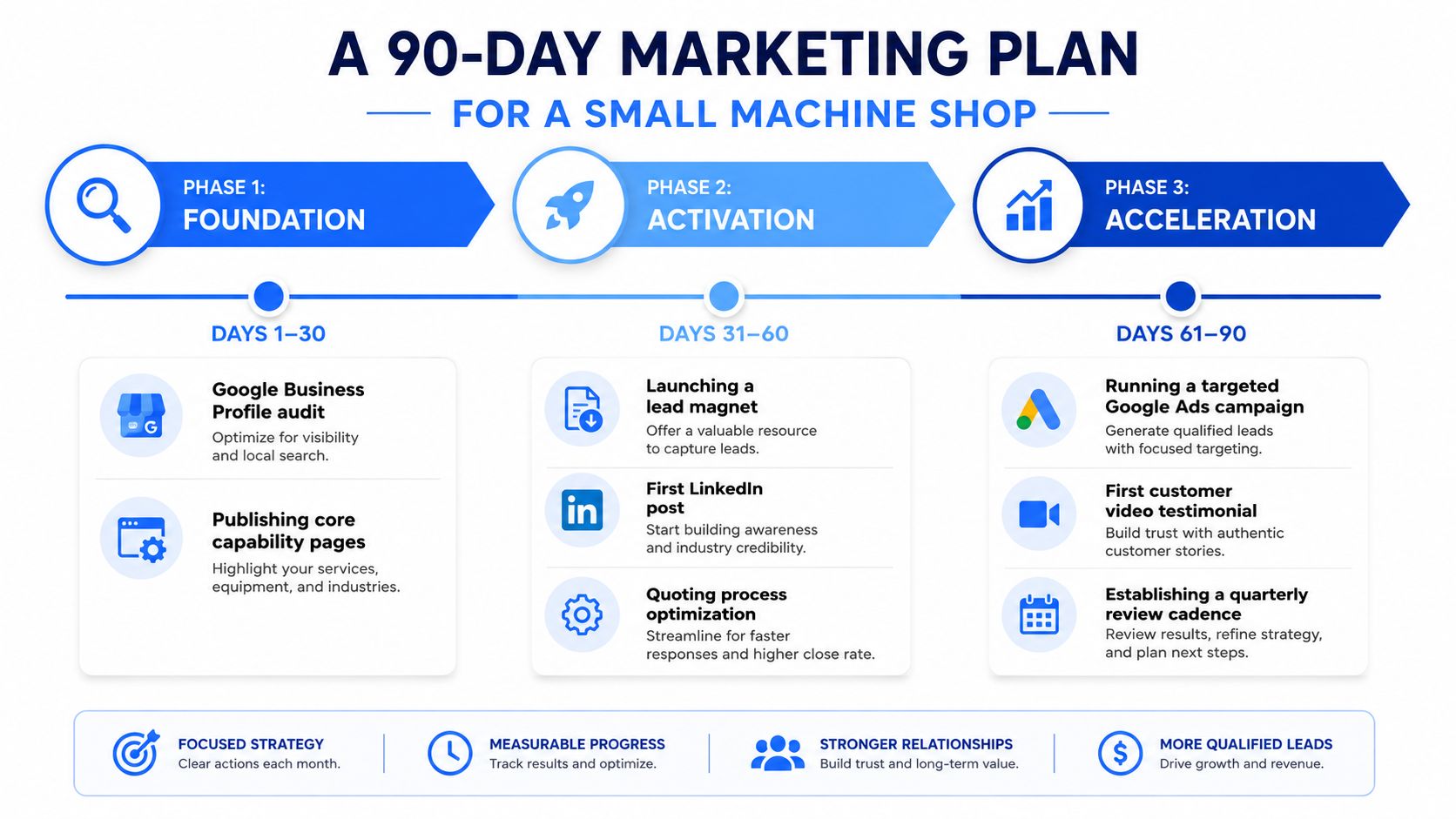
Days 61 through 90 double down on what produces conversations
Review early performance by channel, message, and audience. Which service pages produced submissions? Which email angles got replies? Which LinkedIn posts led to profile visits, connection growth, or inbound conversations? Which directory listings produced relevant inquiries?
Double down on the channels that generated credible new opportunities. Cut or reduce the activities that consumed time without producing conversations.
Ask satisfied customers, vendors, and partners for introductions. Referral-based growth still matters in manufacturing, especially when tied to specific work such as CNC turning, aluminum enclosures, stainless components, powder-coated assemblies, or repeat production support.
A quoting platform can support downstream conversion once those opportunities arrive. Uptool parses RFQ emails, drawings, CAD files, and BOMs, organizes requests in a command center, supports estimating and quote templates, and keeps revisions and conversations together. Treat it as one workflow option, not the core of upstream marketing.
Success in the first 90 days is not a viral post or a spike in empty traffic. It is a stronger market position, clearer proof, more qualified first-time conversations, and a measurable increase in RFQs from new accounts.
If your shop wants more opportunities from new customers, start by making your capabilities easier to find and easier to trust. Strengthen the website, sharpen the message, show real proof, and build consistent outreach habits. Then, when the right buyer is ready to source a part, your shop is far more likely to make the list.
If your team also needs help organizing inbound requests after those efforts start working, visit Uptool to see how its AI-powered quoting workflow can support the handoff from first RFQ to finished quote.
