You've got a promising RFQ sitting in an inbox, but the estimator is already buried under drawings, revisions, material requests, and follow-up calls. A PDF needs to be opened, a CAD file inspected, machine time estimated, finishing priced, and every assumption checked before anyone can send the customer a number. By the time the quote is ready, the opportunity may have gone to a faster shop.
That's the practical starting point for manufacturing 4.0 technologies in a job shop. You don't need to rebuild the factory around autonomous equipment. You need to remove the manual delays that consume estimating time, cause handoff errors, hide machine problems, and weaken margins. For CNC machining and sheet metal fabrication, modernization often starts in the front office, then follows the job through materials, cutting, bending, machining, finishing, inspection, and invoicing.
Table of Contents
What Running a Modern Job Shop Actually Looks Like
The bottleneck often appears before a machine starts. An owner or lead estimator checks several inboxes, downloads drawings, confirms the latest revision, and determines whether the request calls for aluminum, stainless steel, mild steel, or a specified grade. A phone call interrupts the calculation. Then someone asks whether the previous job required powder coating, plating, anodizing, or a particular outside finisher.
The work is familiar, but the process is fragile. One missing attachment can delay a quote. One overlooked revision can invalidate the estimate. One forgotten finishing requirement can turn a profitable CNC or sheet metal job into a margin problem after production begins.
Shop-floor truth: A machine can be fully booked without being the shop's biggest bottleneck. In many small and mid-sized operations, the constraint is the person turning incomplete RFQ information into a reliable price.
That delay affects competitiveness because job shops sell responsiveness as well as machining and fabrication capability. Customers want a clear answer on price, lead time, material, and process. If an estimator spends hours copying part numbers into spreadsheets and calculating operations manually, the shop can miss work it is equipped to produce.
The hidden cost of manual quoting
Manual quoting also makes the business dependent on individual memory. An experienced estimator may know which distributor provides reliable aluminum pricing, which finisher can meet a demanding cosmetic requirement, and which machine struggles with a particular family of parts. That knowledge often remains in email threads, personal spreadsheets, and handwritten notes instead of becoming reusable shop information.
A modern quoting workflow turns those decisions into structured records. It can capture the RFQ, organize files, identify the part revision, record material and finish requirements, and preserve the assumptions behind the price. The estimator still applies judgment. That judgment can focus on manufacturability, capacity, risk, and commercial decisions rather than repetitive data entry.
A 2026 industry review of Industry 4.0 adoption reported that 60% of manufacturing companies had adopted at least one Industry 4.0 technology, with IoT the most common at 55% and cloud-based manufacturing systems implemented by 35% of firms. For a job shop, the point is not to copy a large factory's technology stack. Connected data and automated workflows are becoming practical operating tools, including for smaller CNC and sheet metal businesses.
The first modernization decision should be specific: Where does work wait? If RFQs sit untouched, start with quoting. If repeat jobs lose time to machine failures, start with condition monitoring. If information disappears between estimating and the traveler, fix that handoff before buying more automation.
Core Technologies Powering the Smart Shop Floor
A smart shop floor does not require a massive factory rebuild. For a CNC or sheet metal shop, the practical starting point is matching each technology to a recurring production problem. IIoT connects machines and sensors to production software. Artificial intelligence interprets those signals and supports decisions. Digital twins test equipment, processes, or production cells before physical work begins. Robotics handles repetitive movement when volume and process stability justify the investment.

IIoT starts with useful signals
A CNC monitoring project should begin with a decision, not a dashboard. Vibration and temperature sensors on a spindle can show changing machine condition. Current, pressure, acoustic, and usage-time signals add context when a fault does not appear during a brief manual inspection.
A review of CNC-focused smart manufacturing deployments describes systems built with wired Ethernet, MQTT, Raspberry Pi gateways, and edge analytics. The review reports benchmarks including 99.0% accuracy, 1.81 ms latency, and 13.3 to 20.6 μJ per inference in specific systems. These figures show what the technology can achieve under defined conditions. The shop-floor test is more direct: does an alert give the operator time to prevent a failed tool, damaged spindle, or scrapped batch?
Hydraulic equipment needs the same discipline. Guidance on hydraulic system predictive upkeep can help a shop choose pressure, temperature, or vibration conditions that should trigger inspection before a breakdown.
Digital twins prevent expensive assumptions
A digital twin earns its place when it changes a production decision before material is committed. For sheet metal, that may mean testing a bend sequence, checking tool access, or finding collision and deformation risks before a blank reaches the press brake. For a complex 5-axis part, it can support toolpath verification, fixture planning, and machine-load analysis before the first cut.
The strongest systems connect the virtual model with live operating data. A 2026 study on digital twins and IIoT-based reliability forecasting reported up to a 93.4% reduction in unscheduled downtime and a 90.4% improvement in remaining useful life estimation precision under optimal simulated conditions. Those results come from simulations, so they do not guarantee the same outcome for every shop. They do clarify the operating loop: sensors collect condition data, the model identifies risk, and maintenance staff act on it.
Robotics belongs in the same practical category. A cobot loading repeatable blanks into a CNC machine can free a skilled operator for setup, inspection, or programming. It will not correct poor fixturing, unstable cutting conditions, or constantly changing job geometry. The process must be defined well enough for the robot to repeat safely.
For implementation planning, map how estimating, machine data, travelers, and accounting connect in a machine shop software stack. A useful stack reduces retyping and keeps production information available at the point of work. That connection often delivers more value than adding another isolated application.
Transforming the RFQ to Quote Workflow with AI
A customer email arrives with a drawing, a STEP file, and a spreadsheet of quantities. The estimator must confirm which revision is current, identify missing specifications, decide whether the work fits the shop, and return a price before the opportunity goes elsewhere. For many CNC and sheet metal shops, that inbox is the highest-return starting point for Manufacturing 4.0.
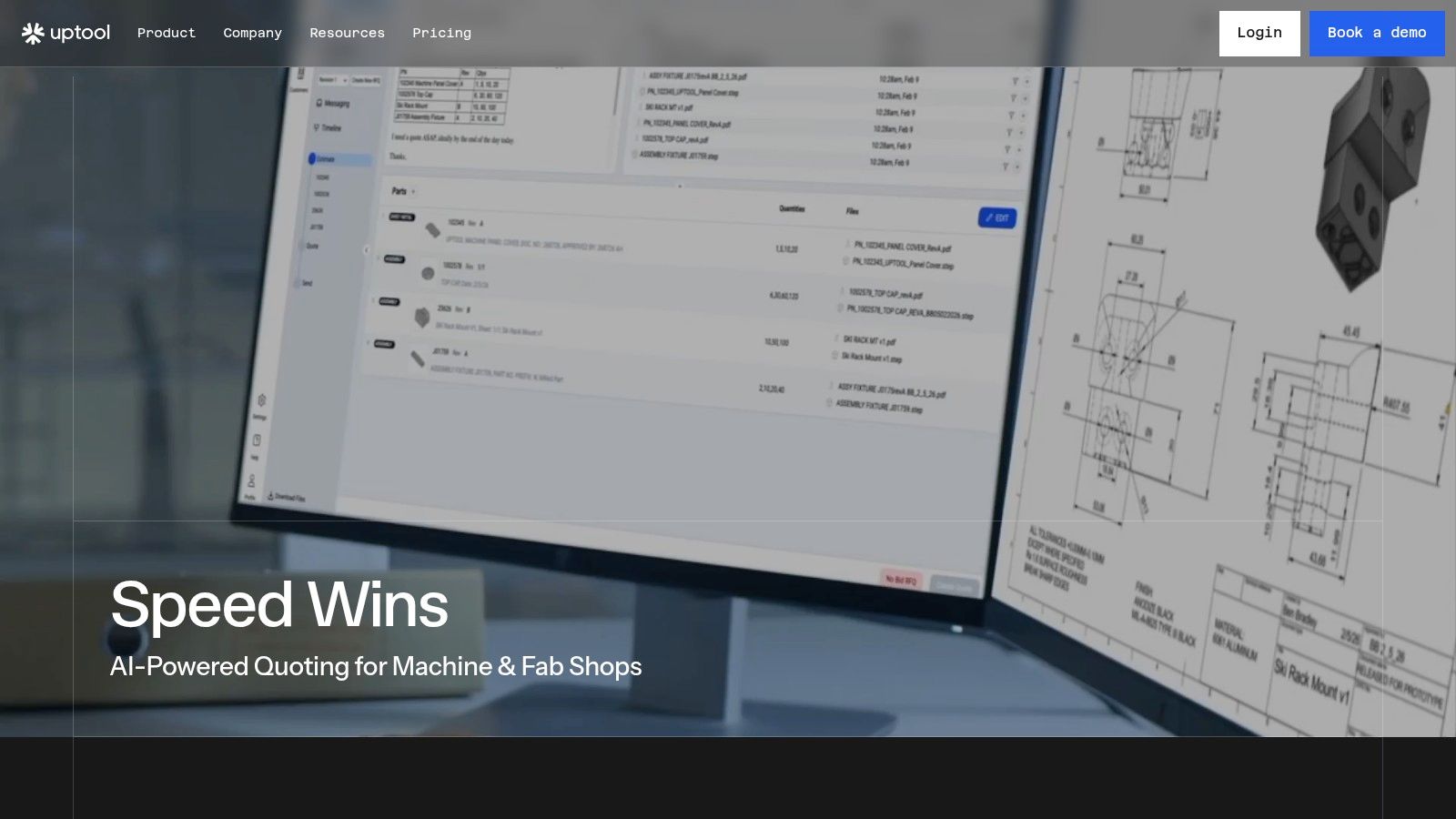
A quoting platform connects to the accounts receiving customer work. It detects new requests, groups them in a central queue, and shows which RFQs are active, waiting for information, or ready for review. The immediate gain is control over incoming work and fewer hours spent locating attachments or deciding whether separate files belong to the same job.
A practical AI quoting sequence
A useful workflow follows an experienced estimator's sequence while reducing manual retyping:
Capture the request. The system groups the email, attachments, drawings, CAD files, BOMs, and customer replies into one RFQ record.
Extract part information. It identifies part numbers, revisions, descriptions, quantities, materials, and finishes. The estimator verifies those fields instead of entering each one from scratch.
Review manufacturability inputs. For CNC work, the model can organize geometry, material, finish, and whether the part is independent or part of a larger assembly. For sheet metal, it can structure information for laser or waterjet cutting, bending, deburring, and downstream finishing.
Apply shop rules. Calculators and operation libraries convert those inputs into machine time, setup requirements, material usage, outside processing, labor, markup, and lead-time assumptions.
Flag exceptions. Missing tolerances, unclear finishes, incomplete drawings, and unusual geometry should appear as review questions. The system should expose uncertainty, not bury it inside a confident-looking price.
Issue a controlled quote. Templates, configurable markups, lead times, revision history, and customer messages create consistency while leaving final approval with the estimator.
Material and finishing data can change the result as much as the part geometry. An industry source on AI quoting workflows describes platforms that combine material and finishing databases with workflow calculators, allowing estimates to reflect distributor and finisher inputs rather than the drawing alone.
Where the estimator still matters
Automation handles file organization and repeatable calculations. It does not replace judgment about a cosmetic stainless part that needs protection, a thin feature requiring a different bend sequence, or a tight-tolerance bore that must fit available inspection capacity.
The estimator remains accountable for the assumptions. AI prepares the RFQ record, extracts inputs, and produces a draft. The estimator checks the process, adjusts the numbers, requests clarification, and approves the quote. Teams planning this setup can document their existing workflow with a guide to the typical machine shop RFQ process before configuring automation.
The practical result is a traceable estimate. Source files, revisions, materials, finishing requirements, assumptions, and approval history stay together, giving the shop a defensible price and a clearer starting point for production.
Connecting Front Office Quoting to Back Office Execution
A quote can be accurate and still fail on the shop floor if its assumptions disappear during handoff. In many CNC and sheet metal shops, the estimator prints the quote, then production rebuilds the traveler from email, drawings, and memory. That re-entry creates errors in material, finish, revision, and routing.
The data thread should begin with the RFQ and continue through purchasing, cutting, machining, finishing, inspection, job costing, and invoicing. The quoted material grade must follow the job. Outside processing should remain visible. Setup assumptions should reach programming and production instead of staying in estimator notes.
The traveler is the handoff point
A digital traveler can carry the part number, revision, quantity, material, finish, routing, setup notes, inspection requirements, and customer documentation. For sheet metal, it can retain the link between the flat pattern, laser or waterjet cutting, bend sequence, deburring, and finishing. For CNC work, it can connect stock size, fixture notes, tooling assumptions, inspection points, and later operations.
That continuity becomes important after a customer revises a drawing. Staff should be able to identify the quote, traveler, program, material purchase, and inspection record tied to the current version. If revisions do not stay connected, email and paper will remain the unofficial record.
A shop does not need a large factory overhaul to improve this handoff. Connecting quoting software to the traveler and existing production records often removes more re-entry than adding another machine sensor.
Accounting needs production context
QuickBooks or another accounting system can issue invoices, but profitability depends on the work performed before billing. Compare quoted material, labor, machine time, outside finishing, and shipping assumptions with actual job costs. Those comparisons sharpen future estimates and expose recurring leakage, such as underestimated setup time or finishing charges.
An overview of manufacturing quoting software can help teams evaluate how quote fields connect with digital travelers and back-office processes. Ask which fields transfer, how revisions are handled, whether job numbers remain consistent, and how actual costs return to estimating before selecting an integration.
Sensors can later add machine state, cycle time, downtime reason, and maintenance events to job costing and capacity planning. Set ownership and data standards first. Inconsistent part numbers or incomplete downtime codes will only produce faster confusion.
Overcoming the Real Barriers to Digital Adoption
Small and mid-sized manufacturers rarely reject modernization because they dislike technology. They hesitate because the business case feels uncertain, capital is limited, experienced people are stretched thin, and integration sounds like a project that could consume the very time the shop is trying to recover.
A Deloitte survey on smart manufacturing barriers points to familiar obstacles, including weak business cases, limited awareness, implementation costs, workforce shortages, and skill gaps. Those concerns are rational. A shop shouldn't buy an impressive system without knowing which decision it will improve and who will maintain the workflow.
Start with the problem that already costs time
A phased plan reduces risk:
Choose one bottleneck: Track where RFQs wait, where machines lose time, or where travelers require rework. Pick the problem employees already complain about.
Define the handoff: Write down the fields that must survive from customer request to production, including material, finish, revision, quantity, and due date.
Run human and automated workflows together: Let the estimator compare the system's extraction and calculations with the existing method. This exposes errors before the process becomes operational.
Keep the first integration narrow: Connect the email inbox, quoting workflow, and accounting or production destination that matter most. Avoid replacing every system at once.
Review the result: Measure qualitative outcomes such as response consistency, missing information, revision control, and estimator workload before expanding.
Cloud tools can reduce infrastructure work, but cloud adoption doesn't remove process design. The shop still needs clean material names, reliable finishing suppliers, sensible calculators, and a clear approval path. A low-friction subscription can make testing easier, but the owner should still assign someone to manage permissions, templates, and exceptions.
Protect the expertise you already have
Veteran estimators often carry the shop's most valuable manufacturing knowledge. Treating them as obstacles will produce resistance and poor configuration. Ask them to define the rules, identify common exceptions, and review the first automated estimates.
Interoperability is another barrier, especially when a shop works with suppliers and outside finishers. Research on manufacturing ecosystems highlights standardization, data ownership, partner maturity, and legal or regulatory clarity as adoption concerns. The practical response is to document who owns each field, which system is authoritative, and what information can be shared with a supplier.
The first investment should create evidence. If a quoting workflow saves meaningful administrative effort and improves estimate completeness, it earns the next investment. If it creates another dashboard nobody trusts, stop and fix the foundation.
Measuring ROI and Industry Adoption Trends
A modern job shop earns back digital investment by protecting margin before a work order reaches the floor. A quoting model that reads geometry, material, finish, and job context can improve pricing decisions more directly than a general productivity dashboard. A report on Xometry's AI model architecture describes about 15% improvement in CNC cost-prediction accuracy during live testing after using more granular, part-specific inputs.
The gain matters most when process assumptions carry real cost. A simple turned component may be quick to estimate manually. A complex milled part can involve several setups, special tooling, tight inspection requirements, and outside finishing. Each handoff creates another opportunity for the estimate to drift from production reality.
Sheet metal shops face the same pressure. A sheet metal fabrication industry statistics source reports CNC adoption rising from 55% in 2018 to 78% in 2023, while automation reduced labor costs by an average of 18% since 2020. It also projects laser cutting at 52% of sheet metal cutting share by 2025. Treat that last figure as a source-specific projection, not a promise for every shop.
Industry adoption gives owners a useful reality check. The Siemens-referenced Industry 4.0 scaling survey found that around eight in every 10 larger manufacturers had piloted a significant Industry 4.0 project. Only 29% had begun rolling solutions across production processes, while 41% remained in pilot stages and 30% had not started. The message for a smaller CNC or sheet metal shop is practical: testing technology is common, but turning a pilot into a dependable workflow requires process ownership and measurable results.
Technology Area | Operational Impact | Key Metric |
|---|---|---|
IIoT monitoring | Flags machine-health changes and production interruptions earlier | IoT was the most commonly adopted Industry 4.0 technology at 55% in the 2026 industry review |
Cloud manufacturing systems | Keeps quoting and production information available across connected workflows | Implemented by 35% of firms in the same review |
AI cost modeling | Uses geometry, material, finish, and job context to improve estimate precision | About 15% better CNC cost-prediction accuracy in live testing (Quiver Quant report) |
Digital twins | Links live sensing with simulation and maintenance planning | Up to 93.4% simulated reduction in unscheduled downtime (CJOS study) |
Sheet metal automation | Supports CNC cutting, bending, and repeatable material handling | 18% average labor-cost reduction since 2020, as reported by World Metrics |
Use these figures to frame a decision, not to forecast your exact result. Track quote turnaround, estimator hours, scrap, rework, downtime, outside-processing variance, and the gap between estimated and actual job cost. For a small shop, a shorter RFQ queue and fewer pricing corrections may justify a tool before a large factory-wide deployment does.
Your First Steps Toward a Smarter Manufacturing Business
A small CNC or sheet metal shop can find its first useful improvement by tracing one real job from RFQ to invoice. Mark every point where staff retype drawing data, search for CAD files, wait for material or finishing information, or discover that the quoted process does not fit production.
A practical adoption checklist
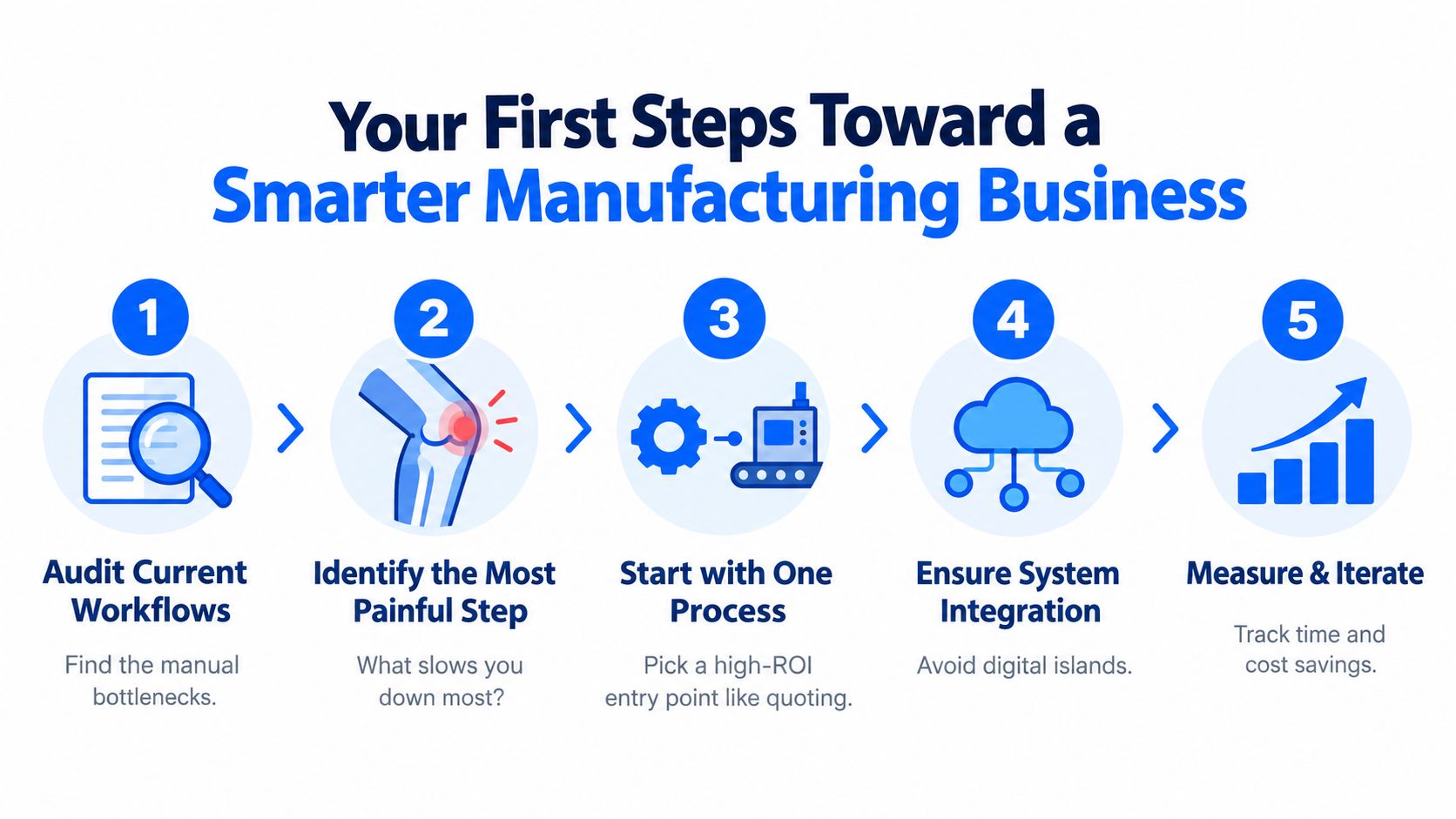
Audit current workflows. Trace a CNC quote and a sheet metal quote separately. Record where drawings, CAD files, BOMs, materials, finishes, and revisions live.
Name the painful step. Choose the largest constraint, such as an RFQ backlog, setup variation, missing material details, finishing delays, or weak job-cost feedback.
Start with one process. AI-assisted quoting often makes a practical first project because it affects every potential job before labor and machine capacity are committed.
Check integration before features. Confirm compatibility with email, CAD formats, accounting, and production workflows. If employees must rebuild information by hand, the bottleneck remains.
Measure and iterate. Track quote completeness, turnaround consistency, estimator review time, revision handling, and actual-versus-quoted costs. Adjust calculators, templates, permissions, and approval rules based on those results.
Manufacturing 4.0 technologies should support the people who already know how to make good parts. Connected quoting gives estimators cleaner job information. Digital travelers give operators clearer instructions. IIoT monitoring gives maintenance staff earlier warnings, while simulation helps programmers prevent avoidable scrap. The shop keeps its flexibility, and its working knowledge becomes easier to share and repeat.
Uptool provides AI-powered quoting software for CNC machine and fabrication shops, including RFQ intake, CAD and drawing analysis, material and finishing inputs, quote organization, digital travelers, and QuickBooks integration. Visit Uptool to assess whether a connected quoting workflow addresses your front-office bottleneck.