Your estimator is trying to price three urgent RFQs, a repeat customer wants a delivery date moved forward, and a machine has just gone down with a half-finished stainless part on the table. The schedule already looked tight before the disruption. Now every decision depends on whether the original estimates reflected setup time, outside processing, material availability, and operator capacity.
That's the operating reality of job shop manufacturing. The shop doesn't fail because every individual job is impossible. It struggles when small errors in quoting become bad production assumptions, then turn into crowded queues, rushed decisions, rework, and missed promise dates. A profitable job shop therefore needs more than capable CNC machines and experienced fabricators. It needs a reliable connection between the quote, the routing, and what happens on the floor.
Table of Contents
What Makes Job Shop Manufacturing Different
A job shop owner might start the week with a small aluminum housing, a stainless bracket, a sheet metal enclosure, and a repair part for equipment that's no longer supported. None of these jobs follows the same routing. One may go through sawing, CNC milling, deburring, and anodizing. Another may require laser cutting, press-brake forming, welding, powder coating, and final assembly.
That variety is the point. Job shop manufacturing is a flexible production model built around small-batch, custom work rather than long, repetitive runs. A mass-production plant wins by repeating a controlled sequence with dedicated equipment. A job shop earns its place by changing tools, fixtures, programs, materials, and work instructions without rebuilding the entire operation.
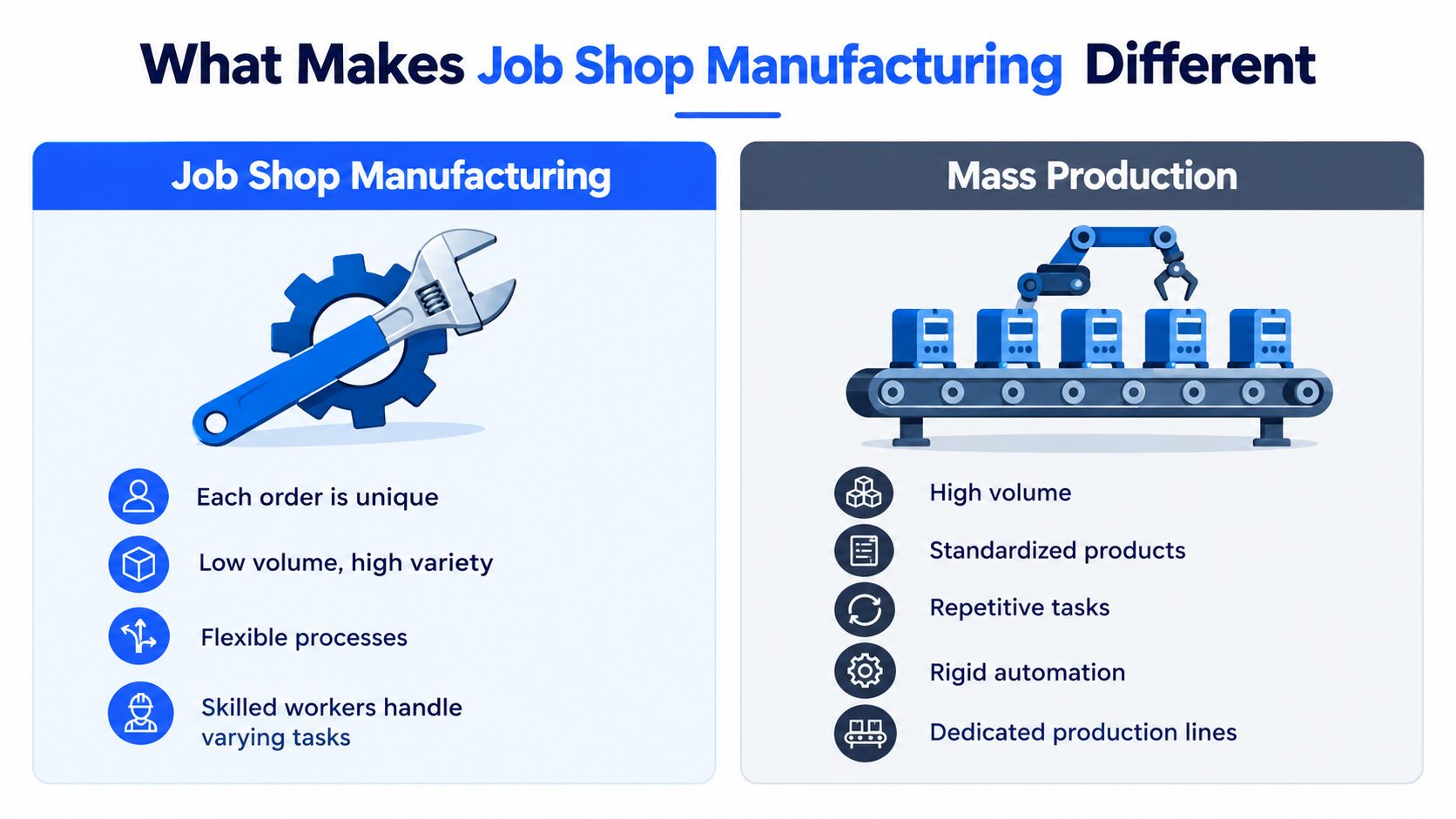
The benchmark data reflects that operating model. A widely cited industry survey reported a median batch size of 95 parts, while 65% of parts fit within a 6-inch cube. Precision requirements are also significant, with 40% of jobs requiring tolerances of 0.0005 inch and 33% reporting an even tighter 0.0001-inch tolerance. Those figures describe a low-volume environment where setup decisions and inspection discipline matter as much as cutting speed. The industry survey summarized by Connell provides the underlying benchmark context.
The business model behind the flexibility
Job shops typically serve customers who can't justify dedicated tooling or a long production line. They may need a prototype, replacement component, short production run, custom fixture, precision-machined insert, or fabricated enclosure. The customer pays for the shop's ability to interpret requirements, select a workable process, and deliver parts without demanding a massive minimum order.
The sector also has a broad ownership and customer structure. The same survey found that 48% of facilities were independent job shops, 40% were contract shops, and 11% were captive shops, confirming that the model exists across different manufacturing relationships rather than in one narrow niche. The work may be local and relationship-driven, but the operating demands are globally familiar.
Historically, the model reaches back to the pre-industrial putting-out, or domestic, system, one of the earliest forms of job shop production before large factories became dominant. In modern U.S. manufacturing, the surrounding labor base remains substantial. The Bureau of Labor Statistics reported about 12.6 million manufacturing employees overall in 2026, while a machine-shop industry summary cited 265,030 U.S. employees in NAICS 332710 in May 2023. That summary projected 243,068 employees in 2025 and 269,958 by 2030, showing that custom machining remains a sizeable industrial activity. AMT's job shop employment summary gives the broader context.
A shop fits the job shop model when mix, customization, and routing variability dominate volume. That means management practices built for repetitive production often create more problems than they solve. The owner needs visibility into every job, but also enough flexibility to respond when material, equipment, or customer priorities change.
Core Processes in Modern Job Shops
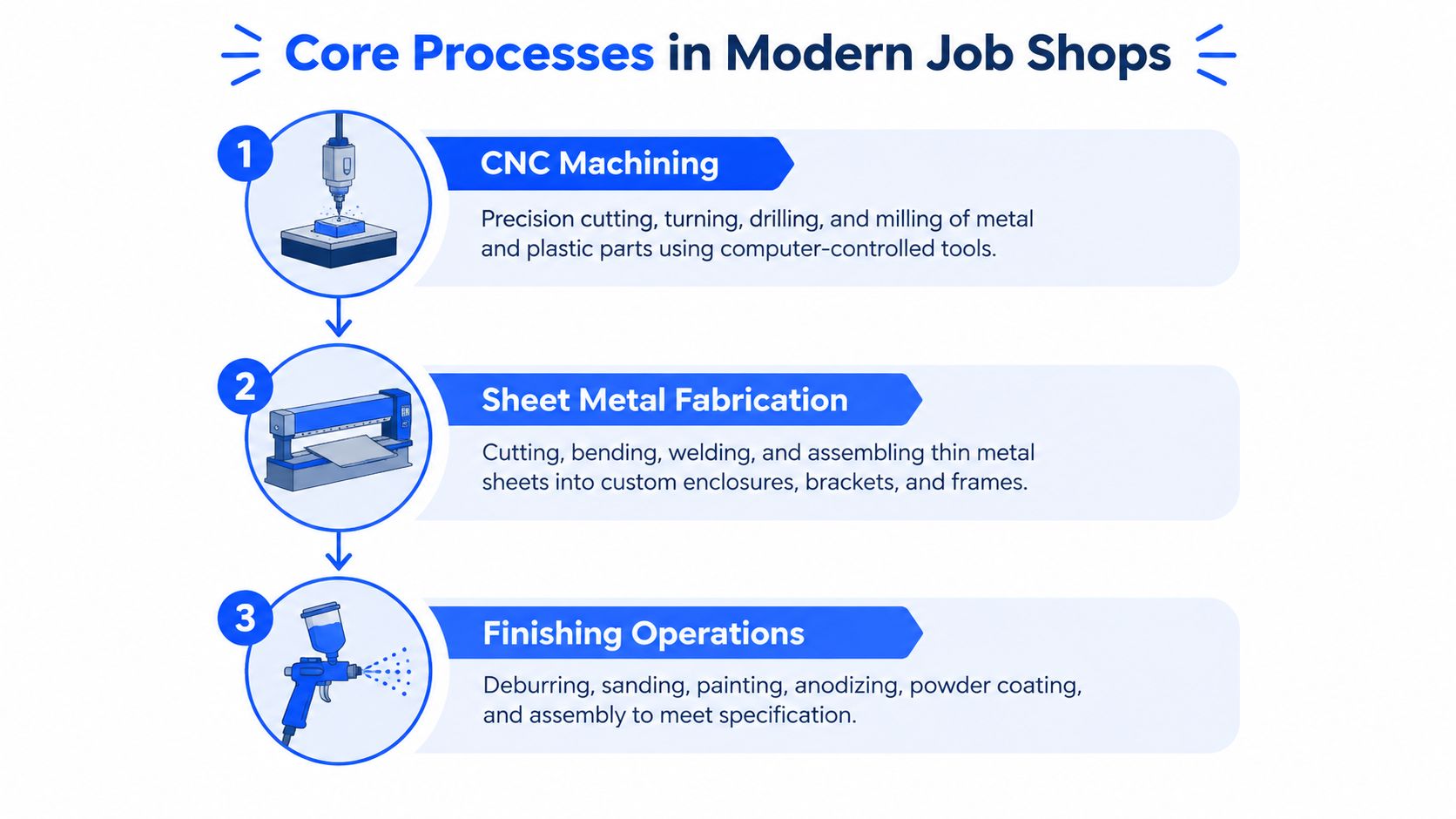
Modern job shops often combine three connected capabilities: CNC machining, sheet metal fabrication, and finishing. Treating them as separate departments can hide costs and create schedule gaps. A reliable quote and routing follow the complete part, including material certification, inspection, secondary operations, and outside finishing.
CNC machining
CNC mills and lathes handle precision cutting, turning, drilling, boring, and milling. A small bracket can require several setups, custom soft jaws, probing, tool changes, and inspection points. The estimate should separate programming, setup, first-piece verification, cycle time, tool wear, deburring, and cleanup. Spindle time alone rarely represents the actual work.
Material choice also affects both cost and delivery. 6061-T6 aluminum, 304 stainless, and mild steel are common materials that shops may often find in stock. 7075-T6 plate and 316L bar are typically 3–7 days out, while titanium Grade 5 and Inconel 718 are often 2–4 weeks out. Specialty alloys such as Hastelloy can take 4–8 weeks. These material lead times come from CNC Fabworks' guide to manufacturing lead-time factors. A delivery promise that ignores material availability will destabilize the schedule before machining begins.
Sheet metal fabrication
Sheet metal fabrication introduces different production variables. Cutting may use a laser, punch, saw, or shear, followed by press-brake forming. Welding, hardware insertion, grinding, and assembly can require more labor than cutting. Estimators need to account for bend sequence, tooling, grain direction where relevant, weld access, distortion control, and the expected amount of hand finishing.
Drawings often specify thickness and finish without resolving practical details. Visible weld faces may need cleanup. Holes may need to be cut before forming. An enclosure may require captive hardware, masking, or a separate inspection fixture. Each unresolved detail can change the quote, routing, and promised delivery date.
Finishing operations
Finishing includes deburring, sanding, painting, powder coating, anodizing, plating, cleaning, and assembly. Many of these processes occur outside the shop, so supplier capacity and transit time belong in the production plan. Common plating and anodizing work can add 5–10 business days, according to Nimble Manufacturing's precision manufacturing lead-time guide.
The operating rule is direct:
A part isn't ready for delivery when machining ends. It's ready when every specified process, inspection, and document is complete.
A CNC-machined aluminum part requiring anodizing needs a routing that carries the finish requirement from the RFQ through purchasing, production, outside processing, inspection, and shipping. Fabricated steel requiring powder coating needs the same control. If finishing remains in a separate email thread, the missing handoff will eventually appear as waiting time, rework, or a late shipment. Accurate estimates protect the schedule because they expose those dependencies before the job reaches the floor.
The Job Shop Workflow from Quote to Delivery
A reliable workflow starts before the purchase order arrives. Each stage should preserve the assumptions made at the previous stage, so the production team isn't forced to reconstruct the job from emails and memory.
RFQ received. Capture the drawing revision, CAD files, bill of materials, material grade, quantity, tolerance requirements, finish, inspection needs, and requested deadline. Missing information should become a visible question, not a silent assumption.
Quoting and estimation. Break the work into material, programming, setup, run time, secondary operations, inspection, packaging, outside processing, and overhead. A practical reference for the typical machine shop RFQ process helps clarify what information should be collected before pricing.
Order entry. Once the customer accepts, assign a job number and lock the approved drawing revision. The purchase order, quote, customer correspondence, and internal notes should point to the same controlled record.
Production planning. Create the routing, order material, reserve tooling and fixtures, check work-center capacity, and identify outside-process dependencies. A vague estimate becomes a finite production commitment.
Manufacturing. Operators follow the traveler through machining, fabrication, finishing, and inspection. The traveler should provide a place to record actual quantities, time, deviations, and quality results.
Delivery. Complete final inspection, verify documentation, package the parts correctly, ship, invoice, and record customer feedback. If the final delivery date slipped, the team should be able to identify whether material, setup, capacity, rework, or outside processing caused the variance.

Variability enters at every handoff. A rush order changes priorities. A tool breaks during a critical operation. A material shortage stops a route that looked ready. An operator finds that the drawing revision on the traveler doesn't match the file at the machine. Without a controlled traveler and clear routing, each disruption creates a separate investigation.
The most useful workflow is not the one with the most forms. It's the one that lets a planner answer three questions quickly: What is this job waiting for, where is it now, and what assumption is threatening its delivery date?
Why Quoting Accuracy Determines Shop Performance
Quoting is often treated as sales administration. In a job shop, that view is too narrow. The quote establishes the labor load, machine demand, material timing, outside-process requirements, and promise date that production will later try to meet.
Underestimate setup time and the schedule carries hidden work. Underestimate processing time and the queue becomes overloaded. Miss a finishing operation and the parts may reach the end of machining only to wait for a supplier. Overestimate everything and the shop may protect its capacity, but the price and delivery promise can become less competitive.

A quote is therefore a production control input. The estimator's assumptions influence which jobs the shop accepts, how much capacity planners reserve, and whether the promised date leaves room for normal variation. MIT-based operational analysis identifies unpredictable variability as a primary characteristic of job shops, including machine failures, rush orders, tool breakages, shortages, rework, and operator unavailability. The MIT job-shop analysis also describes the importance of accurate routings, setup times, processing times, and priority rules such as due date, slack, and critical ratio.
The cost of discovering errors late
Many shops learn that an estimate was wrong only after the job closes. The traveler shows more setup hours than quoted. The fabricator spent additional time fitting and grinding. The outside finisher took longer than expected. The job may still ship, but the margin is gone, and the schedule has absorbed the extra work.
That feedback often stays trapped in the completed job folder. The next estimator then relies on memory, a spreadsheet copied from an older quote, or a standard rate that no longer reflects actual conditions. The cycle repeats.
Material costing deserves the same discipline as labor and machine time. A structured guide to estimating material cost can help shops separate raw stock, yield, remnant use, freight, and material-specific assumptions instead of hiding everything inside a broad allowance.
The cheapest quote to prepare is the one that forces production to explain the estimate afterward.
A stable shop doesn't aim for perfect prediction. It creates a process that exposes estimate-to-actual variance, identifies recurring errors, and updates future quotes. That approach improves both commercial judgment and schedule credibility.
Managing Work-in-Progress and Lead Times
A crowded shop floor can look busy while delivery control deteriorates. Parts wait beside machines, travelers disappear beneath paperwork, and operators switch jobs because the next operation is not ready. Machine utilization may appear healthy, yet customers receive uncertain promise dates. In high-mix, low-volume work, quoting accuracy has a direct effect on that stability. An underestimated route releases work the schedule cannot absorb, while an accurate estimate gives planners a credible sequence.
Job shops manage WIP and flow time, not maximum utilization at every individual machine. Excess WIP creates congestion and extends lead time. Job-shop research treats due-date performance, lower WIP, lower average flow time, and effective use of machines and workers as connected objectives. A CONWIP-style manufacturing study reported throughput within 5% of expected maximum while reducing WIP by 45% versus a comparable CONWIP setting. The manufacturing operations paper documents that comparison.
Release work deliberately
Releasing every approved job can keep upstream departments occupied, but it also fills queues before the constraint processes the work already in front of it. Gate new releases so WIP remains near a small buffer around the bottleneck. That buffer protects throughput without turning each work center into a storage area.
A CNC and fabrication shop needs clear release checks:
Material readiness: Do not launch a route that will stop for missing 7075-T6 plate or outside hardware.
Routing completeness: Include programming, setup, inspection, deburring, finishing, and packaging before placing the job on the schedule.
Constraint awareness: Load the work center against available capacity, not an idealized machine-hour total.
Priority rules: Use due date, remaining slack, and critical ratio to resolve conflicts instead of reprioritizing whenever a new request arrives.
These checks connect the estimate to the floor. If setup, inspection, or outside processing is absent from the quote, the schedule inherits a false capacity assumption. The resulting WIP is often a symptom of quoting and release decisions, not a machine shortage.
Promise dates need more than cycle time
Lead-time quotes must account for operation time, transitions, outside processing, material availability, queue conditions, and capacity constraints. A nominal cycle time describes cutting time. It does not establish when a finished part can ship.
Process | Prototype Lead Time | Production Lead Time, 50-500 pcs |
|---|---|---|
CNC machining | 5-15 business days | 3-6 weeks |
Sheet metal fabrication | 5-10 business days | 2-4 weeks |
These benchmarks come from Nimble Manufacturing's guide to precision manufacturing lead times. External finishing may add 5–10 business days for common plating and anodize work, so the promise date should cover the complete route, not only internal machining.
WIP accounting also matters. Unfinished jobs tie up material, labor, and overhead, and their value remains attached to work that has not shipped. The HireAccountants guide to WIP accounting explains how work-in-process appears in the accounts.
Accept a shorter promise date only when material, capacity, outside processors, and inspection workload support it. A credible estimate keeps releases orderly, limits rescheduling, and gives customers a date the shop can defend.
Building a Closed-Loop Quoting System
Estimates drift when the shop closes jobs without closing the learning loop. The estimator may remember that a similar stainless part was difficult, but memory rarely captures the exact setup sequence, tool changes, fixture adjustments, inspection time, scrap, or supplier delay that caused the problem.
The remedy doesn't require a major software purchase on the first day. It requires a consistent comparison between what the quote assumed and what the completed job consumed.
Capture the data that changes future decisions
At minimum, the shop should record actual setup time, run time, programming time, material usage, outside-processing charges, inspection labor, rework, and delay reasons. The operator doesn't need to write an essay. A traveler or digital job record can capture a clear variance against the estimate.
For example, if a five-operation aluminum housing repeatedly takes longer during fixture setup than the quote allows, that isn't an operator problem to hide. It's a standard that needs correction. If anodizing regularly adds an unexpected queue, the lead-time model needs a supplier allowance or a different promise-date rule.
The review should separate types of variance:
Estimate error: The original assumption was too low or too high.
Execution problem: The process deviated from a sound estimate.
Scope change: The customer or drawing changed after approval.
External delay: Material, finishing, or transport caused the slip.
That distinction prevents the team from “fixing” a good standard because a customer changed the job.
Start simple, then automate
A spreadsheet can work if every closed job uses the same fields and someone reviews the results on a regular cadence. The danger isn't simplicity. The danger is inconsistent entry, disconnected versions, and no owner responsible for updating standards.
Integrated quoting and production systems make the loop easier by linking the original estimate to the job traveler and actual time records. The estimator can then search for comparable materials, operations, and part families instead of rebuilding each quote from scratch.
A completed job should leave behind more than an invoice. It should improve the next estimate.
This approach also changes the conversation between office and floor. Operators can explain why a setup ran long. Estimators can see which assumptions need revision. Planners can trust that the route reflects actual work rather than a theoretical sequence. Over time, the shop gains a pricing and scheduling system that learns from its own production history.
The objective isn't to eliminate judgment. Skilled judgment remains essential for unusual geometries, tight tolerances, difficult materials, and incomplete drawings. The objective is to reserve that judgment for genuine uncertainty instead of repeatedly solving the same known problem.
How Quoting Software Accelerates Shop Performance
Quoting software matters when it keeps the right information connected from RFQ intake to production. A system can pull requests from connected inboxes, organize them in a command center, analyze CAD files, drawings, and BOMs, and help the estimator build a costed quote from structured inputs.
For CNC and sheet metal shops, the useful capabilities are practical:
RFQ capture: Surface incoming requests so they don't remain buried in email threads.
CAD and drawing review: Extract geometry and key inputs before the estimator builds the process plan.
Cost databases: Keep material, operation, and finishing assumptions together.
Revision control: Preserve drawing versions and quote history when the customer changes requirements.
Digital travelers: Carry approved information into production without retyping it.
Accounting connection: Sync relevant front-office information with systems such as QuickBooks.
Uptool is one example of this approach. Its platform ingests RFQ emails and manufacturing files, supports AI-assisted estimating, uses material and finishing databases, creates configurable quotes, maintains revision history, generates digital travelers, and integrates with QuickBooks. The workflow is designed to reduce per-part estimating from hours to minutes while keeping the estimator in control of edits and approval. Shops comparing options can review the machine shop software stack alongside their current quoting, scheduling, and accounting tools.
The operational benefit isn't speed alone. Faster estimates help the shop respond while the opportunity is active, but traceable estimates help planners build more credible routes and promise dates. That is the connection owners should evaluate. A quoting tool earns its place when it improves the quality of the handoff, not merely the appearance of the quote.
Uptool helps CNC machine and fabrication shops organize RFQs, analyze CAD and drawings, build material and finishing costs, and carry approved quote information into digital travelers. Visit Uptool to see how a more connected quoting workflow can improve estimate accuracy and give your production schedule a stronger starting point.
