In high-mix job shops, setup can consume 15% to 30% of total available machine hours, and frequent-changeover environments can lose 20% to 40% of available capacity to setup. Accurate estimating starts by breaking setup into its actual tasks, timing each one, and adjusting the estimate for the fixture, machine, material, and first-part risk.
That makes setup time one of the most important profitability levers in CNC machining, sheet metal fabrication, and finishing. A quote can look competitive while hiding hours of unpaid preparation, alignment, programming, inspection, and rework risk.
The practical answer isn't to find one universal setup-time average. It's to build a repeatable estimate from task-level data, then use software to extract the information that estimators currently gather by hand. The shops that do this well protect their margins without slowing down every RFQ.
Table of Contents
Why Setup Time Drives Your Shop's Profitability
Setup can consume 15% to 30% of total available machine hours in high-mix, low-volume job shops, tying up capacity before production begins (Bloomfield's manufacturing analysis). That time includes labor, machine occupancy, scheduling disruption, and the risk of a first part that needs correction.
A quote can look competitive while carrying unpaid preparation. If setup runs longer than planned, the job occupies the machine and operator beyond the quoted window. Delivery dates tighten, the schedule becomes harder to adjust, and higher-value work may be pushed aside. The margin loss comes from the gap between the work assumed in the estimate and the work required on the floor.

Define the cost before you calculate it
For quoting, setup runs from the end of one production run to the start of the next acceptable production run. Track the work performed in that interval, including:
Workholding: Remove the previous fixture, prepare the next one, load it, and secure the work.
Tool preparation: Gather, load, and preset tools, then enter or verify offsets.
Program readiness: Load the CNC program, confirm its revision, and check it against the job.
Alignment and proving: Establish datums, probe or touch off, run a dry check, and correct errors.
First-part approval: Produce and inspect the first acceptable part before normal production begins.
A broad setup allowance hides the source of an error. A task-level estimate shows whether the time is going into fixture access, tool staging, alignment, programming, or inspection.
AI-powered quoting platforms can reduce manual guesswork by parsing CAD files, identifying setup-related requirements, and comparing the job with historical setup records. Historical data should still be checked for differences in machine, fixture, material, and operator process. Querio's approach to AI benchmarking is a useful reference when defining operational data for consistent comparison.
Practical rule: If your quote does not show what the operator will do before the first good part, it is not a setup estimate. It is a guess.
What Actually Counts as Machine Setup
The setup clock starts when the previous job ends and stops when the next job is ready to run production. That definition keeps estimators from mixing setup with cycle time, material handling after production starts, or finishing work that belongs elsewhere in the route.
Start with the paperwork and digital files. The operator may need to review the drawing, confirm the revision, check material and quantity, verify the work instructions, and identify critical dimensions. For sheet metal, that review may also include bend sequence, tooling, grain direction, and finishing requirements. For CNC machining, it may involve confirming the datum scheme and the number of operations.
Then account for physical preparation:
Retrieve the setup package: Find the fixture, vise jaws, clamps, tooling, gauges, raw stock, and setup documentation.
Prepare the machine: Remove the previous workholding, clean the table or chuck, install the next fixture, and verify clamping access.
Load the process: Transfer the program, load tools, check tool numbers, and enter or confirm tool length and diameter offsets.
Establish location: Align the fixture or workpiece, set the datum, probe the part when applicable, and verify the coordinate system.
Prove the operation: Run a dry check or controlled first run, observe clearances, and correct offsets or program details.
Approve the first part: Inspect the required features, document the result, and release the process for production.
The first acceptable part matters. A machine can be cutting metal while the job is still in setup if the operator is adjusting offsets, confirming dimensions, or waiting for approval. That time belongs in the estimate because the machine and operator aren't yet delivering normal production output.
Safety checks also belong in a disciplined workflow. A short Take 5 hazards and controls checklist can help operators identify risks before fixture changes, lifting, clamping, or machine access. Safety preparation shouldn't be treated as waste or squeezed out of the quote.
Setup Variance in CNC Machining and Fabrication
Manual CNC setups commonly take roughly 20 to 60 minutes, while palletized changes can take about 1 to 5 minutes (Symestic's overview of setup processes). Those ranges are useful benchmarks, but they are poor substitutes for job-specific records. A manual setup may keep the machine idle while the operator handles every preparation task. A pallet system can shift fixture preparation, inspection, and loading away from the spindle.
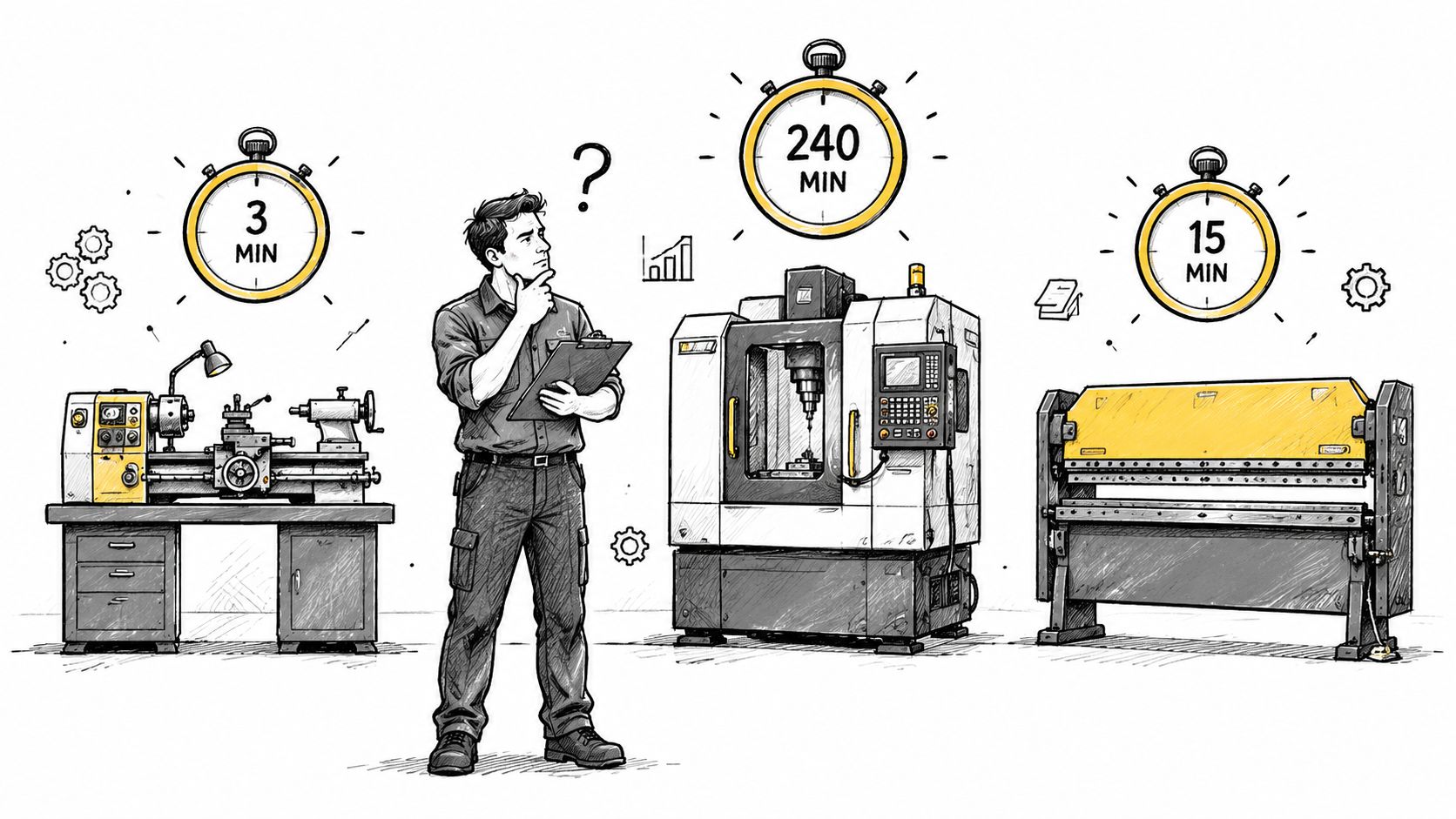
The variance sits in the job details. Standardized tooling, preset offsets, quick-change vises, zero-point systems, and modular fixtures reduce the time spent inside the machine window. A new fixture, unfamiliar material, or incomplete setup record puts that time back into the quote.
A proven repeat job may need cleaning, fixture loading, locating, and an offset check. A new part can require drawing review, fixture adjustment, tool selection, probing, program proofing, and first-piece inspection. The same machine can produce either estimate when the workholding and process history differ.
Fabrication shops face comparable variation without a CNC spindle. A sheet metal setup may involve selecting a press brake program, loading punches and dies, positioning backgauges, confirming bend allowances, and checking the first formed part. Finishing preparation can include masking, rack setup, surface preparation, color or coating confirmation, and inspection.
Track the causes of variance, not just total minutes. A proven fixture carries less uncertainty than improvised clamping. Tools, fixtures, and offsets staged before the machine stops shorten machine-occupied time. Repeat orders should draw from actual prior setup data rather than the original estimate. Tight tolerances, difficult materials, multiple datums, and demanding finishes increase the chance of further proving or inspection.
AI-powered quoting platforms can make this comparison practical at quote time. Automated CAD parsing can identify features, orientations, workholding implications, and process complexity. Historical setup records can then anchor the estimate in comparable jobs instead of a rigid rule of thumb. The estimator still checks unusual clamping, access, and inspection requirements, but the platform exposes variance that memory often misses.
Quick-change hardware pays back when it removes repeated internal work across enough jobs to improve capacity and reduce quote risk. Measure actual setup minutes before and after the change, including preparation moved offline. Modern equipment alone does not make a quote accurate. Consistent data does.
How to Estimate Setup Time for CNC Machining Quotes
A reliable CNC setup estimate is a sum of activities, not a single allowance. Start with the drawing and process plan, then price the work the operator must complete before the first acceptable part.
Use this sequence:
Review the part and process. Identify material, quantity, critical tolerances, surface requirements, number of operations, datums, and whether the part needs multiple orientations.
Estimate preparation. Account for drawing review, program retrieval or preparation, fixture retrieval, raw stock handling, tool gathering, and gauge selection.
Estimate installation and adjustment. Include fixture removal and installation, workholding adjustment, tool loading, offset entry, workpiece leveling, and datum alignment.
Estimate prove-out. Allow for dry checks, probing, first cuts, offset corrections, toolpath verification, and operator adjustments.
Estimate approval. Include first-piece inspection, documentation, and any required quality signoff.
An engineering study of CNC setup estimation found that trial runs and adjustments accounted for about 50% of total setup time in one facility, with fixture loading, workpiece leveling, and alignment identified as major bottlenecks (the University of Maryland setup-estimation study). That finding changes how an estimator should think. The visible work of loading tools may be easy to time, while the prove-out stage carries the greater risk.
Adjust for the variables that create variance
Fixture maturity is usually more useful than part size as a setup predictor. A proven fixture with clear instructions is different from a new fixture that needs adjustment.
Datum count and alignment tolerance also matter. A part with several critical locating surfaces requires more verification than one with a simple, repeatable datum.
Operator skill and process documentation affect the result. A well-documented setup reduces decisions at the machine. An undocumented setup transfers those decisions to the operator, where they take longer and are harder to predict.
Record estimated setup, actual setup, first-part approval time, and the reason for any difference. A structured cycle-time estimating workflow can help keep setup assumptions separate from cutting-time assumptions, which makes later quote reviews more useful.
Using Quoting Software to Speed Up Estimating
Manual estimating breaks down when job details sit across emails, drawings, CAD files, and spreadsheets. The cost is not limited to slower quoting. Hand entry can miss a finishing requirement, overlook a drawing revision, or assign setup time without recognizing the geometry that drives workholding, probing, and first-part approval.
A quoting platform creates one structured record from those inputs. Uptool provides RFQ ingestion from any connected email inbox, automatic detection, and automated analysis of 3D CAD, 2D drawings, and BOM files. Its AI-powered estimating extracts geometry and part details for costing. Material and finishing databases compiled from distributors and finishers inform pricing, while operation libraries and material calculators support machining and fabrication work.

The useful output is not a setup number with no explanation. It is an editable chain from the source files to the assumptions behind the estimate. For a CNC job, that chain can include part orientation, feature complexity, holes, pockets, material, quantity, and drawing tolerances. For sheet metal, it should capture thickness, bends, cuts, material, and finishing. Finishing estimates also need the specified process, preparation, and inspection requirements.
Those inputs connect directly to shop-specific decisions. Geometry identifies work: features and orientation suggest operations, workholding, and likely setup steps. Material affects preparation: difficult materials may require additional tool checks and more careful proving. Drawings expose risk: tight tolerances, surface requirements, and inspection notes can extend first-part approval. Historical jobs improve calibration: comparable parts give the estimator a defensible starting point based on actual results rather than a fixed assumption.
A platform for automated quoting software becomes more useful when it keeps the RFQ, extracted inputs, estimate, assumptions, and final quote together. After production, the shop can compare quoted setup with actual setup, identify which input caused the variance, and refine future estimates. That record also prevents setup knowledge from remaining trapped in one estimator's spreadsheet.
Balancing Automation with Human Oversight
Automation earns its place when it removes clerical work without hiding process risk. An AI-powered quoting platform can parse CAD geometry, drawings, and RFQ fields, then compare those inputs with historical jobs to produce a starting setup estimate. That replaces guesswork and rigid rules of thumb, but it cannot know every constraint on your shop floor.
The estimator owns the exceptions. Review the result for New workholding: a fixture with no proven setup history or a need for engineering input. Check Unusual material: special tooling, preparation, or finishing treatment may change the baseline. Examine Tight alignment: multiple datums or critical relationships can increase first-piece risk. Stop for Incomplete RFQ data: unclear drawings, BOMs, quantities, or finishing requirements undermine the estimate. Confirm Revision changes: a new drawing version can invalidate an earlier setup assumption.
Software should handle repetitive extraction and baseline calculations. A trained estimator then checks whether the proposed process fits the machine, tooling, operator capability, inspection plan, and actual production environment. That review is where shop knowledge affects margin.
Keep the original quote, revised drawing, estimator edits, actual setup, and first-part result connected in the job record. Version history shows whether variance came from a weak assumption or a production problem, giving the team a sound basis for improving the model and its exception rules.
The outsourced health and safety support offered by Opus Safety illustrates the same principle: automated or external support should strengthen controlled processes while accountability stays with the responsible manager. In quoting, that person is the estimator or shop manager who approves the assumptions.
The best automation doesn't hide uncertainty. It makes uncertainty visible early enough for a human to act on it.
Turning Accurate Estimates into Repeatable Wins
Accurate setup estimates improve more than individual margins. They give sales a defensible quote, scheduling a more realistic view of machine availability, and production a clearer handoff from RFQ to job traveler.
The operating discipline is simple:
Capture the estimated setup before quoting.
Record the actual setup after the first run.
Classify the variance by cause.
Update the relevant fixture, machine, material, or operation history.
Reuse the corrected data on similar jobs.
This system turns setup from tribal knowledge into a business asset. It also helps owners decide whether a fixture, pallet system, presetting station, probing routine, or better documentation will solve a real bottleneck.
Faster quoting only helps when the estimate remains credible. A structured quoting-speed and win-rate workflow connects response speed with the underlying job data, so the shop can answer customers quickly without treating every RFQ as a fresh guess.
Visit Uptool to see how its RFQ ingestion, CAD and drawing analysis, material and finishing data, and AI-assisted estimating can structure setup inputs before a quote reaches the customer. Use it to build a repeatable estimate, then keep the estimator in control of the assumptions that determine whether the job is profitable.