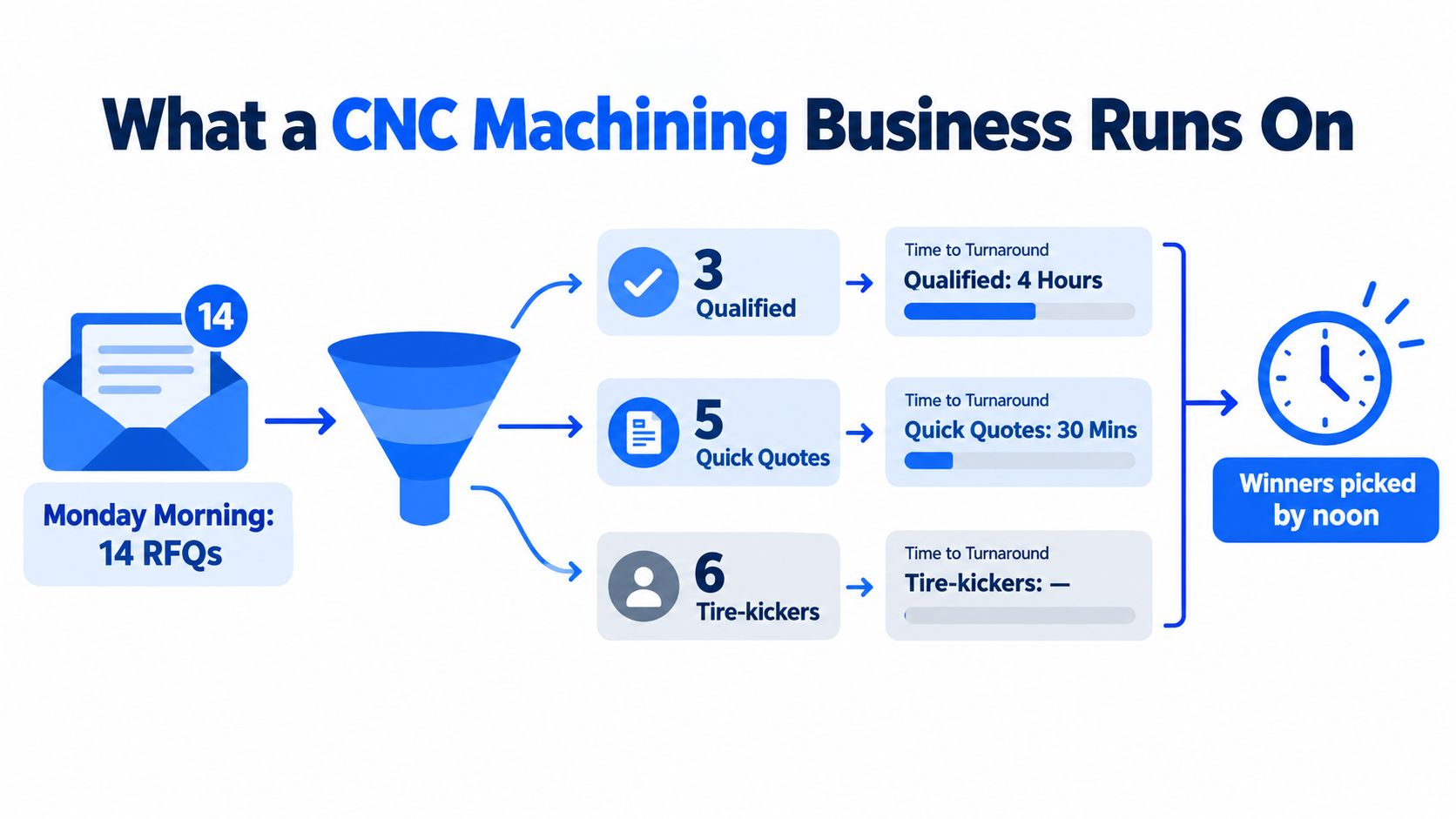
Fourteen RFQs are waiting in the inbox on Monday morning. Three look like serious opportunities, five need a quick answer, and the rest are missing information or were sent to every shop in town. By noon, you need to know which drawings deserve engineering time, which jobs can be quoted quickly, and which ones should be declined before they consume the week.
That's the reality of running a CNC machining business. The mills, lathes, press brakes, inspection equipment, and finishing vendors matter, but they don't create profit by themselves. Profit comes from choosing the right work, returning a defensible quote quickly, scheduling it through the shop without bottlenecks, and feeding actual job results back into the next estimate.
Table of Contents
What a CNC Machining Business Really Runs On
A shop owner usually notices the visible problems first. A machine is waiting for material. A programmer is searching for the latest drawing. A finishing supplier has pushed a delivery date. An operator discovers that the setup takes much longer than the estimator allowed.
The less visible problem is often earlier in the chain. The shop accepted a job without understanding its inspection burden, quoted a repeat part using an old material price, or spent half a day estimating work that had little chance of becoming an order. Those decisions create the panic that shows up later on the floor.
The global market gives capable shops plenty of potential work. One industry summary valued the global CNC machine market at $83.7 billion in 2024, with a projection of $143.4 billion by 2035 at a 5.02% CAGR. A broader definition that includes software, controllers, and services placed the market at $110.65 billion in 2024, projected to reach $191.7 billion by 2035 at a 5.12% CAGR. Another market estimate counted more than 2.5 million CNC machines in operation worldwide in 2024, including 860,000 in Asia-Pacific. These figures are reported in this CNC machining market summary.
That scale doesn't mean every RFQ deserves attention. It means a small improvement in selection, response speed, or machine throughput can matter because the shop is competing inside a large, active production ecosystem.
The four levers owners pull every day
RFQ selection: Decide whether the part fits your machines, materials, tolerances, customer profile, and available capacity. A bad-fit job can be unprofitable even if the machine technically can make it.
Response speed: Get a useful first response to the customer before a competitor becomes the default supplier.
Job sequencing: Slot work around fixtures, material availability, outside processing, inspection needs, and promised dates rather than just filling the next open machine.
Bottleneck removal: Clear programming queues, missing tools, inspection holds, purchasing delays, and finishing handoffs before they stop the next batch.
Revenue is the result of those decisions. Chasing revenue directly often leads owners to accept low-margin work, overfill the schedule, and create overtime that hides weak pricing.
Risk also belongs in the operating picture. A machine breakdown can turn a profitable schedule into an expensive recovery exercise, so it's sensible to compare machinery breakdown policies while reviewing the broader cost of owning and operating equipment.
The RFQ to Quote Workflow That Wins Work
A good quoting process should be repeatable enough that another estimator can follow it without asking the owner to interpret every drawing. It also needs a clear handoff between commercial judgment and technical judgment. The following sequence works because it exposes uncertainty early, before anyone spends time polishing a number built on incomplete information.
Start with triage, not costing
Open the STEP file, drawing, BOM, and customer notes together. Check material, quantity, revision, tolerance zones, GD&T datums, surface finish callouts, certifications, inspection reports, packaging requirements, and any special process such as anodizing, powder coating, plating, heat treatment, or passivation.
Mark the items that can change the job radically. A tight positional tolerance may require probing or CMM time. A cosmetic surface requirement may change fixturing and handling. A material certification requirement adds purchasing and paperwork even when the cut time looks simple.
Use the email inbox and shared folders for intake, but move each RFQ into a visible queue. A typical machine shop RFQ process should make ownership and status obvious, not leave the request buried in a thread.
Build the process before the price
Choose the likely machine, workholding method, tools, number of setups, and rough order of operations. For a milled aluminum bracket, that might mean saw cutting, first-side milling, drilling, tapping, second-side machining, deburring, inspection, and anodizing. For sheet metal, include blanking, bending, deburring, hardware insertion, welding if required, finishing, and final inspection.
The process plan doesn't need to be perfect at triage. It needs to expose the operations that could invalidate a quick estimate.
Estimate time from evidence
Use a machinist calculator, CAM simulation, prior job actuals, or a validated cycle-time library. Don't estimate runtime from the part's overall size or from how familiar the geometry looks. Include tool changes, probing, loading, unloading, part turning, chip clearing, and inspection interruptions.
For sheet metal, account for programming, tool setup, bend sequence, handling, and rework risk around cosmetic surfaces. For finishing, confirm whether the vendor prices by part, batch, rack load, surface area, color, masking, or special certification.
Assemble the cost stack
Put material, setup, runtime, tooling, secondary operations, inspection, packaging, outside processing, and overhead into separate fields. That separation makes omissions visible and lets you adjust one assumption without rebuilding the entire quote.
A spreadsheet can work for a low-volume shop if the formulas are controlled and the revision history is clear. Quoting software becomes more useful as material libraries, finish rates, operations, and customer-specific terms multiply.
Send a quote that can survive revision
The final PDF should identify the drawing revision, quantity, material specification, finish, inspection deliverables, lead time, exclusions, payment terms, freight assumptions, and quote expiry. If the customer sends a revised drawing, create a new version rather than editing the old file in place.
Speed matters, but speed without scope control produces expensive promises. A manufacturing benchmark reports average quote turnaround of 3.8 days for general job shops, 4.5 days for precision machining shops, and 2.4 days for sheet metal and fabrication shops. The top 10% of shops respond in about 1.2 days, according to manufacturing quoting speed benchmarks. The practical rule is simple: aim for a useful first response within hours, then complete the technical quote before the opportunity goes cold.
Pricing Parts and Sheet Metal Jobs With Margin Left
A quote can look busy and still be incomplete. The common mistake is to combine several operations into a single “machining” line, then forget that the customer is buying a finished, inspected, packaged part rather than spindle time alone.
Use a cost stack that mirrors the actual route through the shop.
Keep every cost visible
Material should reflect the current certifiable price and the purchase form you need. Include saw kerf, nesting loss, drops that can't be reused, minimum order quantities, and freight where they affect the job. A 6061 bracket made from a convenient remnant has a different material decision from one requiring a full certified bar or plate.
Setup time belongs to each machine and should be amortized across the run. Cycle time should reflect realistic feeds, speeds, tool changes, probing, loading, and handling. Tooling consumables need their own treatment, especially when hard materials, deep pockets, tight finishes, or frequent insert changes are involved.
Secondary operations deserve separate lines:
Deburring: Include manual edge work, tumbling, vibratory finishing, or hand blending.
Finishing: Use the actual anodize, powder coat, plating, or passivation rate, including masking and color requirements.
Inspection: Allow for first-piece inspection, reports, CMM programming, sampling, and customer-specific records.
Packaging: Protect finished surfaces and account for special labels, bags, foam, pallets, or export preparation.
Overhead: Load the hourly burden required to keep the building, equipment, software, utilities, maintenance, and administration available.
A sheet metal estimate needs its own logic. Material utilization, laser or punch time, bend setup, hardware, welding, grinding, cosmetic handling, and powder coat surface area can all move the result. A sheet metal fabrication quoting guide is useful as a checklist, but your own vendor invoices and job actuals should control the rates.
Sanity-check the job before sending it
The table below intentionally uses shop-calculated fields rather than invented market prices. Fill each value from your own material invoices, labor rates, machine burden, outside-processing quotes, and measured job history.
Cost Category | Bracket Part ($) | Sheet Metal Part ($) |
|---|---|---|
Material and waste allowance | Shop-calculated | Shop-calculated |
Setup and programming | Shop-calculated | Shop-calculated |
Machine or fabrication time | Shop-calculated | Shop-calculated |
Tooling and consumables | Shop-calculated | Shop-calculated |
Deburring and secondary operations | Shop-calculated | Shop-calculated |
Finishing and outside processing | Shop-calculated | Shop-calculated |
Inspection and documentation | Shop-calculated | Shop-calculated |
Packaging and freight allowance | Shop-calculated | Shop-calculated |
Overhead burden | Shop-calculated | Shop-calculated |
Explicit margin | Added after cost | Added after cost |
For the 6061 bracket, ask whether the estimate includes stock preparation, two-sided workholding, tapping, edge break, anodizing, and inspection after finishing. For the bent sheet metal part, check blank size, nesting yield, bend tooling, hardware, cosmetic handling, powder coat coverage, and packaging that prevents scratches.
The most frequent leaks are mundane. Estimators set scrap to zero, use a list finishing price instead of the shop's vendor rate, overlook inspection labor, or apply finishing cost to the wrong surface area. Independent coverage of quoting accuracy highlights the same underlying issue: shops often price before material utilization, nesting, waste, and actual machine runtime are known, leaving the estimate dependent on personal judgment rather than structured information. That problem is discussed in this review of improving accuracy in every quote.
Separate cost to make from price to charge. Margin shouldn't be whatever remains after the costs are guessed. Add it as an explicit line, then test whether the resulting price makes sense for the risk, customer, schedule, and opportunity cost.
Building a Pricing Strategy Customers Accept
Customers rarely object to a price just because it is high. They object when the price feels arbitrary, changes without explanation, or doesn't match the scope they believe they requested. A defensible CNC pricing strategy makes the cost drivers visible without handing over every internal labor assumption.
Start with a floor. That floor includes machine time, direct labor, setup, programming, tooling, inspection, finishing, packaging, outside processing, and the overhead burden required to deliver the job. Then add a margin band based on complexity, tolerance, material risk, customer requirements, and schedule pressure.
Match the price to the job shape
Prototype work and low-volume work need to recover setup and engineering effort across fewer pieces. Repeat production can earn a lower unit price when the shop reuses fixtures, standardizes tools, improves cycle time, and buys material efficiently. The lower unit price should come from a lower cost structure, not from removing margin.
Use a quote structure that gives the buyer choices:
Standard lead time: The normal price for the planned route and supplier schedule.
Expedited delivery: A separate premium for schedule disruption, overtime, priority programming, or faster outside processing.
Nonrecurring engineering: Programming, fixture design, first-article planning, and special documentation shown separately from piece price.
Volume tiers: Different unit prices only where the run size changes setup recovery, purchasing, or production efficiency.
Minimum order: A clear threshold for jobs whose setup, inspection, or purchasing effort makes a tiny release uneconomic.
Job Type | Typical Order Quantity | Margin Band | Minimum Order | Rationale |
|---|---|---|---|---|
Prototype or development part | Customer-defined low volume | Higher risk-adjusted band | Setup recovery required | Engineering and setup costs are spread across few pieces |
Small batch machining | Customer-defined batch | Standard shop band | Shop-defined minimum | Covers setup, inspection, and material handling |
Repeat CNC production | Scheduled recurring release | Volume-adjusted band | Commercially agreed release | Fixture reuse and stable routing can reduce unit cost |
Sheet metal prototype | Customer-defined low volume | Higher handling band | Shop-defined minimum | Programming, blanking, bending, and finishing effort remain |
Repeat sheet metal work | Customer-defined recurring release | Volume-adjusted band | Release or batch minimum | Nesting, tooling, and vendor coordination improve with repetition |
Show enough detail that procurement can see why the number exists. “Material and machining” is easy to challenge because it hides the work. “6061 plate, two setups, drilling and tapping, anodize, inspection report, and protective packaging” gives the discussion something concrete to evaluate.
If a buyer asks for a reduction, trade scope before margin. Offer a longer lead time, a different finish, a consolidated release, a revised inspection package, or a customer-supplied material option only after checking the technical and commercial consequences.
Where Workflow Automation Pays Back First
Automation should start where people repeat the same review and transfer the same information between systems. In most small shops, that point is quoting. A person opens an email, downloads files, checks a drawing, looks up material, estimates operations, copies numbers into a spreadsheet, writes a response, and then repeats the process for the next request.
That sequence is vulnerable to missed attachments, stale rates, incorrect revisions, and skipped secondary operations. Automating the handoffs doesn't remove estimator judgment. It gives the estimator a more complete starting point and a clearer audit trail.

A benchmark reports that normal RFQs often take 3 to 5 days, while complex requests can take 7 to 10 days. The same source reports automated quoting teams averaging 2 to 4 hours, with top teams returning quotes in 48 minutes and showing a 46% close rate versus a 23% industry average. It also cites monthly quote-versus-actual reviews recovering 3 to 8 margin points within two quarters, while setup is routinely underestimated by about 40% when actuals aren't fed back into estimating. These figures appear in this benchmark on speed to quote.
The numbers aren't a substitute for your own baseline. Measure the time from RFQ receipt to first review, first technical question, draft estimate, and final quote. Then measure how often material, finish, setup, or inspection assumptions change after the job starts.
Sequence the investment
Quoting intake comes first. Connect email intake to a visible RFQ queue. Add automatic file collection, revision tracking, material lookup, operation libraries, and reusable quote templates. DFM analysis can flag obvious geometry and tolerance issues before an estimator builds the price.
Scheduling and order handoff come next. Connect CRM, ERP, purchasing, and shop scheduling so the released job carries the same revision, route, due date, and customer requirements. Digital travelers reduce repeated entry and make missing information easier to spot.
CAM standardization follows. Maintain tool libraries, proven feeds and speeds, fixture conventions, and controlled post-processors. Standardization reduces variation between programmers and makes repeat jobs easier to recover.
Inspection automation closes the loop. Probe routines, in-process gauging, and consistent inspection templates can catch drift before parts reach anodizing, powder coat, or the customer.
Treat each stage as a capital decision. Write down the labor hours removed, the errors avoided, the remakes prevented, and the revenue opportunity created by faster responses. For shops evaluating an automated quoting software workflow, the useful test is whether the system fits existing email, CAD, drawing, BOM, accounting, and revision practices. A tool that creates another disconnected database won't solve a handoff problem.
Hiring the First Five People for a Growing Shop
Hiring in the wrong order creates overhead before it creates capacity. A shop doesn't need a polished office structure if every quote still depends on the owner, and it doesn't need another operator if programming, purchasing, and inspection are holding up the machines.
The first hires should own the points where work currently stops.
Hire for workflow ownership
First, hire a senior machinist. Look for someone who can read drawings, plan setups, program or edit code, run tight work, troubleshoot tooling, and explain decisions to less experienced operators. This person sets the technical standard and helps determine whether the shop should accept difficult work.
Second, hire a quoting and customer-facing lead. This role owns RFQ intake, clarification questions, quote follow-up, revision control, and communication with engineers and buyers. The person should understand machining, sheet metal fabrication, materials, finishing, and the difference between a missing detail and a true commercial risk.
Third, add a second-shift or generalist operator. The purpose isn't just to keep a machine occupied. The operator should load and unload accurately, follow travelers, manage in-process checks, report problems early, and protect the process established by the senior machinist.
Fourth, assign quality and inspection ownership. This can begin as a floor promotion. The owner of quality must control first-piece checks, inspection records, nonconformance decisions, calibration coordination, and feedback to estimating and programming.
Fifth, bring in an office manager or light controller. Purchasing, invoicing, vendor coordination, customer paperwork, and collections can consume the owner's attention all day. Moving those tasks to a responsible owner keeps material and cash moving while the shop leader focuses on customers, people, and process.
Interview for daily behavior rather than title. Ask the senior machinist to explain a difficult setup, the estimator to identify cost-driving drawing callouts, and the quality lead to describe how an out-of-tolerance part should be contained. Define what each person must own during the first ninety days.
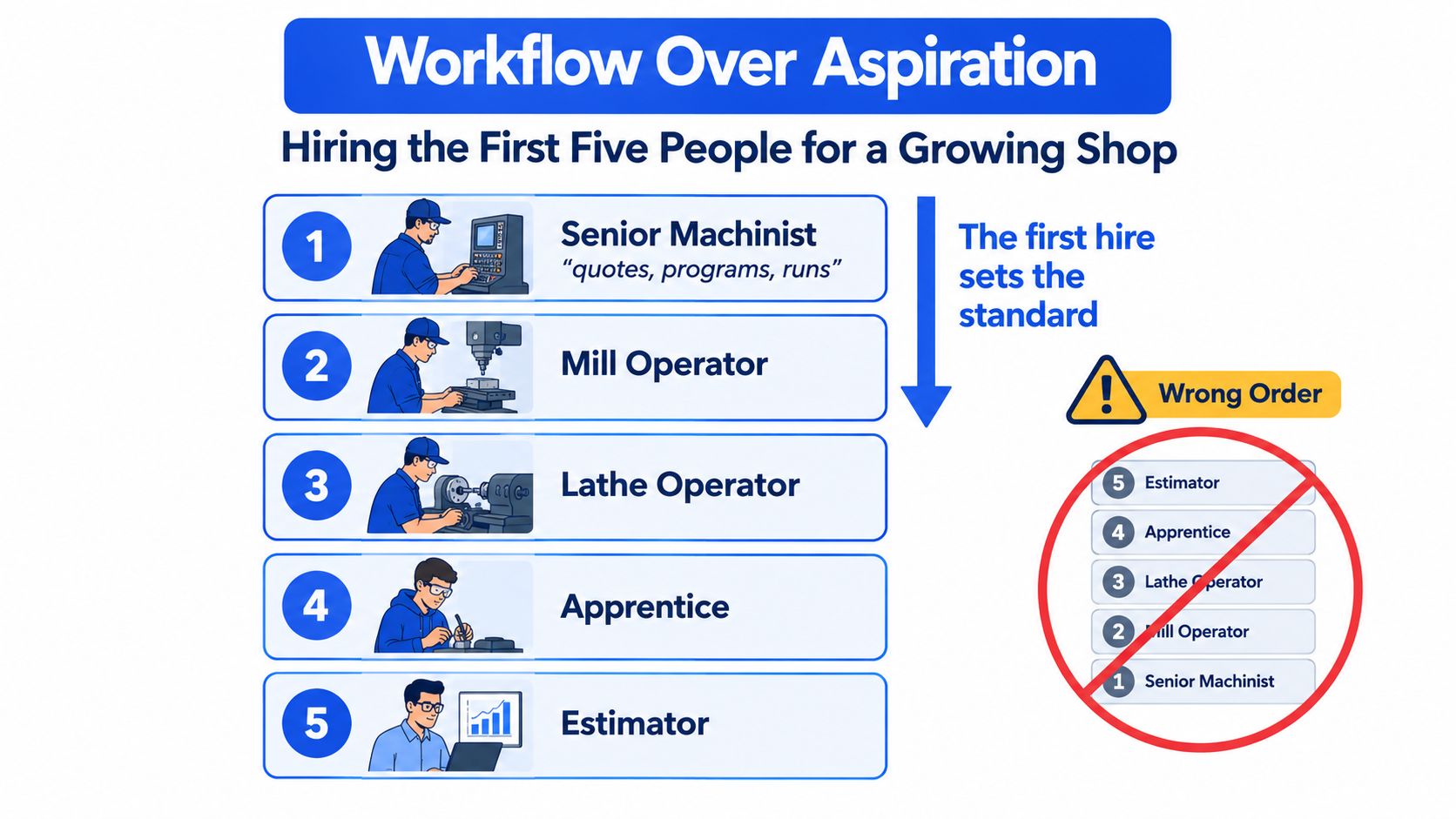
The visual order shown here reflects a floor-first approach. In practice, the exact titles can change with the shop's equipment and customer mix, but the principle stays the same: hire to remove a recurring bottleneck, not to match an imagined organization chart.
The Metrics That Tell You If the Shop Is Healthy
A busy shop can still lose money. Machines may be running while estimates miss setup, finishing vendors delay shipments, customers pay slowly, or operators spend productive hours fixing preventable errors.
Review a small set of indicators every Monday before opening the RFQ inbox. Use your own historical job data to define healthy ranges, because a prototype shop, a repeat production shop, and a sheet metal fabricator won't share the same operating profile.
Metric | What It Measures | Healthy Range | What a Bad Number Means | Immediate Action |
|---|---|---|---|---|
Quote-to-order conversion | Whether quoted work fits customer need and shop economics | Stable shop-defined range by job type | Weak qualification, poor scope, price leakage, or slow follow-up | Review lost quotes by reason and customer segment |
Average margin per job | Whether quoted economics survive production | Positive range above the shop's required burden and return | Missing setup, tooling, inspection, finishing, or rework cost | Compare recent quotes with actuals line by line |
On-time delivery | Whether the promised route matches real capacity | Consistent performance against committed dates | Scheduling drag, late material, outside-processing delays, or unstable jobs | List every late order and assign one cause and owner |
Machine utilization | Whether available capacity becomes productive work | Useful utilization without crowding out profitable work | Too much idle time, excessive changeover, or overloaded bottlenecks | Re-sequence jobs and remove the largest constraint |
Days sales outstanding | How quickly completed work becomes cash | Stable collection cycle that supports purchasing and payroll | Invoice errors, weak terms, disputed work, or slow follow-up | Contact overdue accounts and fix the source problem |
The quote-to-order rate needs context. A low conversion rate may indicate bad pricing, but it may also mean the shop is quoting work outside its capability or responding to low-quality RFQs. A high conversion rate isn't automatically good if the jobs carry weak margins or consume the capacity needed by better customers.
On-time delivery is also more useful when paired with cause codes. “Late” isn't a diagnosis. Separate material shortages, programming delays, machine downtime, inspection holds, finishing delays, and customer changes so the weekly meeting produces an action rather than a complaint.
Use leading indicators before financial statements
The most useful review asks what will happen next month if current behavior continues. Count open RFQs without an owner, jobs waiting for material, parts waiting for inspection, and quotes that have passed their promised response time. These signals appear before month-end financial reports show the damage.
Keep accounting metrics separate from shop-floor KPIs. A machine that runs continuously may be producing low-margin work, rework, or parts that can't ship because inspection or finishing is late. The healthy CNC machining business is not the one that looks busiest. It's the one that turns controlled quoting into profitable, on-time shipments and collects the cash.
If your shop loses time between RFQ intake, drawing review, estimating, and customer response, Uptool offers AI-powered quoting software that organizes emails, CAD files, drawings, and BOMs into structured estimates and professional quotes. Visit Uptool to review the workflow, then compare its potential against the quoting delays and margin leaks you can measure on your own floor.