You quote a steel weldment in March, win the order, and feel good about the margin. Production starts in July. The supplier invoice arrives, and the profit you expected has already been spent on material. Nothing went wrong on the shop floor. The estimate was wrong because one old price was treated as a fact instead of an assumption.
Changing material costs aren't just a purchasing problem. They're a quoting-data problem. If your estimate doesn't record where a material price came from, how long it was valid, and what happens when it changes, you aren't protecting margin. You're guessing and hoping the customer accepts the loss.
The fix is practical. Record the basis of every material price, then write quotes so the material assumption can be repriced without rebuilding the entire estimate.
Table of Contents
Spot, Fixed, and Indexed Pricing and What Each Means for Your Quote
Quoting Under Asymmetric Risk with High, Base, and Low Scenarios
Finishing as a Separate Cost Line and a Simple Material Clause
A Short List of Habits That Make Material Volatility Survivable
The Quote That Looked Fine Until Shipment
The job looked ordinary. A customer needed a batch of steel weldments, the drawings were complete, and the estimator pulled a familiar steel price from the shop spreadsheet. Labor, welding time, cutting, machining, and overhead were added. The quote went out in March, the customer accepted it, and the job entered the schedule.
By July, the supplier's price had changed. So had the freight and surcharge. The estimator opened the original quote, but the material line showed only “steel plate,” a quantity, and a unit price. There was no supplier reference, no quote date, no expiration date, and no record of whether the price covered a specific mill form or merely reflected an old average.
The shop bought the plate because production couldn't wait. The invoice was higher than the estimate, and the difference came straight out of gross margin. The estimator could explain what happened internally, but the customer had received a fixed price with no adjustment language. The shop owned the gap.
That loss wasn't created in July. It was created in March when a single material number was typed into a spreadsheet without its conditions.
The rule I learned the hard way: A material price without a date, source, and validity period isn't a quote input. It's an untracked risk.
Global commodity markets became unusually volatile during the 2020 to 2024 period. The World Bank's October 2024 Commodity Markets Outlook describes price swings during that period as “frequent and sharp.” Prices fell sharply in early 2020, reached historical highs in 2022, then eased during 2023 and 2024 while remaining above January 2020 levels.
A CNC or fabrication shop can't control those movements. It can control whether the estimate preserves the assumptions behind its material line. Start there, and repricing becomes a controlled revision instead of a frantic forensic exercise.
Why Material Is the Cost Line That Hurts Most
A stale stock price can erase the margin on an otherwise well-estimated job. One manufacturing cost-estimation guide places material at roughly 40% to 60% of total manufacturing cost, compared with 15% to 30% for direct labor and 20% to 35% for manufacturing overhead. Treat the material line as a controlled cost record, not a single number in a spreadsheet.
Material includes more than the weight of the finished part. Raw stock is the purchased input. Conversion cost covers cutting, forming, machining, welding, and inspection. Overhead keeps the facility operating, but it usually does not change with one job as directly as the material invoice. That makes a stale material assumption especially dangerous on a fixed-price quote.

Separate stock cost from consumed material
Do not price a finished part by multiplying its weight by a commodity rate. Record what the shop must purchase, what the job consumes, and what remains recoverable. Standard stock sizes, grain direction, nesting limits, and minimum-order quantities can change the cost before production starts.
Track these fields separately:
Purchased quantity: The bar, plate, or sheet required from the supplier.
Usable quantity: The portion that becomes saleable parts.
Scrap and remnant value: Material that can be reused, recovered, or sold.
Yield: Loss from cutting, nesting, kerf, setup, and part geometry.
Freight and surcharges: Charges that may move independently of the base material price.
A plate producing several parts may cost less per part than one bought for an awkward blank. The part weight is unchanged. The purchasing record is not.
See the margin sensitivity before accepting the order
Put material on its own quote line and show conversion and overhead separately. If material represents 30% of the selling price, a 20% material increase can erase roughly 6 points of gross margin, as documented in the specialty manufacturing metals update from Stout.
Set a review trigger before sending the quote. Recheck the estimate when the supplier validity period expires, the required grade or form changes, the order is delayed, or the material line moves beyond the allowance in your quote. The practical guide to estimating material cost can help structure the calculation. Your records should still show the source, date, quantity basis, yield, freight, and surcharge assumptions so the customer price remains defensible from RFQ to invoice.
Spot, Fixed, and Indexed Pricing and What Each Means for Your Quote
Your supplier's price isn't just a number. It has a pricing mechanism behind it, and that mechanism determines how much of the market risk stays with your shop.
Raw materials represent about 55% to 75% of steel production cost, depending on the production route. Steel suppliers commonly sell through spot purchases, fixed-price contracts, or indexed and formula-based contracts that adjust against inputs such as scrap, iron ore, or energy.
The three mechanisms
Spot pricing means you buy at the current market price. It can make sense for short-lead jobs or readily available stock, but the price may be valid only for a limited period. If your quote remains open while the customer reviews it, the supplier's spot price may no longer apply when you release the order.
Fixed pricing locks a rate for a defined period or contract scope. It gives the shop a clearer basis for a fixed customer quote, but only if the supplier's validity period covers the expected order and shipment dates. A fixed price that expires before material is purchased isn't protection.
Indexed or formula-based pricing adjusts against an agreed benchmark. The adjustment may occur monthly or quarterly, or it may use a mill surcharge published for a particular shipment period. The invoice can therefore change even after the customer has accepted your quote.
Pricing Mechanism | How It Works | Common Materials | Quote Risk |
|---|---|---|---|
Spot | Current supplier or market price | Standard steel, aluminum, copper stock | Price can move before order release |
Fixed | Rate locked for a defined period | Contracted plate, sheet, bar, or recurring volumes | Risk returns when validity expires |
Indexed or formula-based | Price adjusts against a benchmark or surcharge | Steel contracts, stainless products, energy-sensitive inputs | Final cost may be set at shipment |
Stainless surcharges show the timing problem
A typical surcharge establishes a base price, a reference index, a trigger level, and a consumption factor. The surcharge is calculated from the current index value minus the trigger value, multiplied by the amount of volatile input used in the finished material.
Stainless products may use nickel-related surcharges because austenitic stainless grades commonly contain about 8% to 12% nickel. Surcharges are often published monthly or quarterly using an earlier averaging period, and the applicable charge may be determined at shipment rather than order placement.
For a fabrication job with an 8 to 12 week material lead time, that timing matters. Your customer can accept a profitable quote today, while the applicable surcharge changes before the stock ships. Your purchase order should preserve the supplier's pricing basis, effective period, index, and expected shipment date.
For a deeper look at how pricing basis affects profitability, review using Suby for margin analysis. The same discipline applies here: compare the actual replacement cost with the net price you quoted, not with an outdated list value.
The Material Record That Makes a Price Repricable
A material record should let anyone on the shop floor answer one question without calling the estimator: What exactly did this price mean when we quoted the job?
“6061 aluminum, 100 lb” is not enough. That line omits temper, form, thickness, supplier, freight, and usable yield. If the customer changes the quantity or the supplier revises the price, the estimator must reconstruct the quote from memory. That is how margin disappears on a job that looked profitable at RFQ stage.

Capture the fields that control the decision
Field | Why It Matters | Example |
|---|---|---|
Supplier | Identifies the source behind the price | Regional metals distributor |
Grade and temper | Prevents substitution errors | 6061-T6 |
Mill form and thickness | Price varies by form and size | Plate, specified thickness |
Quantity purchased | Reflects the actual buying obligation | Full plate or bar |
Usable quantity | Shows yield and part allocation | Net blanks after nesting |
Remnant or scrap value | Credits recoverable material | Reusable drop retained |
Freight | Separates logistics from base price | Supplier delivery charge |
Surcharge | Captures a variable charge | Mill or alloy surcharge |
Quote date | Establishes the price snapshot | Date supplier quote was received |
Validity period | Defines how long the assumption stands | Supplier-stated expiration |
Expected shipment date | Tests whether the price window is realistic | Planned material release |
Record the fields because metal categories do not move together. Steel, aluminum, and copper can follow different price paths, so one general “metal escalation” assumption will misstate the exposure. A dated supplier quote, tied to the exact grade, form, quantity, and validity period, gives the estimate a defensible starting point.
Reprice the affected line, not the entire quote
Consider a copper-heavy electrical component. If the supplier changes the copper basis after a tariff change, do not edit the total manually and hope the related assumptions remain correct. Open the material record, enter the new supplier price, preserve the old revision, recalculate purchased quantity and freight, and identify the specific line that changed.
The quote history should retain the original price, revised price, dates, reason for the change, and approving employee. That record gives you the evidence to explain a revised customer price instead of arguing from memory.
A quoting tool with structured material records and revision history, such as Uptool's approach to automated quoting, can hold these fields for you. It cannot decide which fields protect your margin. Define the required record, approval trigger, and customer-facing quote language before relying on software.
Quoting Under Asymmetric Risk with High, Base, and Low Scenarios
A single material assumption hides the risk. Build three scenarios when material exposure is meaningful:
Low: The material becomes cheaper or the supplier confirms a favorable price.
Base: The price currently supported by a dated supplier quote.
High: The price increases before release, shipment, or production.
The scenarios aren't a prediction. They're a way to show what happens if the assumption moves.
Calculate sensitivity before setting the customer price
Start with the material portion of the selling price. If material accounts for 30% of selling price and the high scenario applies a 20% increase, the direct cost impact is approximately 6 percentage points of selling price. That calculation tells you whether a fixed price is reasonable or whether the order needs a clause, a shorter validity period, or a purchasing decision before acceptance.
Flag the RFQ for review when material exposure exceeds the threshold your shop can absorb. The threshold should reflect cash position, customer relationship, lead time, and whether the supplier offers a fixed price. Don't force a senior estimator to review every quote. Send the review only the jobs where a material movement can materially change the result.

Choose the customer-facing treatment deliberately
For a short job with material available and a supplier price that remains valid through release, the base scenario may support a fixed price. For a long-lead job, use the base scenario with a material-adjustment clause or obtain a fixed supplier commitment before accepting the order.
Don't show customers a vague range unless the job can't be priced. A better quote states the base material assumption, the validity date, and the exact event that permits repricing. That sounds controlled because it is controlled.
Practical rule: Quote the base case, document the high case, and make the customer-facing protection match the time between acceptance and material purchase.
Why Waiting for Prices to Fall Is Not a Strategy
A broad forecast can point down while your delivered material cost rises. Those statements aren't contradictory because a commodity index isn't the same thing as the alloy, temper, form, region, freight, surcharge, and order quantity your shop must buy.
A 2026 metals-industry guide expected the metals and minerals price index to decline about 0.9% in 2025 and 3% in 2026, while U.S. producer-price data recorded double-digit increases in specific manufactured forms, including aluminum mill shapes, steel mill products, and copper and brass mill shapes.
The difference is replacement cost. A distributor may have limited stock, a regional premium may widen, freight may increase, or a minimum order may force you to buy more than the job consumes. Production cutbacks during a downturn can also create shortages and sharp price increases when demand returns. Waiting may save money, but it may also leave you without the material needed to keep the job moving.
Use timing controls instead of market hope
Set a short quote-expiration window when the supplier won't hold the price. Revalidate material at order release and again before production if the lead time is long. If the price has moved, revise only the affected line items and preserve the previous version.
Your revision record should show:
Original material basis and date
New supplier price and effective date
Freight, surcharge, and availability changes
Customer communication and approval
Impact on total price and margin
This process lets you buy early when availability matters, or wait when the risk is acceptable. Either decision becomes defensible because you can see the assumption and the trigger instead of relying on a general forecast.
Finishing as a Separate Cost Line and a Simple Material Clause
Finishing gets hidden too often. Anodizing, powder coating, plating, paint, abrasives, masking, packaging, freight, certification, and outside-processing minimums can sit inside overhead until the vendor invoice exposes the difference.
EPRI data reports average materials costs of about 17.7% for captive metal-finishing shops and 19.3% for job shops, according to its metal-finishing cost data. That makes finishing worth tracking as its own cost category, even when the work is subcontracted.
Give every finish its own record
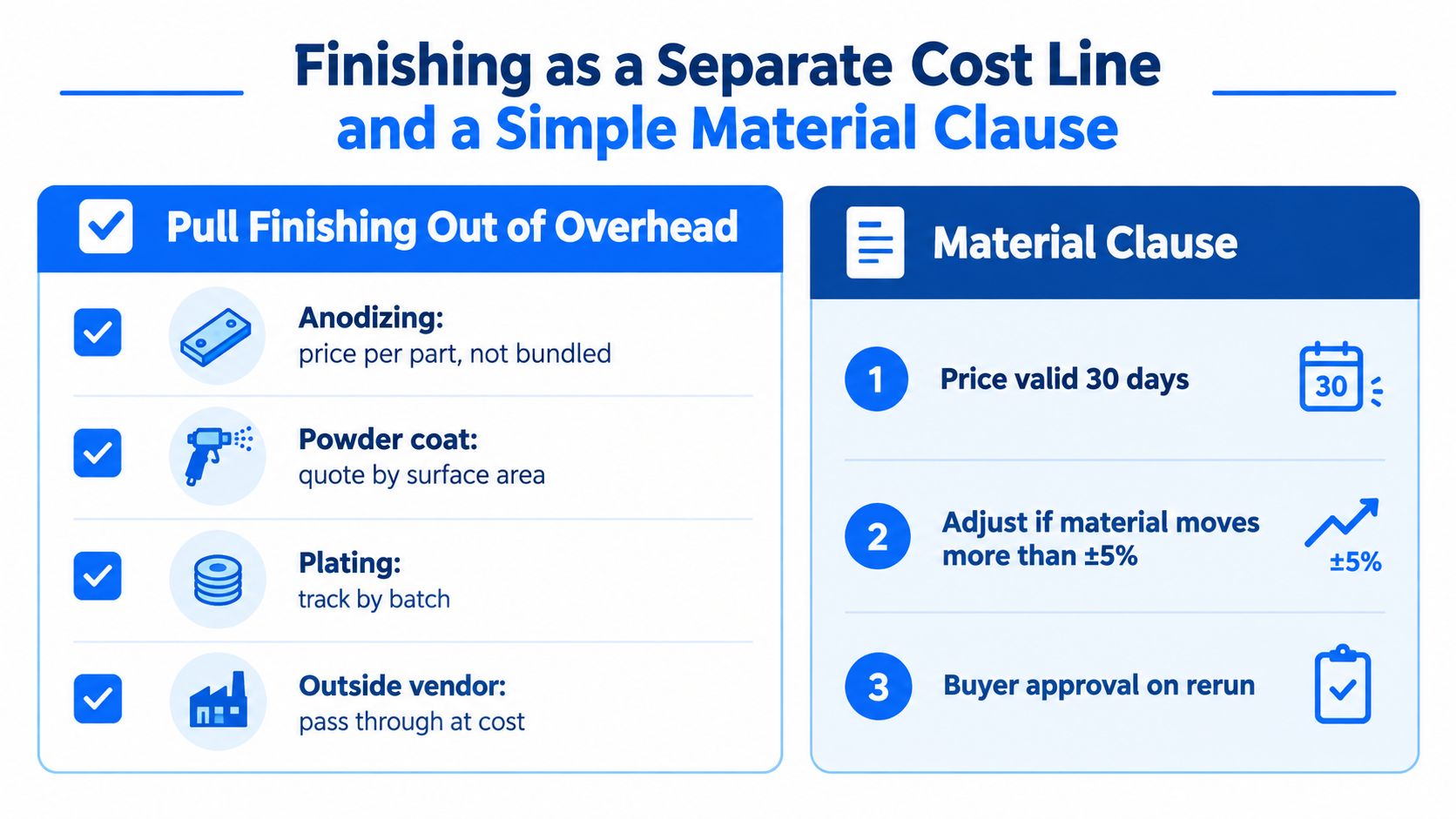
Record the specification, supplier, price basis, minimum lot charge, freight, inspection or certification fees, consumption rate if performed internally, and quotation date. Price anodizing per part where appropriate, powder coating by surface area, and plating by batch. Don't blend a vendor's changing charge into a general overhead percentage.
A customer change from one finish to another should create a clean revision. The estimator should be able to replace the outside-processing line, update freight and lead time, and show the effect without reopening machining calculations. A full quote breakdown helps keep those categories visible to the customer and the shop.
Use plain adjustment language
A material clause should state:
The quoted material price is valid for 30 days. If the documented supplier price, applicable surcharge, or reference index moves more than ±5% before material release, the material line may be adjusted. The shop will provide the revised basis for approval before purchasing the affected material.
Add the reference index, trigger level, adjustment frequency, and date that locks the charge when those details apply. If a supplier determines a surcharge at shipment, say so. If the customer must approve a rerun before release, say that too.
The clause isn't a substitute for a dated material record. It gives that record a contractual path into the customer conversation.
A Short List of Habits That Make Material Volatility Survivable
Keep the supplier, specification, form, quantity, yield, freight, surcharge, date, and validity period on every material line.
Set triggers for quote expiration, order release, supplier-price changes, and material exposure above your review threshold. Preserve every revision instead of overwriting the original estimate.
Standardize language for fixed pricing, indexed pricing, surcharges, and customer approval before repricing. If you adopt one habit this month, make every material price repricable. That single change turns changing material costs from a surprise invoice into a managed quoting decision.
Uptool provides AI-powered quoting software for CNC and fabrication shops, with RFQ intake, CAD and drawing analysis, material and finishing databases, cost estimates, quote templates, and revision history. Visit Uptool to see how a structured quote record can keep material assumptions visible from RFQ through production.
