Monday morning starts with an estimator sorting through a crowded inbox while production waits for answers. At a 20-person CNC shop, 40 unread RFQs, three drawing revisions, and a scheduler carrying printouts can turn the first hour into administrative triage instead of estimating. By the time the estimator opens the first useful drawing, a customer may already be waiting on another supplier.
That pressure isn't unusual anymore. CNC machining and sheet metal fabrication shops are expected to respond quickly, price materials and finishing accurately, and protect margin even when drawings are incomplete or revisions arrive through separate email threads. AI manufacturing software is showing up in the front office because quoting has become a production constraint.
The practical question isn't whether AI sounds impressive. It's whether it can help your team read drawings, organize RFQs, reuse reliable job data, and keep an experienced estimator in control. This guide focuses on that RFQ-to-quote workflow, with attention to materials, CNC operations, sheet metal fabrication, tolerances, powder coating, scheduling, and quality.
Table of Contents
Why AI Is Showing Up in Machine and Fabrication Shops
A customer who once accepted a slower response may now send the same RFQ to several shops and move forward with the first credible quote. A CNC estimator facing a repeat aluminum housing can lose valuable time copying dimensions, checking old jobs, confirming stock sizes, and rebuilding an operation sequence that the shop has already used. A fabrication estimator may face a similar problem with a bracket family, where every revision requires another pass through bend notes, material thickness, finishing, and hardware requirements.
The lead-time pressure is commercial, not theoretical. Faster customer response matters because a quote that arrives late may never receive serious consideration, even when the price and capability are right. AI can help by extracting information from the RFQ package and presenting the estimator with an organized starting point instead of another pile of attachments.
Shop reality: The estimator's scarce resource isn't only technical knowledge. It's uninterrupted attention.
The labor problem is just as direct. Experienced estimators know which tolerances create extra setups, which materials behave badly in a particular machine, and which finishing requirements need masking or secondary work. When those people are overloaded, newer staff either interrupt them constantly or make assumptions that aren't visible until the job reaches the floor. The AI impact for electricians offers useful broader context on how trade businesses are approaching AI without treating skilled judgment as disposable.
The technology has also become more useful for manufacturing documents. Modern systems can classify drawing content, identify features, extract structured fields, and compare new work with historical jobs. The AI platform backed by Khosla Ventures targeting the quoting bottleneck at machine shops reflects this shift toward practical front-office applications.
The right starting point is simple. Don't ask AI to run the entire shop on day one. Ask it to reduce the repetitive work between receiving an RFQ and producing a quote that an estimator can defend.
What AI Manufacturing Software Actually Does
Think of AI manufacturing software as a senior estimator with a searchable memory, not as a robot replacing the machinist. It can recall how similar jobs were costed, identify geometry in a drawing or model, compare material and process inputs, and flag details that deserve human review. The estimator still decides whether the assumptions make sense.
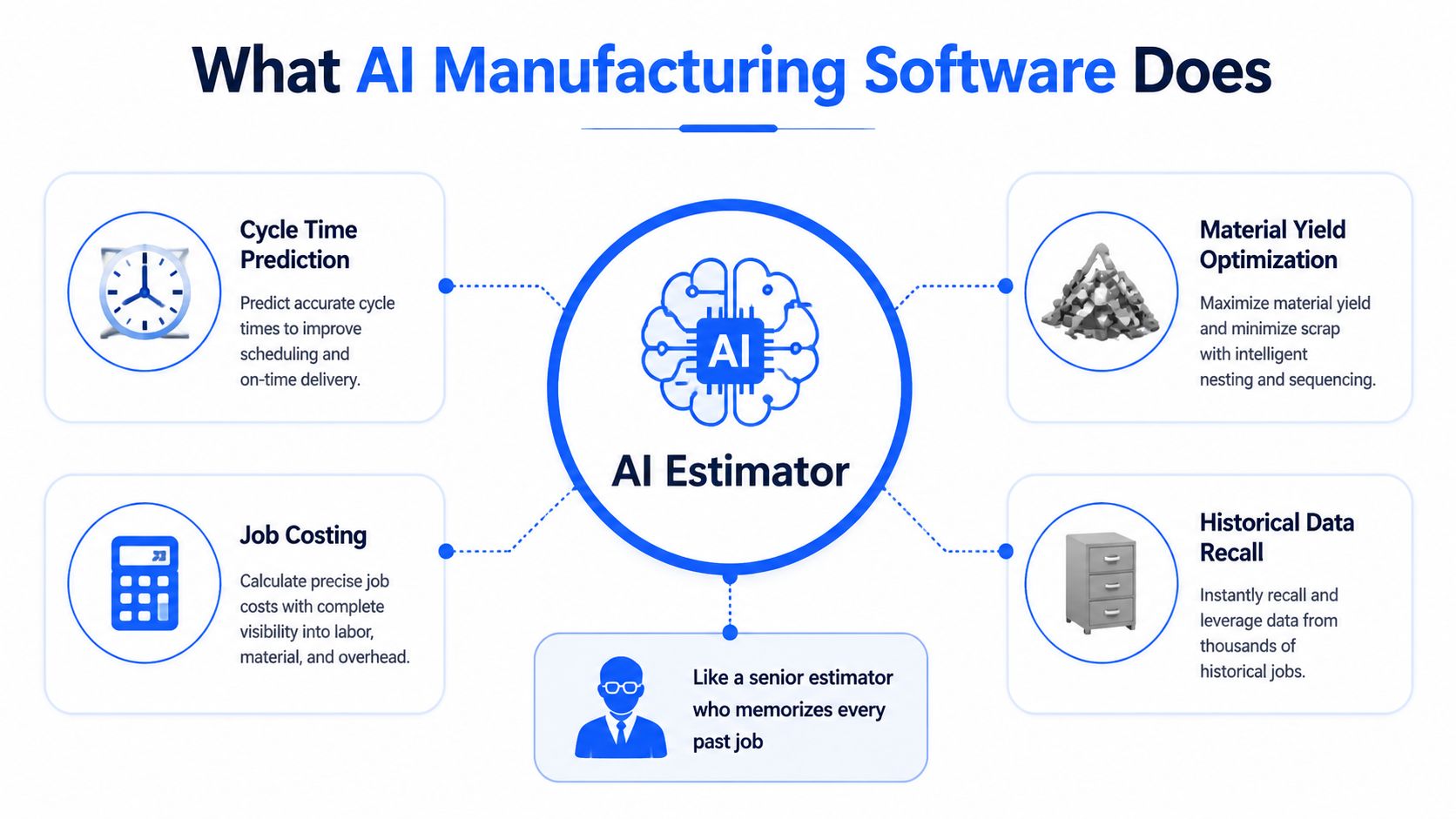
A useful system typically works across several layers:
Document understanding: It reads emails, 2D drawings, 3D CAD files, and BOMs, then pulls relevant fields into a structured estimate.
Feature recognition: It identifies holes, pockets, bends, dimensions, tolerances, and other geometry that affects operations and cost.
Historical recall: It searches previous work for comparable materials, setups, cycle times, yields, and finishing requirements.
Estimating assistance: It suggests operations, tooling assumptions, material usage, and cycle-time inputs for review.
Exception handling: It highlights missing information, unusual tolerances, revision changes, and inputs that don't match shop rules.
Learning from corrections: When an estimator changes an assumption, the system can use that correction to make future recommendations more relevant.
That isn't the same as traditional CAM. CAM turns an approved design into toolpaths and machining instructions. AI estimating sits earlier in the workflow, helping determine what the part may require and what the work should cost before programming begins.
It also isn't an ERP. An ERP manages customers, jobs, purchasing, inventory, production records, and accounting workflows. A quoting system may exchange data with an ERP, but its job is to turn an RFQ into a controlled commercial decision.
Spreadsheets remain useful for calculators and shop-specific rules, but they often depend on manual data entry and individual memory. AI adds a layer that can read unstructured inputs and connect them to those rules. The AI estimating software resource is relevant for shops evaluating that specific front-office layer rather than searching for another general-purpose factory platform.
The best implementation doesn't hide the math. It makes the assumptions visible, lets the estimator edit them, and preserves the reasoning behind the final quote.
The Three Core Areas Where AI Delivers Value
AI creates the most practical value where a shop repeats decisions but still needs a skilled person to approve the result. In CNC and fabrication operations, that usually means estimating first, scheduling second, and quality third.
Estimating
Estimating is the clearest starting point because RFQs arrive in messy formats while the final quote needs organized inputs. A capable system can recognize features on drawings, identify bend information, pull BOM fields, search comparable jobs, and suggest a sequence of operations. The estimator then reviews material, tooling, labor, outside processing, and risk rather than transcribing every field.
A repeat CNC bracket is a good example. The system might identify drilled holes, pockets, stock material, and a finishing requirement, then bring forward similar work. The estimator can focus on whether the new tolerance requires another setup, whether the material is available, and whether the customer has changed the revision.
The limits are obvious when the drawing is unclear. An exotic one-off part, incomplete tolerance scheme, or unusual material may have no trustworthy historical comparison. AI can organize the uncertainty, but it can't turn an undefined requirement into a reliable cost.
Scheduling
Scheduling software becomes more useful when it receives better estimating inputs. If the system has credible cycle-time assumptions and operation sequences, it can help the scheduler see where a rush job may fit, which machine groups are constrained, and how a breakdown affects downstream commitments.
Consider a sheet metal order that needs cutting, forming, deburring, and powder coating. A schedule based on optimistic assumptions may promise a date the shop can't meet. AI can surface the likely work content and make replanning less dependent on one person's memory.
Scheduling still falls short when the shop has weak machine-status data or frequent informal changes. A system can't react intelligently to a job that operators have moved without recording it. It also shouldn't override a production manager who knows a particular press brake, fixture, or operator has a constraint that the database doesn't capture.
Quality
Quality applications use inspection records, images, and sensor data to identify patterns that are difficult to spot manually. The benefit isn't only catching a bad part. It's identifying which combinations of material, tooling, machine, setup, or process conditions tend to create trouble.
A machining shop might use historical inspection results to flag a part family that regularly produces variation around a critical feature. A fabrication shop could use inspection images to identify recurring issues with bend orientation, hole placement, or surface preparation before the order reaches final inspection.
AI won't rescue a quality process with inconsistent measurement methods or missing records. It can prioritize attention and reveal relationships, but the quality team still needs defined acceptance criteria and a reliable method for confirming the finding.
Area | Where AI Helps | Where AI Falls Short |
|---|---|---|
Estimating | Extracts features, compares historical jobs, and organizes cost inputs | Unclear drawings, rare materials, and one-off work still need expert judgment |
Scheduling | Uses operation and cycle-time inputs to support replanning | Unrecorded shop-floor changes and missing machine data undermine recommendations |
Quality | Finds patterns in inspection, image, and sensor records | Poor measurement discipline and undefined criteria produce weak conclusions |
For most small shops, estimating deserves the first investment because it touches every RFQ before material is purchased or machine time is reserved. The quoting speed and win-rate analysis is useful when choosing the measures that will show whether a quoting change is helping the business, rather than merely making the software look busy.
Comparing Human, Hybrid, and Automated Quoting Workflows
There are three practical ways to organize quoting. Human-only estimating keeps every decision with the estimator. Hybrid quoting lets AI prepare the work while the estimator reviews exceptions. Fully automated quoting sends a price without human approval.
For a sheet metal bracket family with 12 part numbers, the differences become clear. A human-only process requires the estimator to open each drawing, confirm material and thickness, review bend counts, check finishing, and apply margin rules. That approach can work when RFQ volume is manageable, but repeated transcription consumes the same attention needed for unusual jobs.
A hybrid workflow lets AI group the part family, extract common inputs, identify differences, and draft the cost structure. The estimator checks bend assumptions, verifies powder-coat requirements, reviews material availability, and adjusts pricing for commercial risk. In my view, this is the right model for most small and mid-sized shops. AI handles the repetitive foundation, while the estimator owns the decision.
Fully automated quoting only makes sense when the historical data is clean, the part family is well-defined, the cost model is current, and the business rules are stable. That combination exists for some repeat work, but it isn't the default condition in job shops.
Dimension | Human Only | Hybrid (AI + Estimator) | Fully Automated |
|---|---|---|---|
Speed per RFQ | Limited by document review and manual entry | Faster because the first draft is prepared automatically | Fastest for qualified, repeatable work |
Accuracy on repeat parts | Depends on memory and careful reuse | Strong when historical data is reliable and corrections are reviewed | Can be consistent, but errors repeat when inputs are wrong |
Margin consistency | Varies between estimators | Guardrails and human review work together | Depends entirely on configured policies |
Estimator workload | High, especially for routine RFQs | Focused on risk, exceptions, and customer context | Low for eligible jobs, high when exceptions break automation |
Customer response time | Slower during inbox surges | Faster without removing accountability | Fast, but potentially risky for ambiguous work |
Practical rule: Automate preparation before you automate approval.
Workflow automation principles from this workflow automation guide for Australia apply well here, especially the need to define ownership, handoffs, and exception paths. A quote isn't finished merely because a number has been generated. Someone must be able to explain why that number is reasonable.
Real ROI Stories From CNC and Fabrication Shops
The strongest return comes from changing a specific workflow, not from installing AI and hoping productivity appears. A published industrial case study reported quotation cycle time falling from 48 hours to 12 hours, quotation accuracy rising from 85% to 98%, and quote-to-order conversion increasing from 30% to 46% after structured data extraction and connected cost databases were introduced. The reported mechanism was straightforward, estimators spent less time transcribing part data and more time validating exceptions. That industrial quoting case study is a useful benchmark for the kind of workflow change buyers should demand from a vendor.
The three examples below are the type of stories frequently used to sell AI, but they need a warning. The supplied evidence does not verify the specific shop names or the additional metrics shown in the required visual, so treat the graphic as an illustration of claimed ROI patterns, not as independently verified case evidence.

A CNC shop
The stated example is a 40-person CNC shop that moved quote turnaround from 5 days to 6 hours and raised win rate from 22 to 34 percent. The proposed workflow change is credible in principle: centralized RFQ intake, automated drawing review, historical cost lookup, and estimator approval can remove waiting between inboxes and spreadsheets. But those exact figures aren't included in the verified evidence, so they shouldn't be presented as confirmed results.
A structural steel fabricator
The stated example describes AI standardizing margin across a scattered estimating team and recovering 4 points of margin in six months. The operational logic is also clear. If estimators use different material assumptions, labor rules, or markup practices, a shared system can expose those differences and require consistent review. The specific result remains unverified in the available data.
A precision machine shop
The stated example claims automated first-article inspection reduced scrap from 6.2 percent to 1.8 percent. AI can help analyze inspection records and highlight recurring patterns, but this article can't validate those exact figures or the associated shop story. A responsible buyer should ask for the before-and-after definitions, the workflow change, and the records behind any vendor case study.
The verified quoting case gives a more defensible lesson: structure the inputs, connect them to estimating logic, and measure the resulting cycle, accuracy, and conversion outcomes. Don't buy a promise. Ask to see how the system handles a real RFQ with revisions, missing information, material changes, and finishing requirements.
Practical Tips for Implementing AI in a Small Shop
A 10-to-50-person shop doesn't need a factory-wide transformation. It needs a controlled rollout that starts where delays are visible and keeps production running.
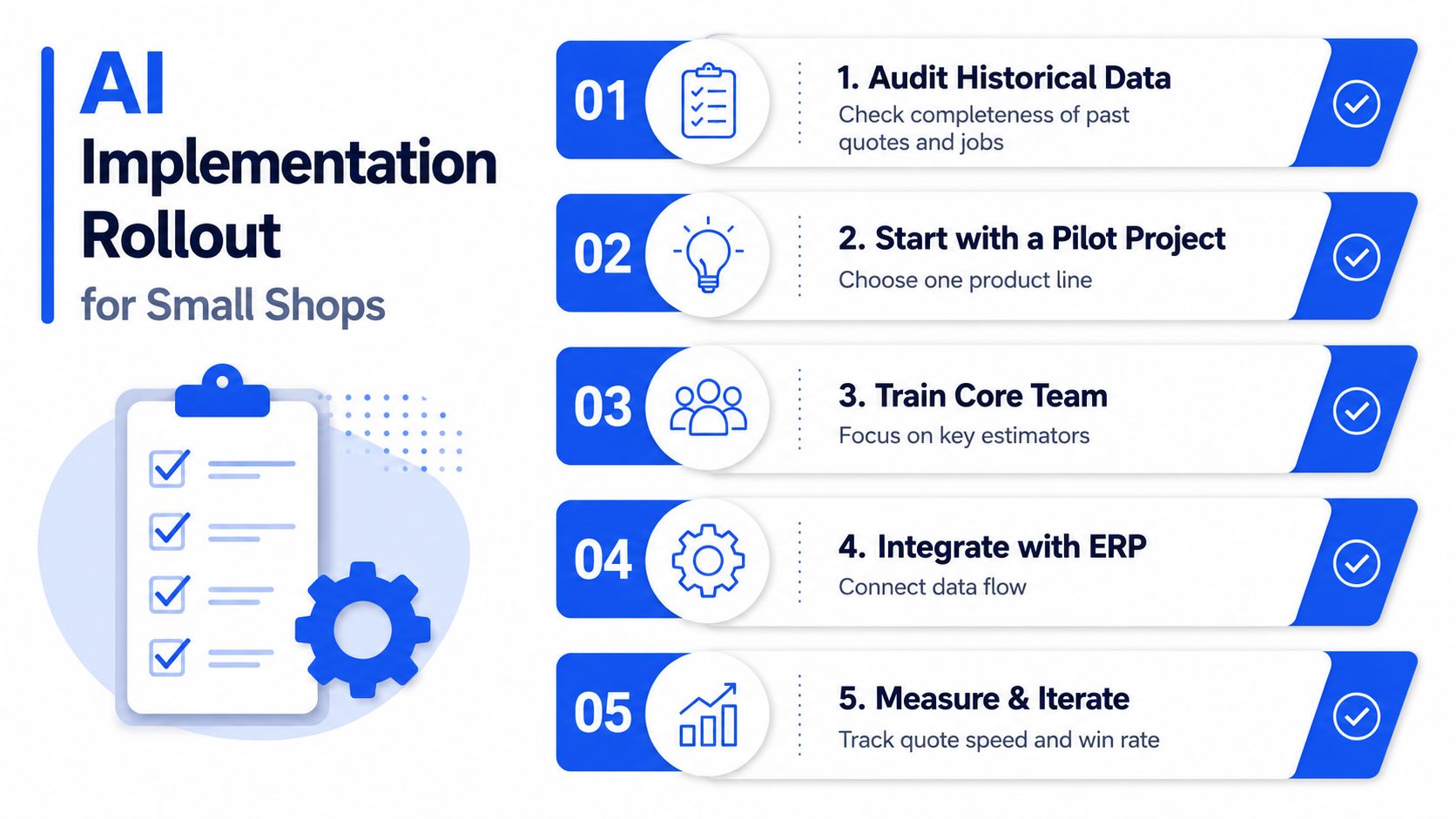
Start with the data you already have
Audit historical quotes, completed jobs, material records, operation notes, and final costs. Look for missing fields, inconsistent naming, outdated prices, and quotes that never connect to actual job results. AI can't produce dependable estimates from records your team can't interpret.
Choose one workflow, usually estimating, and one part family for a 60-to-90-day pilot. Those pilot durations are a practical implementation recommendation, not a verified industry statistic. Pick work that repeats often enough to expose patterns but still requires estimator judgment.
Define the scorecard before the pilot
Track quote turnaround time, estimator review time, win rate, and margin variance. Use the same definitions before and after the pilot. A vague goal such as “improve productivity” won't tell you whether the system helped or whether the team worked harder.
Connect the workflow before expanding it
Integrate the quoting tool with the ERP, CRM, accounting system, or spreadsheet process your team already uses. If the estimator has to retype the AI result into another system, you've moved the bottleneck instead of removing it.
Train reviewers, not button pushers
Estimators need to challenge the output. They should know how to inspect extracted dimensions, confirm material and finishing, review revisions, and document overrides. A rubber-stamped AI quote is still an uncontrolled quote.
Expand only after stability
Move into scheduling or quality after the first workflow has a reliable owner, clean exception handling, and a clear record of corrections. Common mistakes include skipping data cleanup, extending a pilot without making a decision, and ignoring the people who must use the system every day.
What AI Will Not Fix in Your Quoting Process
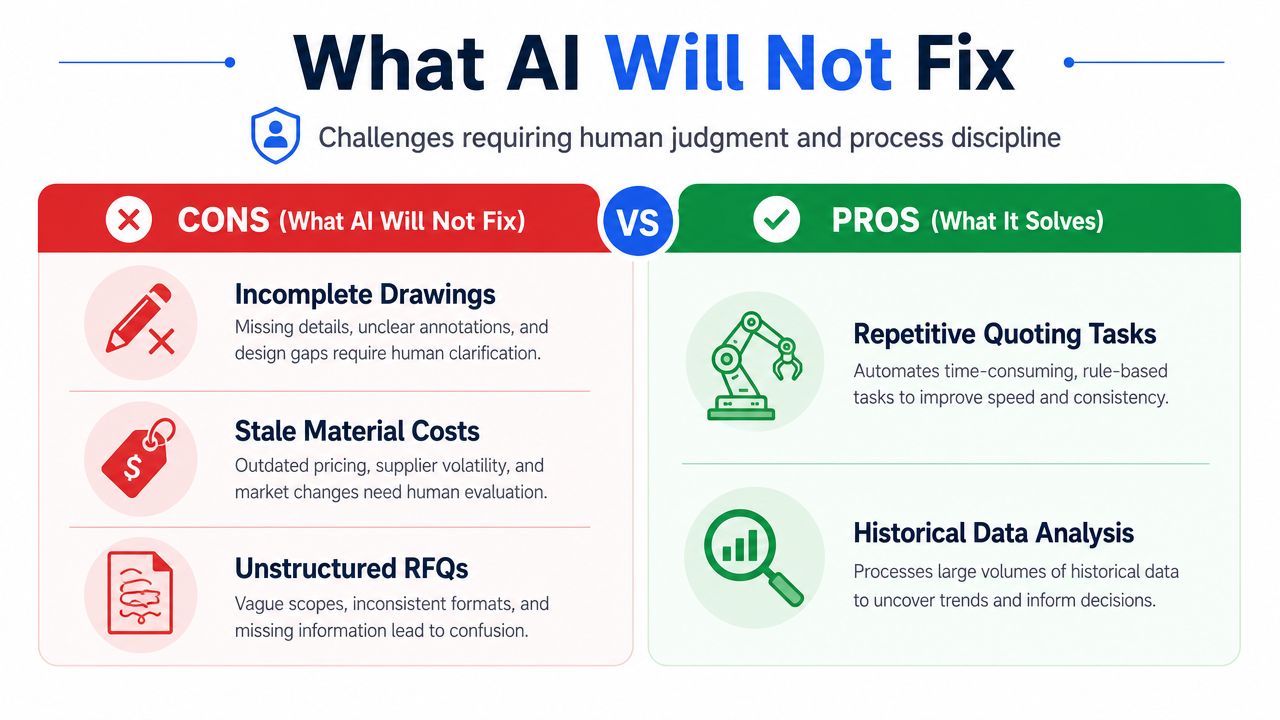
Faster quoting isn't automatically better quoting. If the drawing is incomplete, the material database is stale, or estimators apply different margin policies, AI will produce inconsistent answers faster.
A CNC estimator may see an unspecified dimension governed by a general tolerance class, while another estimator assumes a tighter requirement. ISO 2768-1 defines four general-tolerance classes for technical drawings, and it matters when individual tolerances aren't called out for every feature. This sheet metal tolerance reference explains why the estimator must distinguish between a general class and a feature-specific tolerance.
For sheet metal work, a commonly cited ISO 2768-m reference lists linear tolerances of ±0.1 mm for 0.5 to 6 mm, ±0.2 mm for 6 to 30 mm, ±0.3 mm for 30 to 120 mm, and ±0.5 mm for 120 to 400 mm. The EN EK Metal process conditions provide those ranges, which can materially affect how a part is costed and whether inspection or forming assumptions need review.
Finishing creates another easy-to-miss issue. Powder coating adds roughly 0.06 to 0.10 mm per surface, with some references describing a broader range of 0.001 to 0.005 inches depending on process and coats. This powder-coating tolerance reference notes that coating can make holes smaller and outside dimensions larger.
AI won't enforce margin guardrails unless you configure them. It won't create traceable reasoning unless the workflow records assumptions and revisions. It won't resolve whether a difficult job is worth winning when the answer depends on capacity, customer history, payment risk, or strategic value.
The rule I use: Clean data, explicit policies, and reviewable assumptions come before speed.
Your Next Step Toward AI Powered Estimating
AI manufacturing software makes sense when it improves three things together: response speed, margin discipline, and consistency. The system underneath those results still needs usable cost data, clear shop rules, and an estimator who can challenge the output.
Use this checklist:
Clean the records: Match historical quotes to jobs, materials, operations, finishing, and actual outcomes.
Choose one pilot family: Start with repeat CNC parts or a defined sheet metal product line.
Set vendor criteria: Require drawing and CAD extraction, revision handling, visible assumptions, configurable calculators, and human approval.
Confirm integration: Test the handoff to your ERP, CRM, accounting workflow, and production records.
Train estimators: Make review, correction, and exception documentation part of the process.
Track the first 30 days: Measure end-to-end quote time, review time, win rate, and margin variance using fixed definitions.
Pick one quoting workflow today. Time the current cycle from RFQ receipt to sent quote, then book a 30-minute demo with an AI estimating vendor before the next RFQ rush.
Uptool helps CNC and fabrication shops centralize RFQs, analyze emails, CAD files, drawings, and BOMs, and prepare traceable estimates for estimator review. Visit Uptool to see how its RFQ-to-quote workflow can fit your existing shop processes.
