You're staring at the IMTS registration page with a calculator open beside it. Airfare, hotel, meals, local transportation, admission, and several days away from the shop add up quickly. For a small CNC machining or sheet metal fabrication business, that time away can mean delayed quotes, missed production, and customers waiting for answers.
The promise of IMTS is compelling, but “game-changing technology” doesn't pay the bill by itself. The trip only makes sense when it helps you remove a bottleneck, price work more accurately, add useful capacity, or win business you couldn't handle before. This guide takes a practical view of IMTS for machine and fab shops, with special attention to materials, CNC machining, sheet metal fabrication, finishing, quoting, and workflow software.
Table of Contents
Why Small Shop Owners Debate Attending IMTS
The question usually isn't whether IMTS has useful equipment. It does. The question is whether a shop running a handful of CNC machines, a laser, a press brake, or a small finishing operation can recover the cost of attending.
A five-person shop owner may be comparing the show with a new tooling order, maintenance work, or another day of billed production. A larger job shop may have a lead machinist who could attend, but pulling that person off the floor creates its own operational problem. The doubt is reasonable: is IMTS built for smaller operators, or is it mainly a showcase for aerospace primes, automotive suppliers, and manufacturers with enormous capital budgets?
The answer depends on the shop's current position. If your equipment is reliable, your schedule has room, your quotes go out quickly, and you aren't considering a major process change, IMTS may be expensive wandering. If you're turning away work because of capacity, struggling with setup time, missing fabrication opportunities, or losing RFQs while staff manually reviews drawings and material requirements, the show deserves serious consideration.
Small shops carry a large share of the practical manufacturing workload, and the role of small shops in manufacturing's future makes their buying decisions important beyond the individual business. Still, importance doesn't make every trip profitable.
Practical rule: Don't attend to “see what's new.” Attend to solve a named problem that already costs your shop time, margin, or opportunities.
Write down the bottleneck before you book anything. If you can't name the process, machine, software workflow, or capability you're evaluating, you'll probably return with a stack of brochures and no decision.
What IMTS Actually Looks Like for Machine and Fab Shops
IMTS is large enough to overwhelm an unprepared visitor. The 2024 event ran from September 9–14, included 1,737 exhibitors, occupied 1,226,523 square feet, and drew 89,020 registrants from 110 countries, according to the official IMTS 2024 event figures. More than 40 million pounds of machinery were displayed, making the event feel less like a conventional trade fair and more like a temporary industrial district.
That scale matters to a small shop because it concentrates suppliers, process specialists, software companies, and potential customers in one place. The event is trade-only, but it isn't limited to large manufacturers. IMTS post-show information identifies machine shops and contract manufacturers among its audience and lists interest in general automation, tools and tooling, turning and lathes, and machining centers in the IMTS 2024 post-show report.
The areas that matter most
Don't treat the floor as one continuous exhibition. IMTS organizes exhibitors around the production stack, including metal removing, fabricating and lasers, toolholding, workholding, automation, quality assurance, and software. The IMTS exhibitor sector information shows why the show can help with more than machine selection. Material handling, inspection, programming, setup reduction, finishing coordination, and estimating all affect whether a quote is profitable.
Hall / Pavilion | Key Exhibits | Relevance to Small Shops |
|---|---|---|
Metalworking | CNC mills, lathes, machining centers, tooling, workholding | Evaluate cycle time, setup reduction, spindle use, and support |
Fabricating and Laser | Lasers, press brakes, fabricating systems, tube and sheet metal equipment | Compare cutting, forming, nesting, and material-flow options |
Automation | Pallet systems, loading, handling, connected equipment | Find practical ways to extend runtime without redesigning the whole shop |
Software and Quality | Estimating, production software, inspection, metrology | Improve quote accuracy, traceability, scheduling, and handoff |
Finishing and downstream processes | Process-related equipment and workflow solutions | Protect margin by pricing outside services and requirements correctly |
You'll see equipment aimed at high-volume production, but don't assume every conversation is irrelevant. Ask vendors to show how a system handles high-mix, low-volume work, frequent material changes, short runs, and operator-led scheduling. Those answers tell you more than a polished demonstration.
How to Decide If IMTS Is Worth Your Time and Money
Start with the full cost, not the registration fee. Add registration, flights, a hotel for three to four nights, meals, ground transportation, and the value of the owner or lead machinist being away from production. The IMTS exhibitor and on-site information confirms the East Building is part of the active show layout, which matters when you're planning travel between meetings and exhibit areas.

Then answer three questions:
Capital plans: Are you actively considering a machine, laser, press brake, tooling package, inspection system, or finishing capability within the next 12 to 18 months?
A real ceiling: Is the shop losing work or delaying jobs because of capacity, capability, setup time, labor, or inconsistent estimating?
Readiness to change: Are you prepared to evaluate automation or software instead of just collecting ideas?
If you answer yes to at least two, attending is probably justified. You have a current buying decision or operational problem that gives the trip a target. If all three answers are no, spend the money on a focused vendor visit, a local manufacturing event, or process improvement inside the shop.
Judge the return by decisions, not souvenirs
A successful trip doesn't require buying a machine on the floor. It might produce a credible comparison between two machining approaches, reveal a better workholding method, identify a finishing partner, or expose a quoting workflow that removes delays from RFQ intake.
A single well-negotiated equipment purchase or a new quoting process can repay the trip many times over, but only if you follow through. “We should look into that” isn't a return on investment. A written vendor comparison, implementation date, and owner assigned to the next step are.
The trip is worth paying for when it changes a decision you were already prepared to make.
Where to Focus on the Show Floor
The show floor rewards preparation and punishes curiosity without limits. With more than 1.2 million square feet of exhibit space at IMTS 2024, the event's scale and exhibitor information make one thing clear: you can't see everything, and trying will leave you tired before you reach the conversations that matter.

Build your route around the bottleneck
For a CNC shop, start with metal cutting, tooling, workholding, and automation. Compare machines by the work you quote, not by the largest part in the demonstration. Ask about fixture changes, probing, chip control, bar or pallet handling, service response, training, and the operator skill required to keep the equipment productive.
For a sheet metal shop, make fabricating and laser equipment the anchor. Look at laser cutting, press brakes, nesting, material loading, tube processing, and the handoff between cutting and forming. If finishing is part of your offer, ask how vendors account for deburring, coating, plating, paint, or outsourced processes in the production schedule and quote.
Use demonstrations as interrogations
Live cutting looks impressive, but it rarely answers the questions that determine profitability. Bring representative parts, drawings, material specifications, tolerances, and finishing requirements. Ask the vendor to explain the setup, tooling, inspection method, expected operator involvement, and what happens when the job changes halfway through a batch.
Smaller booths often deserve more attention than the largest displays. A supplier focused on estimating, workholding, inspection, material handling, or production handoff may solve a daily problem more effectively than a massive machine cell designed for a customer profile you don't serve.
Keep a short record at every serious stop:
The problem addressed: Write the bottleneck in your own words.
The required inputs: Note drawings, CAD files, material data, fixtures, or operator skills.
The service commitment: Record lead times, training, maintenance, and support terms.
The next action: Schedule a quote, test, reference call, or shop visit before leaving the booth.
For software and workflow comparisons, review the machine shop software stack alongside the hardware route. A machine purchase that improves capacity but leaves quoting, scheduling, and production handoff disconnected may not deliver the result you expect.
The Automation and Software Gap Most Shops Miss
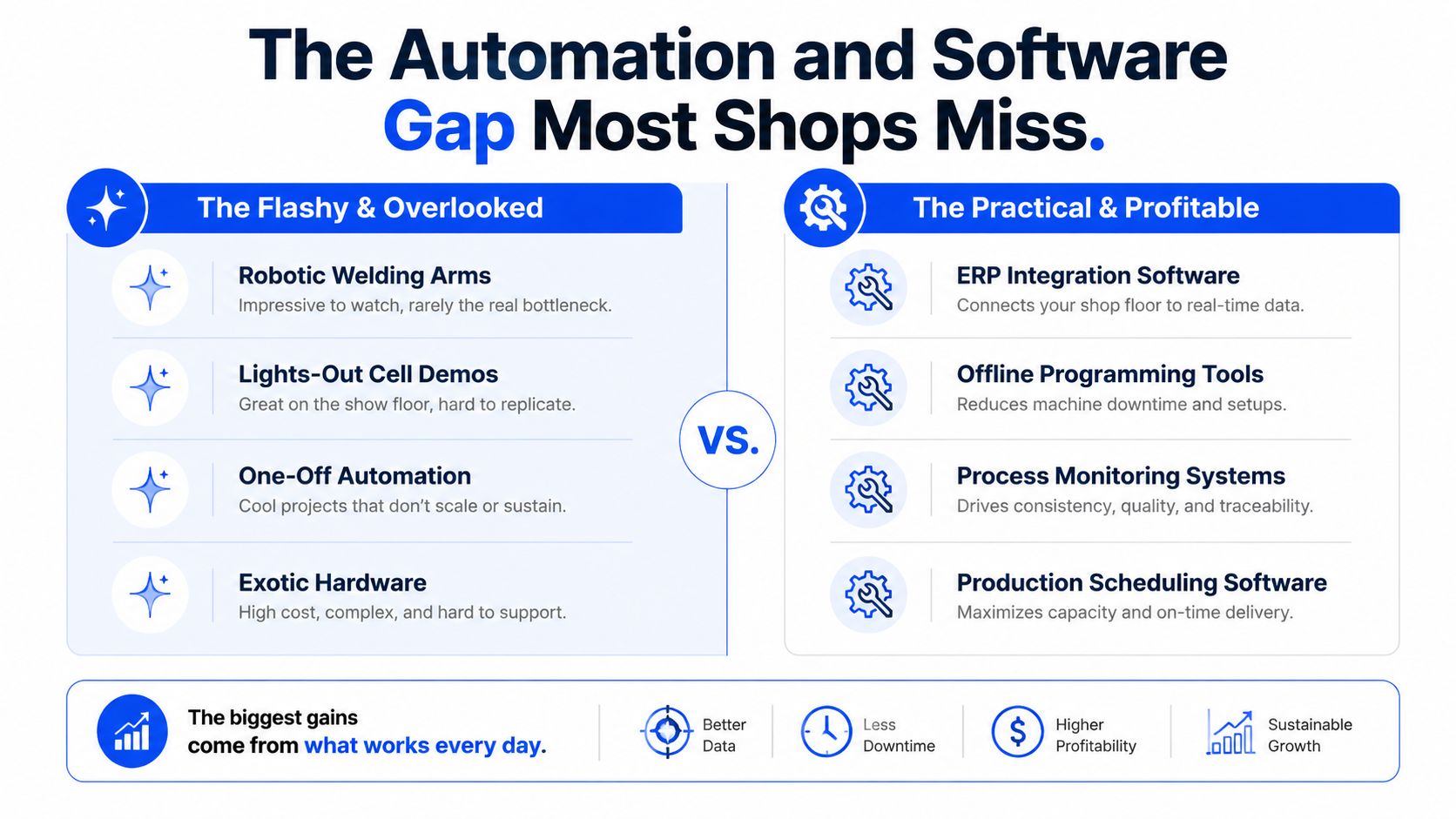
The flashiest equipment at IMTS is often the easiest to understand and the hardest for a small shop to justify. Robotic cells, pallet systems, and lights-out demonstrations can be useful, but they also encourage owners to think automation starts with a major hardware purchase.
IMTS itself says less than 40% of job shops use automation, even while presenting automation, AI, and connected production as important to future competitiveness in its productivity and transformation coverage. That gap tells me many owners need an implementation sequence and a payback discussion, not another dramatic demo.
Start where work disappears
For many small shops, the first automation opportunity is upstream. RFQs arrive in different inboxes, drawings sit in email threads, material and finishing requirements get missed, and estimators spend time rebuilding information that already exists in the customer's files. Faster production doesn't help if the shop never sends a quote.
Software can also connect estimating with the work that follows. Look for RFQ intake, CAD and drawing analysis, BOM handling, material and finishing databases, operation libraries, revision history, quote templates, digital travelers, email tracking, and accounting integration. These functions support the entire path from customer request to shop-floor handoff.
Uptool is one example to evaluate at the show. It provides AI-powered RFQ intake and estimating for CNC and fabrication workflows, including email routing, analysis of CAD files, drawings and BOMs, quote creation, revision tracking, and digital travelers. Its AI software for machine shops is relevant when the constraint is response time and estimate completeness rather than spindle capacity.
Don't accept a software demo built around perfect sample data. Ask the vendor to process a redacted RFQ with a drawing, material, tolerance, finishing requirement, revision, and customer email history. Ask what the system flags for human review and what your estimator can edit. If you're comparing broader automation approaches, this resource on how AI drives real efficiency provides useful context for separating task automation from technology theater.
Ask this before buying: What part of my current quote process will change on Monday morning, and who will own the exception when the software gets something wrong?
Your Game Plan Before, During, and After the Show
Attending without a plan turns a business trip into an expensive walk. Set the objective before you leave the office, and make every vendor earn a place on your schedule.
Before the show
Start with a one-page brief. List the parts you want to make, the materials you run, the tolerances and finishing requirements that create trouble, and the work you currently decline. Turn that list into a short exhibitor route.
Book focused meetings: Contact vendors before arrival and send a clear description of your shop.
Bring real examples: Prepare drawings, CAD files, BOMs, material specifications, and quote samples.
Set outcome goals: Decide whether you need a machine comparison, a software trial, a financing discussion, or a process test.
During the show
Don't spend an hour watching a generic demonstration if the vendor won't address your parts. Take notes in the same format at every booth, photograph permitted displays, record names, and end each serious conversation with a next step.
For software, test the path from RFQ to quote. For equipment, ask about service, training, maintenance, tooling, programming, and changeover. For fabrication and finishing, confirm how the proposed process handles material variation, secondary operations, inspection, and outside suppliers.
After the show
Follow up while the conversations are still fresh. Put competing machines, software platforms, and process options into one comparison document. Include purchase requirements, implementation work, training, service, staffing, material flow, and the effect on quoting.
The strongest post-show advantage often comes from faster response to new RFQs. When your team can organize incoming requests, identify missing information, estimate material and operations, and send a technically specific quote sooner, the contacts gathered at IMTS have a better chance of becoming actual jobs. Set a decision deadline within 30 days of returning, even if the decision is to reject every option.
Making the Trip Count for Your Shop
IMTS pays off when you arrive with a problem, visit the right areas, and act before the badge goes cold. Focus on equipment that solves a capacity or capability constraint, but don't ignore tooling, workholding, inspection, materials, finishing, and software. Those supporting decisions often determine whether a new machine produces margin or creates another disconnected island in the shop.
The best small-shop visitors don't measure success by the number of booths visited. They leave with a short list of qualified options, clear service answers, a better quoting or production workflow, and at least one change ready to implement within 30 days.
If you're attending, add Uptool to your route at Booth #135714 in the East Building, Software Section, as listed in the Uptool IMTS exhibitor directory. Evaluate it against your current RFQ process, especially if slow review of emails, drawings, CAD files, BOMs, material, or finishing requirements is costing you opportunities.
Uptool helps CNC machining and fabrication shops organize incoming RFQs, analyze technical files, build estimates, and create consistent quotes with a connected workflow. Visit Uptool before or after IMTS to see whether faster, more traceable quoting can help turn show-floor conversations into production work.
