Throughout the U.S., small, privately-owned machine shops are the backbone of manufacturing (Read: Why manufacturing’s future depends on the small shops powering it). These businesses are powered by skilled teams capable of turning complex designs into high-quality parts. On paper, they have everything for a successful operation, but the daily reality for many owners feels chaotic.
These shops need to fix a specific issue using purpose-built software that provides automation and reliability, at an affordable price. More specifically, for many small shops, their problem is often a lack of an organized and consistent quoting system (Case Study: Valence Precision’s operations). They are often bottlenecked by paper work, disparate emails, analog spreadsheets, and manual quoting processes that slow their response times, and limit their opportunities to scale.
TLDR
Why ERP Isn’t the Answer: Traditional ERP systems are often too expensive, rigid, and resource-intensive with 55% to 75% of implementations failing (Gartner), they are a risky investment for high-mix, low-volume machine shops.
The Quoting Bottleneck Holding Back Machine Shops: Manual quoting is a massive time drain that relies on inconsistent tribal knowledge; causing machine shops to lose contracts to faster competitors, or take on unprofitable orders.
Intelligent Automation: Uptool replaces manual data entry by syncing with inboxes and automatically extracting specifications from CAD geometry and BOMs to automate 90% of quoting workflows.
Scaling Success: By automating clerical tasks, estimators can complete 10x more quotes, allowing shops to provide same-day responses and scale their talented teams.
Traditional ERP software won’t save machine shops
Unfortunately, the reality is that most ERP software prices out small machine shops. Crucially, these businesses are actually the ones who stand to benefit from modern systems the most. Small shops need agile systems because they often specialize in high-mix, low-volume (HMLV) manufacturing. In other words, every RFQ is a fresh problem to solve, which means manual quoting becomes a massive time drain for experienced employees.
For decades, the industry standard to be a large and successful manufacturer was to implement three foundational systems.
CRMS/CPQs (Customer Relationship Management & Configure, Price, Quote): These systems are designed to help manage customer data and sales opportunities as well as automate complex quoting processes, allowing large manufacturers to track pipeline and create more standardized quotes.
MES (Manufacturing Execution Systems): The next layer of manufacturing software, which focuses on real-time shop floor control, machine monitoring, and material flow.
ERPs (Enterprise Resource Planning): The final layer of a traditional manufacturing tech stack. ERP software informs back-end operations, managing high-level business processes like finance, HR, and vendor relationships.
However, the reality is that 55% to 75% of ERP implementations fail (Gartner, 2026). For machine shops they can be inherently too rigid and complex given the fluid nature of high-mix, low-volume manufacturing. These systems are often: cost prohibitive, resource intensive, and functionally mismatch the needs of real shops.
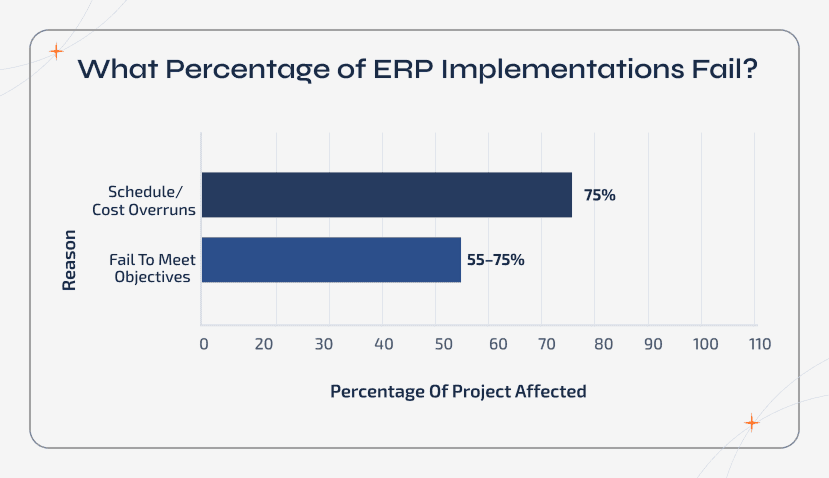
Sparkout: “...the majority of ERP projects were found to struggle in one or more critical areas” (Sankar, 2026)
To recap, ERP systems upkeep implementation costs frequently price out smaller businesses. Additionally, they require significant IT personnel and training, pulling skilled labor away from production. Lastly, they excel at back-office tasks like accounting and payroll but don’t address the real issue that machine shops face, their chaotic quoting process.
Quoting is the modern machine shop’s bottleneck
Every job a shop runs starts the same way: with an RFQ. If their RFQ responses are slow, manual, and error-prone, everything downstream inherits those problems. That's why quoting is the single highest-leverage place to add an intelligent automation tool (Click here for: Customer testimonials).
Here's what manual quoting actually looks like in most shops today:
An inbox overflowing with mixed RFQs, spam, follow-ups, and revised drawings
Where some RFQs are left unread for days
Hours spent digging through old quotes, old jobs, and old emails trying to remember what they charged this customer last time
And whether it actually made money
A quote built on a number someone priced a month ago that nobody can reconstruct or defend
A pricing process that relies on a single person's tribal knowledge
When they're gone, the shop grinds to a halt
Inconsistent pricing across similar jobs that exposes a lack of process to the customer
Makes them wonder how reliable they are as a long-term partner
The cumulative effects are brutal. Shops might initially struggle with slow response times, but this can soon devolve into quotes consistently being sent late. So for small machine shops that can’t keep up, customers usually take their business up elsewhere or overseas. In HMLV manufacturing, speed is the ultimate differentiator that allows small shops to outperform more rigid competitors.
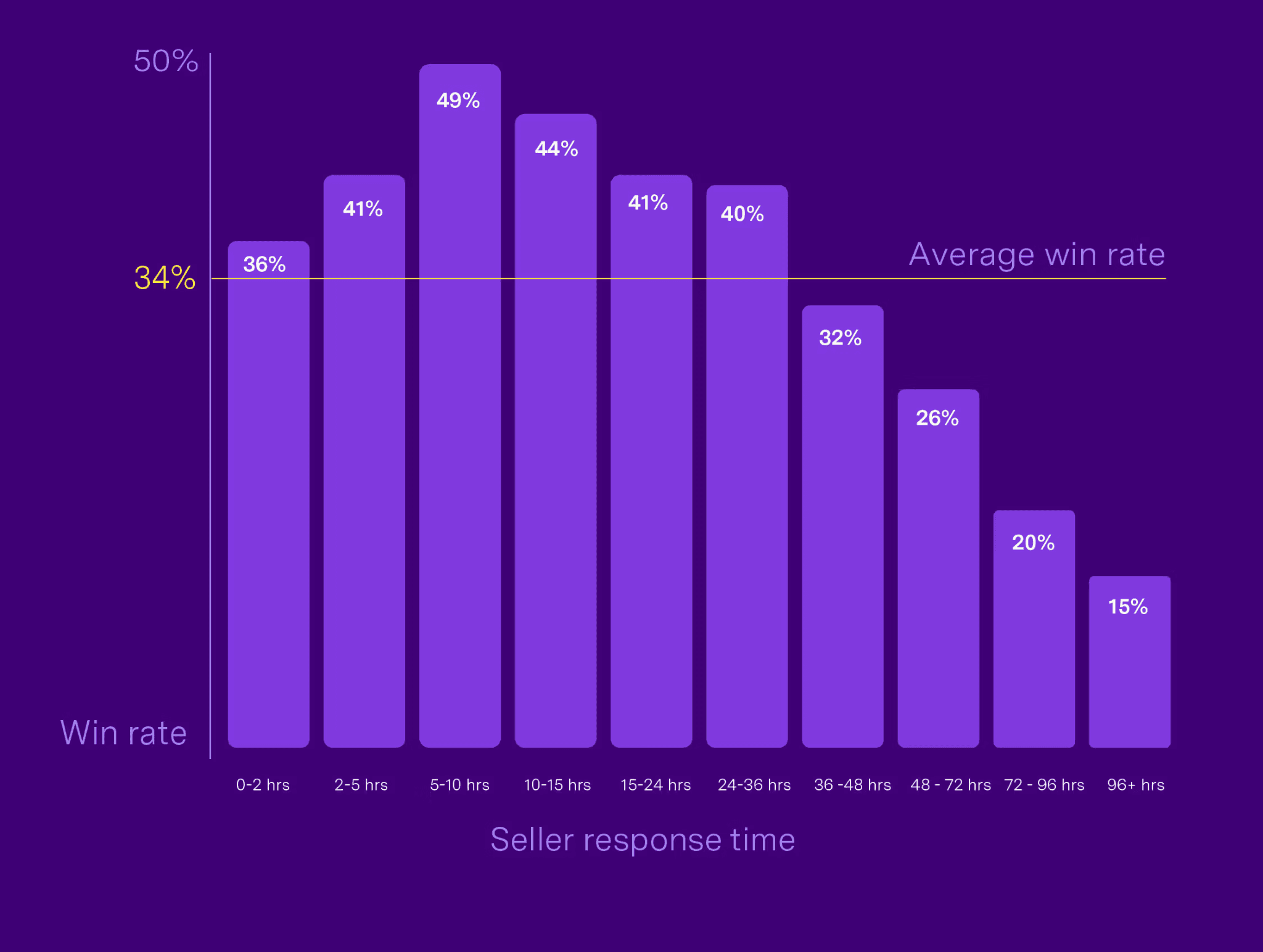
Gong AI: Data suggests that you should action items within the same business day. (Morgese, 2019)
Introducing Uptool’s AI-powered quoting system
Most manufacturing CPQ software functions as a glorified calculator, requiring you to manually feed it every dimension and material cost. Uptool is built differently, as an intelligent quoting software that integrates directly into your existing day to day.
Inbox Intelligence: Instead of requiring you to open a separate portal, Uptool syncs with your inbox, detecting RFQs and revisions the moment they arrive so no job goes unread.
Unified Conversation Flow: Uptool bridges the gap between customer communication and shop data. Every revision and follow-up is tracked in an integrated & real-time dashboard, ensuring every element is up to date.
File Processing: Uptool processes CAD geometry and BOMs to extract specifications automatically. It handles tedious work of retyping material specs and finishing requirements. It streamlines quoting so that an estimator's time, energy, and judgement are spent on the steps that depend on it.
End To End Quoting: Uptool organizes the quoting process so that estimators can make bids with ease. Whether it’s receiving RFQ’s, email correspondence, processing CAD files/engineering drawings, adding markups or volume discounts, sending the actual quote, or syncing with quickbooks, all of it can be done through just one tab, the Uptool dashboard.
To summarize, Uptool’s quoting system is designed specifically for HMLV quotes. Machine shop owners and estimators are able to open RFQs, review, adjust, and send bids out, in minutes, not hours. Which means that when they sit down at their desks every morning, they can now complete 10x more quotes in the same amount of time.
The future for high-mix machine shops
Owners who run a high-mix, low-volume shop, already know the core tension: almost every job is different, almost every job is urgent, and the complexity is not going away. They can't standardize their way out of it like a high-volume shop. Although we can't eliminate complexity, Uptool can eliminate repetitive, disjointed, manual processes. The complexity of designs & requirements is inherent to the work. The complexity of your quoting process is not. The process of retyping specs, hunting through inboxes, and rebuilding a quote from scratch every time is impractical.
The shops that compete, win, and grow are the ones that can handle variety at speed. Machines don't hold small shops back, and Machinists don't grow the business alone. The quoting process is what turns a talented team and a capable floor into a machine shop that can scale. Quoting is the starting line, if you want to see what Uptool can do for your shop, we'd love to show you.
Connect with an expert today: www.Uptool.com/Demo
FAQ
How does Uptool differ from standard CPQ software?
Uptool syncs with your inbox to detect RFQs and revisions automatically. It extracts data from CAD files, engineering drawings and BOMs, eliminating hours of manual, repetitive work each week. The software automatically calculates prices for materials, finishing, and many manufacturing operations.
How does Uptool help me stay organized?
Uptool helps you stay organized by centralizing your quoting process.
It organizes your work through:
Inbox Intelligence: The RFQ dashboard automatically extracts quotes from all your inboxes and visualizes them, allowing you to easily search, filter, and see what’s urgent, and high-value.
Unified Conversation Flow: Every revision and follow-up is tracked in the dashboard, ensuring your shop data and customer communication remain up to date, and jobs never get missed.
File Storage: The system acts as a central storage facility for part files. Users can of course download the whole file package from the system. Additionally, users can upload and store purchase orders and scanned traveler sheets.
What files is Uptool able to process?
Uptool can process virtually any CAD format and is expanding its compatibility to include:
CAD Files: .step, .stp, .jt, .sldprt, .sldasm, .x_t, .x_b, .iges, .igs, .prt, .catpart, .dxf, .stl
Uptool is also able to unzip .zip files and access file portals
Technical Documents: BOMs & Engineering drawings (In a variety of formats)
Business Documents: Quotes, orders, invoices, shipping documents, etc.
I’m not sure if Uptool is the right fit for my shop, can I try it out first?
Uptool offers a simple monthly subscription (starting at $195/month) and one hour, zero cost onboarding, to make it very easy for shops to try.